


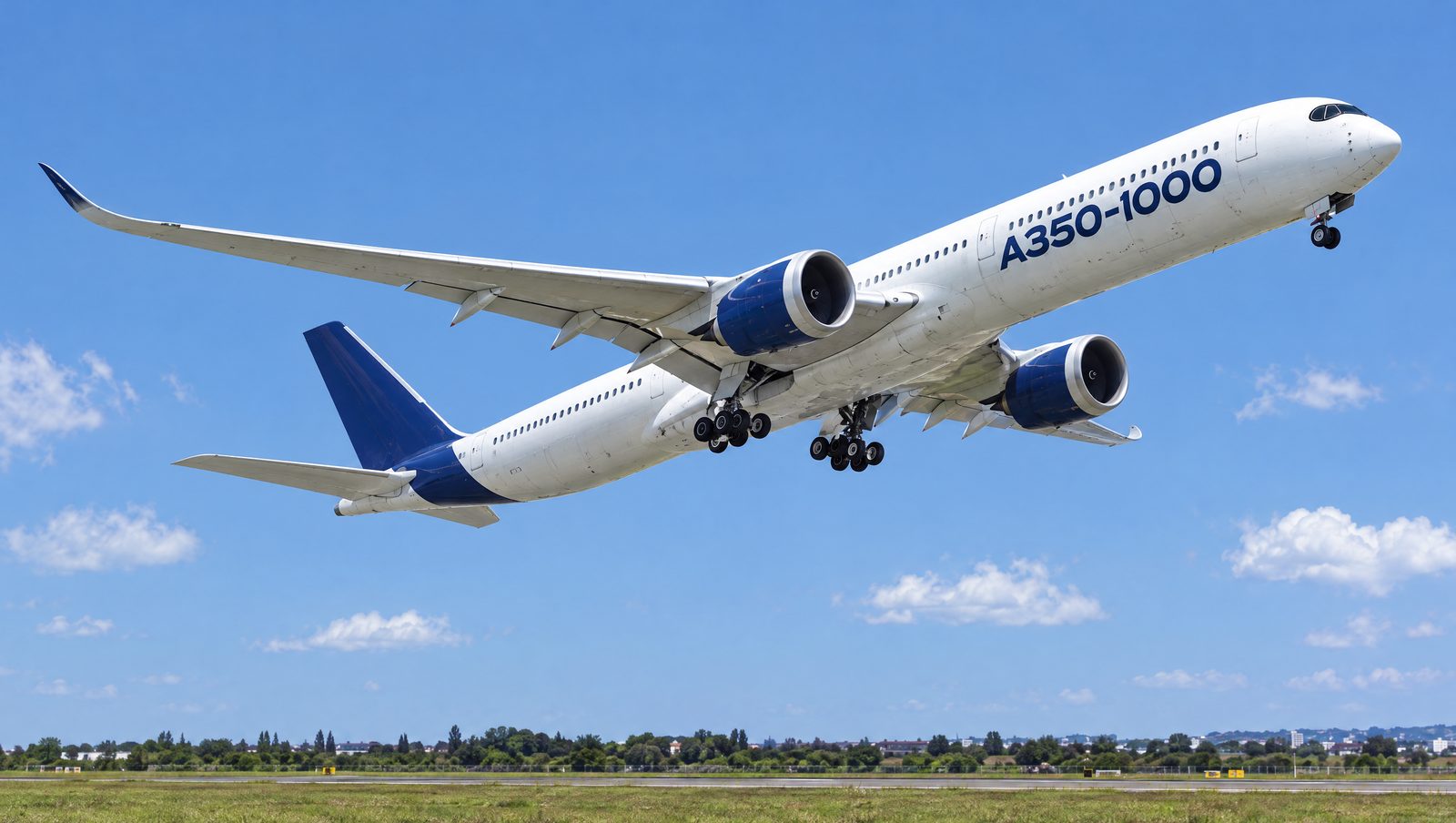
Airbus will decide “sooner rather than later” on raising production of the A350 widebody beyond the capacity of its single assembly line, the head of its commercial aircraft business said on Wednesday, October 14, calling a higher rate “inevitable” as airlines push for more long-haul jets.
Speaking at a news briefing in Toulouse, Airbus Commercial Aircraft CEO Lars Wagner said the investment would need approval from the board of directors. “The decision for an increased rate on the A350 is inevitable. We’re going to do it because the market clearly demands more aircraft,” he said, according to Reuters. “It’s a big decision, so we need to bring it to the board of directors. But this is going to happen rather sooner than later.”
One line, built for 12 to 13 a month
Airbus currently assembles the A350, its rival to Boeing’s 787 and 777 families, on one final assembly line in Toulouse that was designed to produce 12 to 13 aircraft a month. Wagner said going beyond that would require a new line and an additional industrial system.
The manufacturer already aims to reach a rate of 12 A350s a month in 2028, a target AeroTime noted was reaffirmed with Airbus’s July 2026 financial results. The decision now under discussion would allow output to rise further after that.
Wagner, a former chief executive of engine maker MTU Aero Engines, took charge of Airbus’s largest division this year.
Bigger A350 and A220 under study
Alongside the rate decision, Airbus is actively studying larger versions of both the A350 and its smallest jet, the A220. Wagner said there is “clearly demand” for a longer A350 with more seats, widely referred to as the A350-2000, and for a bigger A220, known as the A220-500. Decisions on both are expected towards the beginning of Airbus’s next five-year planning period. Neither aircraft has been formally launched.
Reuters reported that Wagner declined to say whether Airbus might loosen Rolls-Royce’s position as the sole engine supplier on the A350 for a new version. Industry sources told the agency that Airbus has looked at using a GE Aerospace engine for the roughly 400-seat A350-2000, but that interest from the engine maker has so far been muted.
At the same briefing, FlightGlobal reported, Airbus said it sees no business case for stretching the A321neo, its largest single-aisle jet, which is instead being enhanced with technologies developed for the long-range A321XLR.
Supply chain still the constraint
The production ambitions come while Airbus is still working through delays on aircraft already on order. AeroTime noted that some A350 customers were warned in May 2026 of later deliveries amid shortages of fuselage components, including disruption at the former Spirit AeroSystems plant in North Carolina that Airbus took over as part of the supplier’s breakup.
Wagner reiterated that Airbus remains confident of reaching its year-end delivery goals despite recent quality flaws. Engine supply for the A320 family remains the biggest near-term uncertainty. Airbus said it has yet to reach agreement with Pratt & Whitney on engine supplies beyond 2026, and operations chief Florent Massou dit Labaquere said the number of in-service aircraft grounded by spare engine delays is “still quite substantial”.
“We are tackling it very seriously with Pratt & Whitney and trying to make progress as much as we can,” Massou said. He added that disruption to the separate Pratt & Whitney engine model used on the A220 had almost disappeared. Pratt’s parent RTX said in a statement to Reuters that it has increased annual deliveries of new engines since 2019 and continues to expand maintenance capacity.
Next-generation single-aisle still pencilled for 2030
Looking further ahead, Wagner said Airbus continues to work towards a “notional” date of 2030 for launching an all-new single-aisle aircraft to succeed the A320 family. Some analysts doubt the next generation of narrowbodies will take shape that early, as engine makers continue to mature the technologies those aircraft would depend on.
For airlines, a second A350 line would be the clearest sign yet that Airbus expects long-haul demand to stay strong into the 2030s, and it would shorten the wait for new widebody delivery slots that are now booked years ahead.
Sources: Reuters, AeroTime, FlightGlobal.

Comments
Loading comments…