


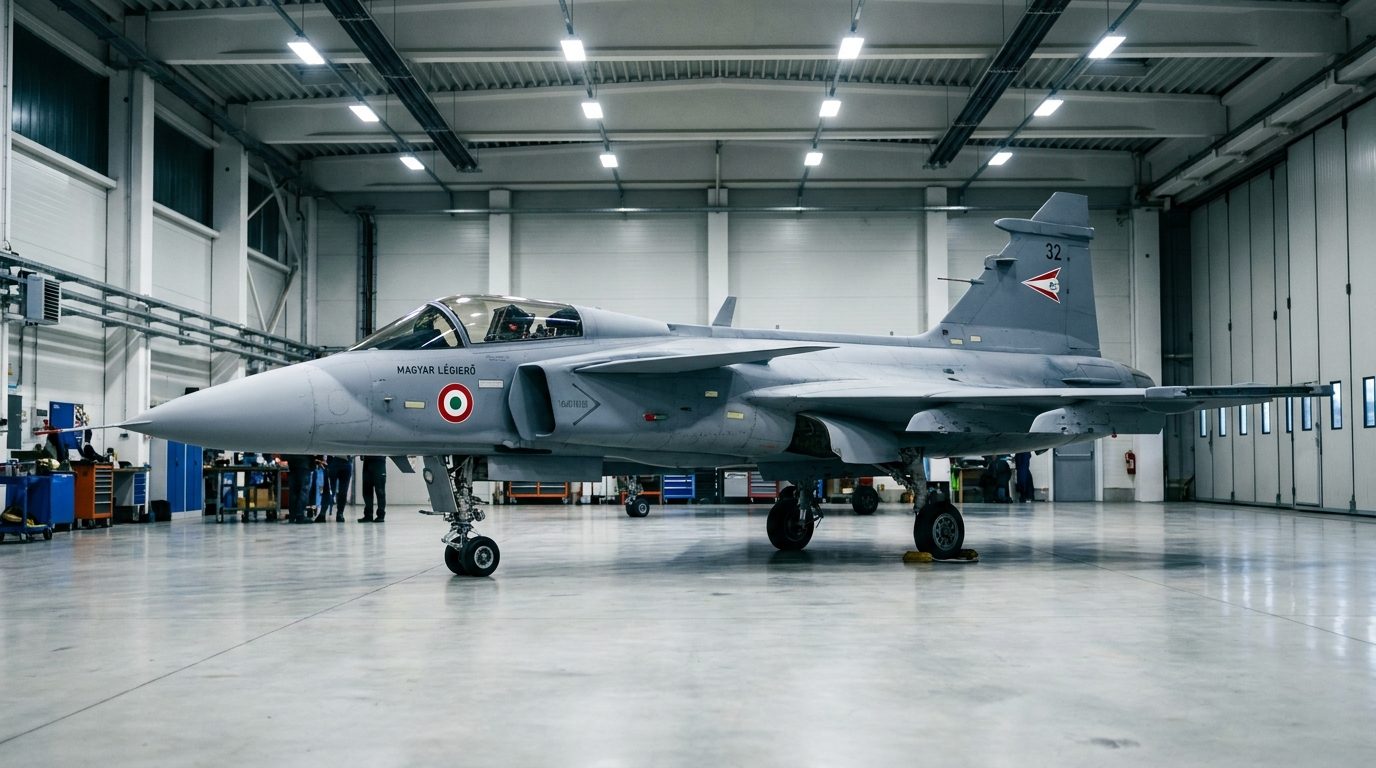
Hungarian Air Force Saab JAS 39 Gripen fighters were scrambled on the morning of 29 August 2026 after a man took off without authorisation from the Kalocsa airfield in a Cessna 172 and flew toward the Paks nuclear power plant, AeroTime reported. The light aircraft came down in a sunflower field before the fighters reached it.
The Hungarian Ministry of Defence published a statement by Defence Minister Romulusz Ruszin-Szendi at 10:02 local time that day, saying military radars detected the aircraft immediately and that the quick reaction alert pair launched. Minutes later the Cessna made a forced landing near Gerjen, in Tolna County. The Gripens located the damaged aircraft and stayed overhead until a rescue helicopter and ground units arrived. Ruszin-Szendi said no one was injured.
The National Police Headquarters said at 11:45 local time that officers had been called to a forced landing on the edge of Gerjen and established that the Cessna 172 had been taken from the Kalocsa airfield. According to police, the pilot left the aircraft and was walking on Route 512 in a confused state when a passing motorist stopped to help. He got into the car and tried to drive off before being stopped, and officers detained a 24-year-old man from Szomor nearby within minutes. Police said the man was intoxicated and that officers were checking whether he was under the influence of any other substance. Bacs-Kiskun and Tolna county police opened proceedings for unauthorised taking of a vehicle and further offences.
Neither the ministry nor the police statement says the Cessna entered the prohibited airspace over the power plant. Hungary's Aeronautical Information Publication, issued by air navigation service provider HungaroControl, designates LHP1 Paks as a prohibited area: a circle of three kilometres, or about 1.8 miles, in radius, from ground level up to FL195, active around the clock.
The response illustrates how European quick reaction alert works in practice. QRA pairs sit on permanent standby specifically so that an unidentified or non-communicating aircraft can be intercepted within minutes, whether the track is a military aircraft off an alliance border or, as here, a single-engine trainer behaving unpredictably near sensitive infrastructure. Visual identification and shadowing are the first tools, and in this case the fighters ended up performing a search-and-locate role after the aircraft was already down.
The Cessna 172 sits at the opposite end of the aviation spectrum from the aircraft sent to find it. It is the most-produced aircraft in history, a four-seat, high-wing, single-engine piston type that forms the backbone of flight training at small airfields worldwide. That ubiquity, and the relative simplicity of the aircraft, is precisely why light-aircraft security at general aviation fields periodically returns to the agenda.
Police said they had opened a joint inspection with the aviation authority at the Kalocsa airfield, and that the country's other airports would follow. Neither statement sets out what those inspections cover or when they conclude.
AeroTime noted it was the second Gripen launch in two days. Hungary operates the Gripen under a lease arrangement that has made the Swedish fighter the mainstay of its air policing mission for two decades.
Sources: AeroTime. Featured image: AI-generated by AviationShop. By Elena Vargas.














Comments
Loading comments…