


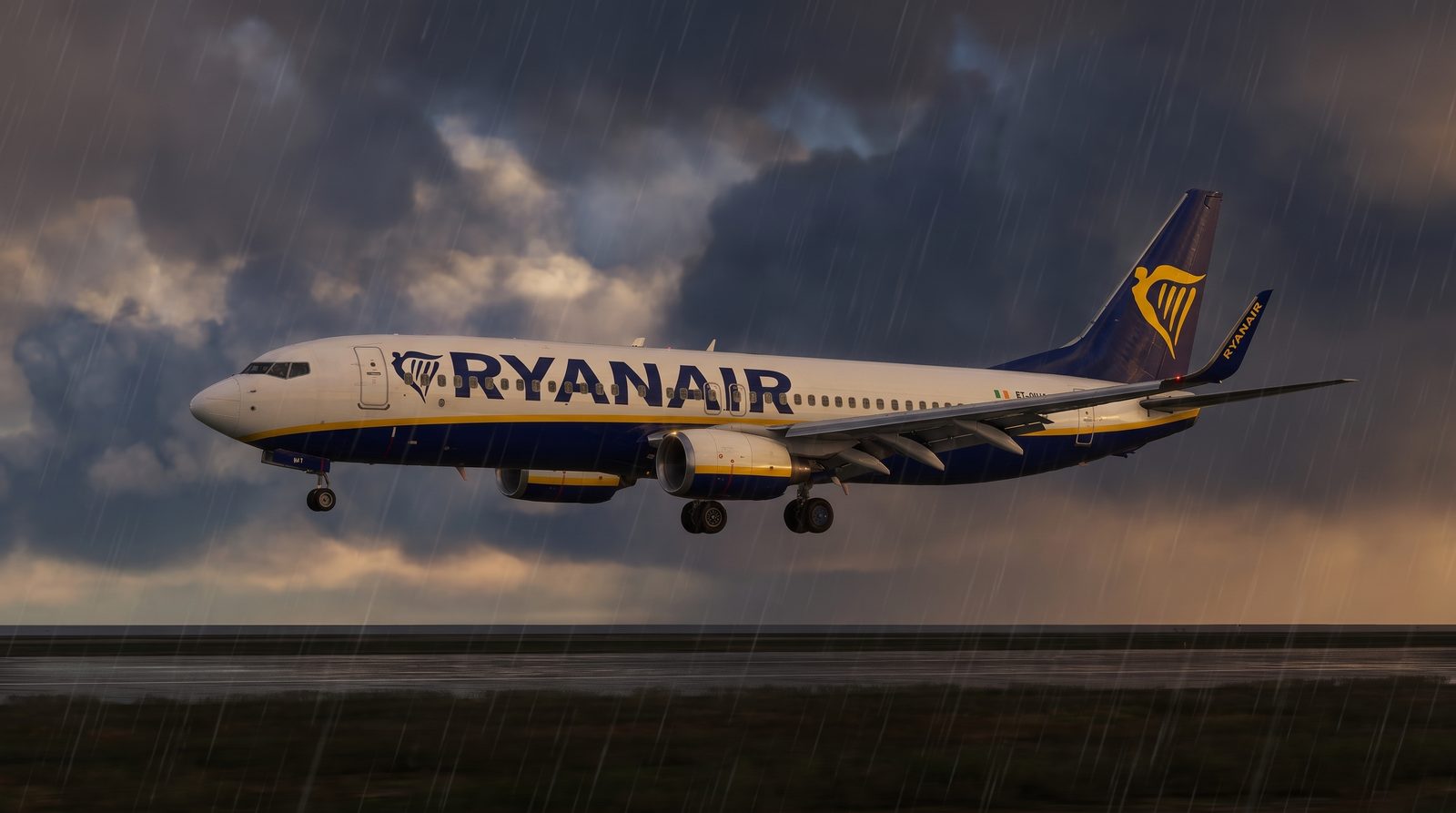
A Malta Air Boeing 737-800 operating Ryanair flight service from Pisa to Glasgow Prestwick landed at Manchester with about 363 kilograms of fuel remaining after Storm Amy weather forced three windshear go-arounds and a contested diversion, according to a UK Air Accidents Investigation Branch serious-incident report published September 24, 2026, and detailed by UK Aviation News on September 26. Nobody was hurt and the jet, registered 9H-QBD with 171 passengers and six crew, was undamaged after the October 3, 2025 flight.
The crew had already uplifted extra fuel for the forecast—about 11,500 kilograms planned, including 1,937 kilograms of discretionary fuel worth roughly seventy-two minutes of flying—and had nominated Manchester as the preferred alternate because its weather looked better than Prestwick or Glasgow. On the first Prestwick approach to Runway 20, with winds about 240 degrees at 29 knots gusting to 45, the Enhanced Ground Proximity Warning System issued a windshear alert near 264 feet. The pilots flew the Boeing 737 windshear escape, went around, and held at 6,000 feet with about 4,608 kilograms still on board.
A second Prestwick approach again produced a windshear warning near 50 feet and another escape manoeuvre. The crew had already told air traffic control they would divert to Manchester if they went around again, but Manchester initially refused the diversion after coordination that the AAIB links to the handling agent rather than Airfield Operations. Glasgow weather looked similar to Prestwick; Edinburgh accepted a diversion after about five minutes.
Edinburgh then produced a third windshear warning near 745 feet. Fuel had fallen to about 2,164 kilograms. Operator rules barred a third approach after two windshear abandonments, and the crew judged they could no longer reach Manchester while keeping final reserve. A MAYDAY fuel call followed at 1912 UTC; predicted landing fuel at Manchester dropped toward about 300 kilograms once the airport was entered in the flight-management computer. Low-fuel alerts appeared en route, with recorded tank quantities briefly near 523 kilograms right and 404 kilograms left before fuel balancing.
The 737 landed on Manchester Runway 23R about 1952 UTC. After shutdown, recorded fuel was about 240 kilograms—well below final reserve—despite three high-power escape manoeuvres that the AAIB says burned discretionary fuel faster than planned. Investigators found the windshear system worked correctly and blamed a stack of weather, diversion delay, and decision pressure rather than a single failure. Manchester later restated that Airfield Operations, not the handling agent, must decide diversion acceptance when capacity exists.
For Ryanair Group operations, the report is a case study in how quickly a well-fueled leisure sector can become fuel-critical when three escapes, holding and a refused preferred alternate stack together. The verified public record is the AAIB serious-incident classification, the fuel figures and go-around sequence, the Manchester process change, and the safe landing—not a new Ryanair network move. Passengers on weather-exposed UK approaches should still expect diversions; this report shows why alternate acceptance and crew fuel math have to move as fast as the weather.
Sources: UK Aviation News (Sep 26, 2026); UK AAIB serious-incident report published Sep 24, 2026.
Comments
Loading comments…