


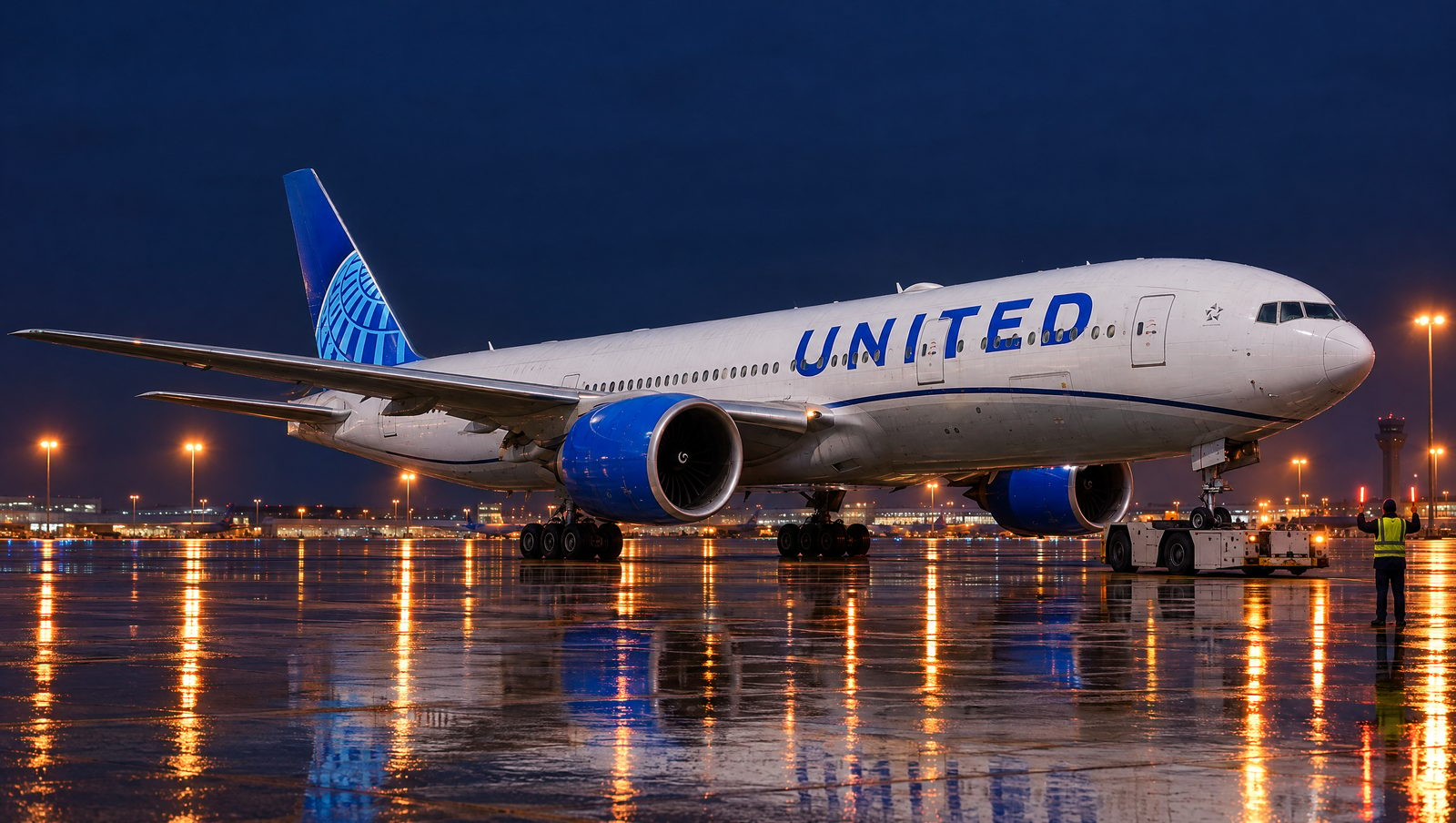
A United Airlines Boeing 777-200 bound for Beijing returned safely to San Francisco on Tuesday, 6 October, after its crew shut down one of the aircraft's two engines during the climb. The jet, registered N796UA and operating flight UA888, landed on runway 28R roughly 90 minutes after departure, and was still on the ground in San Francisco about two days later.
What happened on UA888
According to The Aviation Herald, the 777-200 was climbing through about 28,000 feet out of San Francisco International Airport when its right-hand Pratt & Whitney PW4090 engine began emitting loud noises and suffering severe vibrations. The crew stopped the climb, shut the engine down and turned back to San Francisco, where the aircraft landed safely on runway 28R.
FlightAware history cited by AeroCorner shows UA888 departing San Francisco at 11:34 a.m. local time and back at San Francisco at 1:00 p.m., with the Beijing leg marked as diverted. The Aviation Herald reported that the aircraft was still on the ground at San Francisco around 48 hours after landing, and AeroCorner said FlightAware listed no further flights for N796UA in that period. A later UA888 departure the same evening appears in FlightAware's records as canceled, so it was not clear how or when the Beijing-bound passengers completed their journey.
No injuries have been reported, and no cause for the engine problem has been made public. United had not published a statement on the incident in the sources reviewed for this article.
A first-generation 777 with a long history
N796UA is one of United's original Boeing 777s. The FAA registry lists it as a 777-222 built in 1998, owned by United and fitted with Pratt & Whitney PW4000-series engines. Simple Flying notes that United took delivery of the aircraft new in January 1998, which makes it almost 29 years old, and that it has spent its entire operating life with the airline apart from periods in storage, including during the pandemic.
The same aircraft had a serious engine event early in its career. On 29 July 1998, departing London Heathrow for San Francisco, it suffered smoke in the flight deck and cabin, a loud bang and a complete loss of oil pressure in its left engine. The pilots shut that engine down and returned to Heathrow. The UK Air Accidents Investigation Branch later found that a failed carbon seal had caused rapid oil loss and internal engine damage.
Part of a pattern for older 777s
The incident closely resembles another United event earlier this year. On 9 July 2026, a different 777-200ER, N228UA, operating flight 926 from San Francisco to Frankfurt, had its right-hand PW4090 emit a loud bang while climbing through about 29,000 feet. The crew shut it down and returned to San Francisco, landing safely about an hour after departure. Both events involved the same engine model at similar altitudes, although no evidence has established a common technical cause.
United's first-generation 777 fleet has had several other engine-related incidents in recent years, involving both PW4000 and GE90 engines. The best known was the February 2021 failure on UA328 after departure from Denver, when a fractured fan blade on a PW4077 led to an engine fire and debris falling on residential areas of Broomfield, Colorado. All 239 people on board were unhurt, and the NTSB later identified fatigue failure of a fan blade as the probable cause and the event triggered widespread groundings and regulatory action affecting PW4000-powered 777s. In June 2026, a GE90-powered United 777-200 flying from Houston to Munich returned after passengers reported repeated bangs and flames from the right engine.
Why United keeps flying them
Despite their age, the older 777s remain important to United's network. Simple Flying reports that at the end of 2025 the airline operated 19 Boeing 777-200s averaging 28.5 years old and 55 777-200ERs averaging 25.8 years. United's July 2026 fleet plan projected that all 96 of its 777s, including 22 newer 777-300ERs, would stay in the fleet through year-end, even as its Boeing 787 fleet grows from 85 to 100 aircraft. No firm retirement timetable has been announced for the 777-200 family.
Comments
Loading comments…