


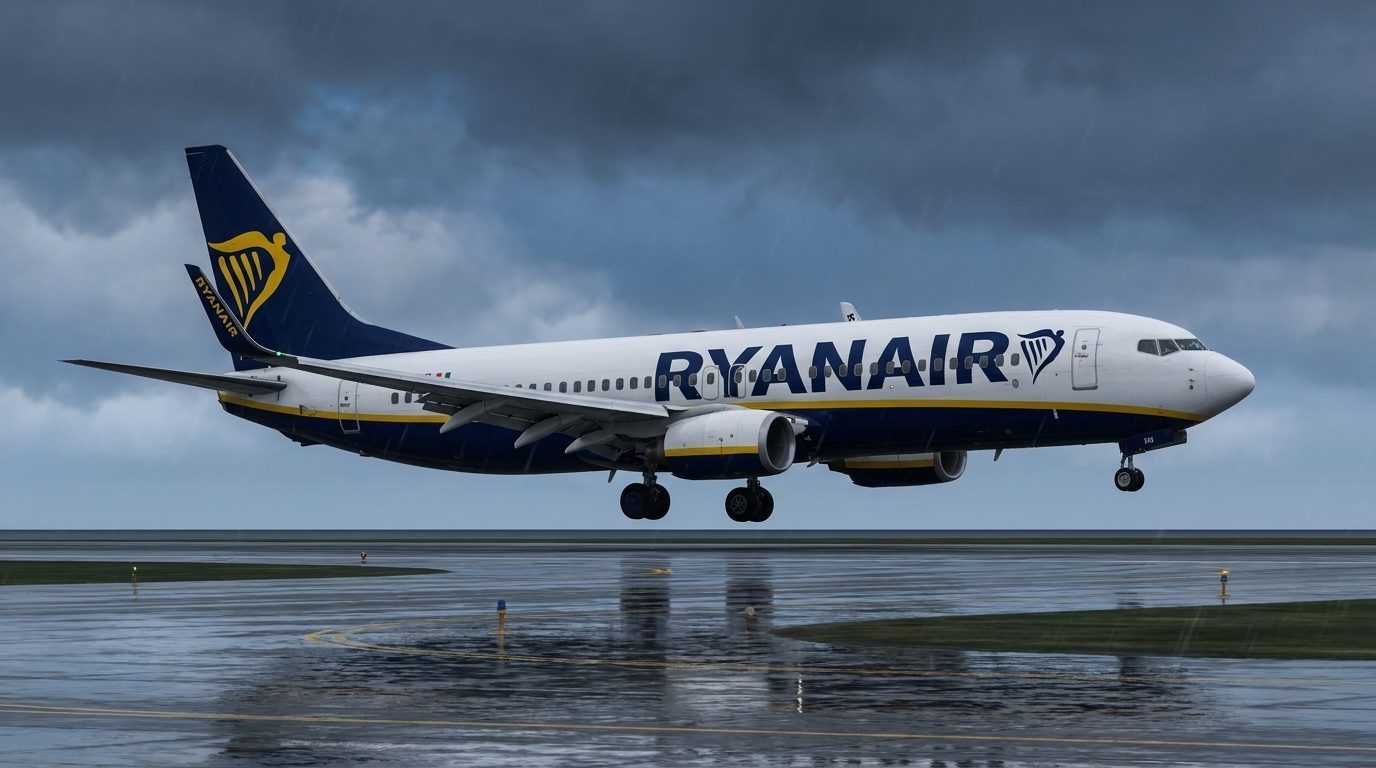
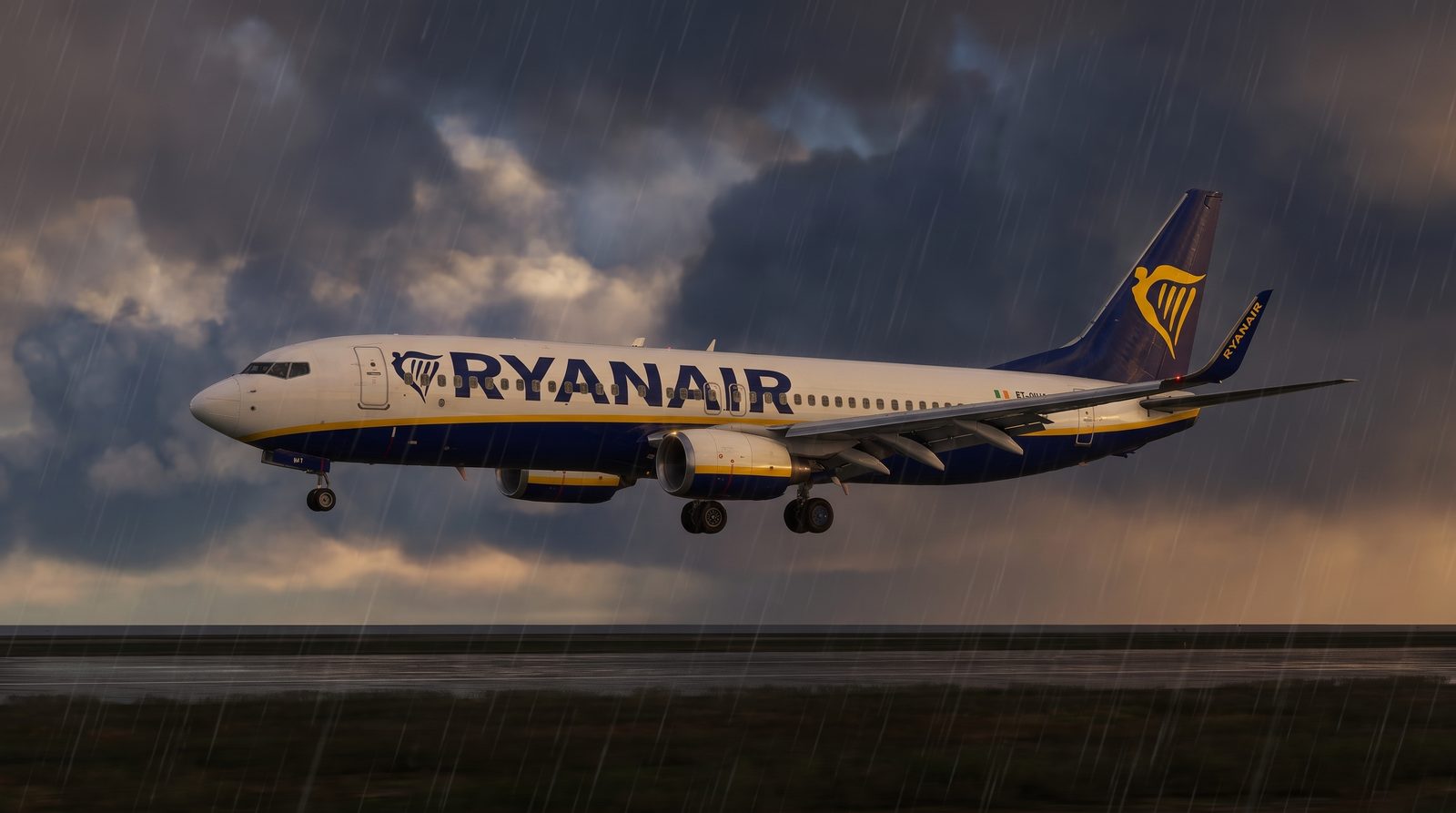
A new UK Air Accidents Investigation Branch report revisits a Storm Amy diversion in which a Ryanair-group Boeing 737-800 landed at Manchester with only 363 kg of fuel remaining—well below the 1,100 kg final reserve mandated for the aircraft. Flightradar24’s September 25, 2026 summary of the AAIB findings describes how Malta Air flight FR3418, registration 9H-QBD, fought wind shear at Prestwick and Edinburgh before declaring an emergency and diverting to Manchester.
The flight was operating Pisa–Prestwick as Storm Amy brought strong gusting winds across Scotland. At Prestwick the crew received wind-shear alerts and flew two wind-shear escape manoeuvres. After the second go-around they asked to divert to Manchester but were refused. The AAIB said the reason for the refusal was not established, yet it appeared to stem from a breakdown in communication between units inside Manchester Airport; airport and handling-agent policies indicated the diversion request should have been accepted.
Declaring a fuel emergency at that moment would have compelled acceptance, but the crew did not believe their fuel state yet met the criteria. They continued to Edinburgh, where wind shear again blocked a landing. While setting up for a second Edinburgh approach, the crew reviewed company fuel policy and remaining fuel, then declared an emergency and diverted to Manchester. They landed safely with 363 kg remaining against a 1,100 kg final-reserve requirement.
The report, as summarised by Flightradar24, focuses as much on ground communication as on airborne decision-making. A diversion request that should have been accepted under local policy was not, pushing the crew toward a second weather-limited airport and deeper into their fuel. Once the emergency was declared, Manchester took the flight and the landing was uneventful on the fuel that remained.
For airlines operating into Scottish airports in autumn storms, the case is a textbook stack of wind-shear escapes, alternate selection and fuel-emergency thresholds. For Manchester Airport, it is a reminder that internal coordination between ATC, airport operations and ground handlers can decide whether a diversion is routine or becomes a low-fuel emergency.
Ryanair and Malta Air already treat final reserve as a hard floor in flight-crew manuals; the AAIB narrative shows how quickly two missed approaches in convective wind shear can burn that margin when the preferred diversion is blocked. Passengers on FR3418 completed the journey on the ground at Manchester rather than Prestwick, which is an inconvenience—not an accident—but 363 kg on a 737-800 is an outcome investigators flag for a reason.
Readers should note the chronology carefully. Storm Amy’s Scottish impacts and the FR3418 sequence belong to the storm event itself; the September 25 Flightradar24 piece is reporting on the AAIB’s published analysis. The confirmed technical points in that summary are the flight number, the Malta Air 737-800 9H-QBD, the Prestwick and Edinburgh wind-shear go-arounds, the refused then later accepted Manchester diversion, and the 363 kg versus 1,100 kg fuel figures.
No recommendation text beyond those facts is required to see the operational lesson: when wind shear is active at primary and secondary Scottish fields, diversion acceptance paths at the next suitable airport need to work on the first request—not after an emergency call.
Sources: Flightradar24 Blog (Sep 25, 2026); UK AAIB report details as cited.







Comments
Loading comments…