


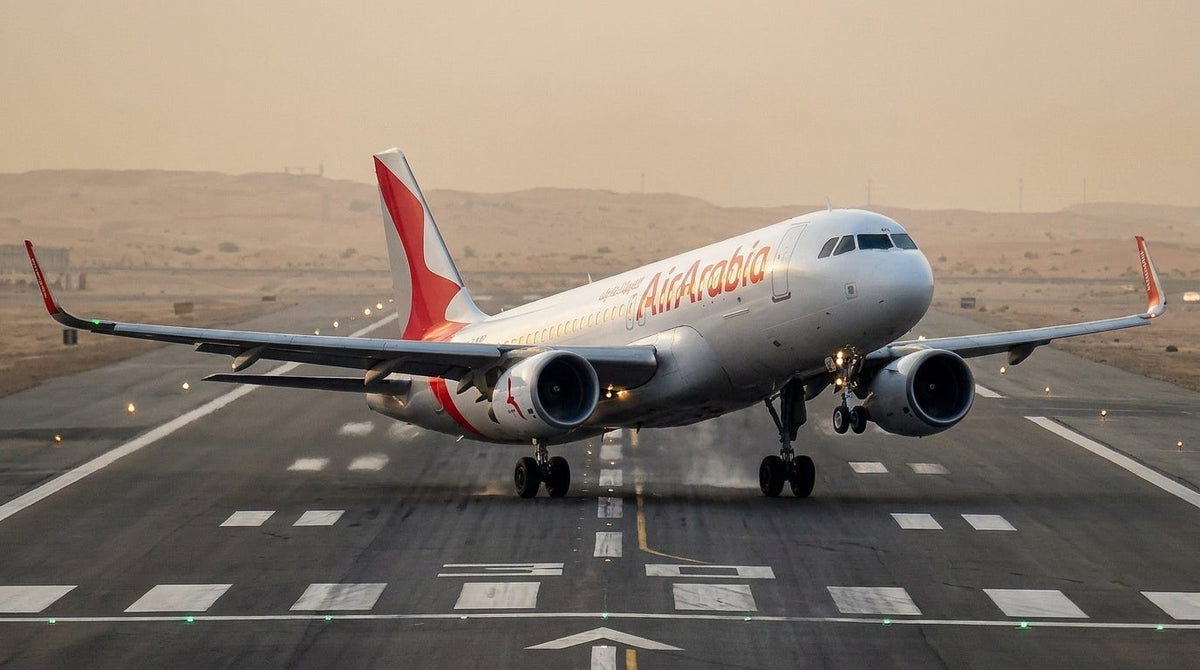
Air Arabia will open a new nonstop route between its Sharjah base and Gdansk on 14 December 2026, extending the low-cost carrier's expansion in Poland during the Northern winter 2026/27 season. The service will operate five times weekly with Airbus A320neo equipment.
The schedule splits across two distinct timings. On Wednesdays, Fridays and Sundays, flight G9626 departs Sharjah at 08:15 and arrives in Gdansk at 12:15, with the return G9627 leaving Gdansk at 13:05 and reaching Sharjah at 22:25. On Mondays and Saturdays the pairing shifts to the evening: G9628 departs Sharjah at 16:00 for a 20:00 arrival in Gdansk, and G9629 leaves Gdansk at 20:50 to arrive back in Sharjah at 06:10 the following morning.
A second Polish city
Gdansk is not Air Arabia's first move into Poland. The carrier already announced a Sharjah–Katowice route opening on 17 December, and separately confirmed plans for a Sharjah–Frankfurt service in the same December window. Taken together, the additions describe a deliberate push into Central Europe from the Sharjah hub rather than a single opportunistic route.
The commercial logic is straightforward. Poland has a large outbound leisure market and a substantial workforce moving between Europe and the Gulf, and Gdansk serves the country's northern coast and the wider Tricity area — a catchment that has historically had to connect through Warsaw or a Western European hub to reach the Middle East and onward markets. A nonstop from Sharjah collapses that itinerary into a single sector.
Sharjah's position matters too. Air Arabia's home airport sits alongside Dubai in the same metropolitan area but operates on a low-cost model, and the carrier has built its network on point-to-point flying plus onward connections through the base to South Asia. For a Gdansk passenger, the practical draw is not only the UAE itself but the connectivity beyond it.
Why the A320neo fits
The five-times-weekly frequency and the aircraft assignment are linked. Sharjah to Gdansk is a long sector for a single-aisle aircraft, and the A320neo's improved fuel burn is what makes a route of that stage length viable at low-cost economics. A larger widebody would need far more traffic to fill; a less efficient narrowbody would struggle on the numbers. The neo sits in the gap.
The split-timing schedule also does useful work. The morning departures give same-day connections at both ends of the operation, while the evening pairing produces an overnight return that lands in Sharjah early enough to feed the morning bank onward. For a five-weekly route, using two timing patterns rather than one is a way of serving two different passenger types with the same aircraft rotation.
Bookings open in line with the December launch. Air Arabia has not indicated whether the route will continue beyond the winter season, which is standard practice for a new market: winter schedules are filed and flown, and summer continuation follows the loads.
Sources: AeroRoutes, Aviation24. Featured image: AI-generated by AviationShop. By Daniel Okafor.








Comments
Loading comments…