


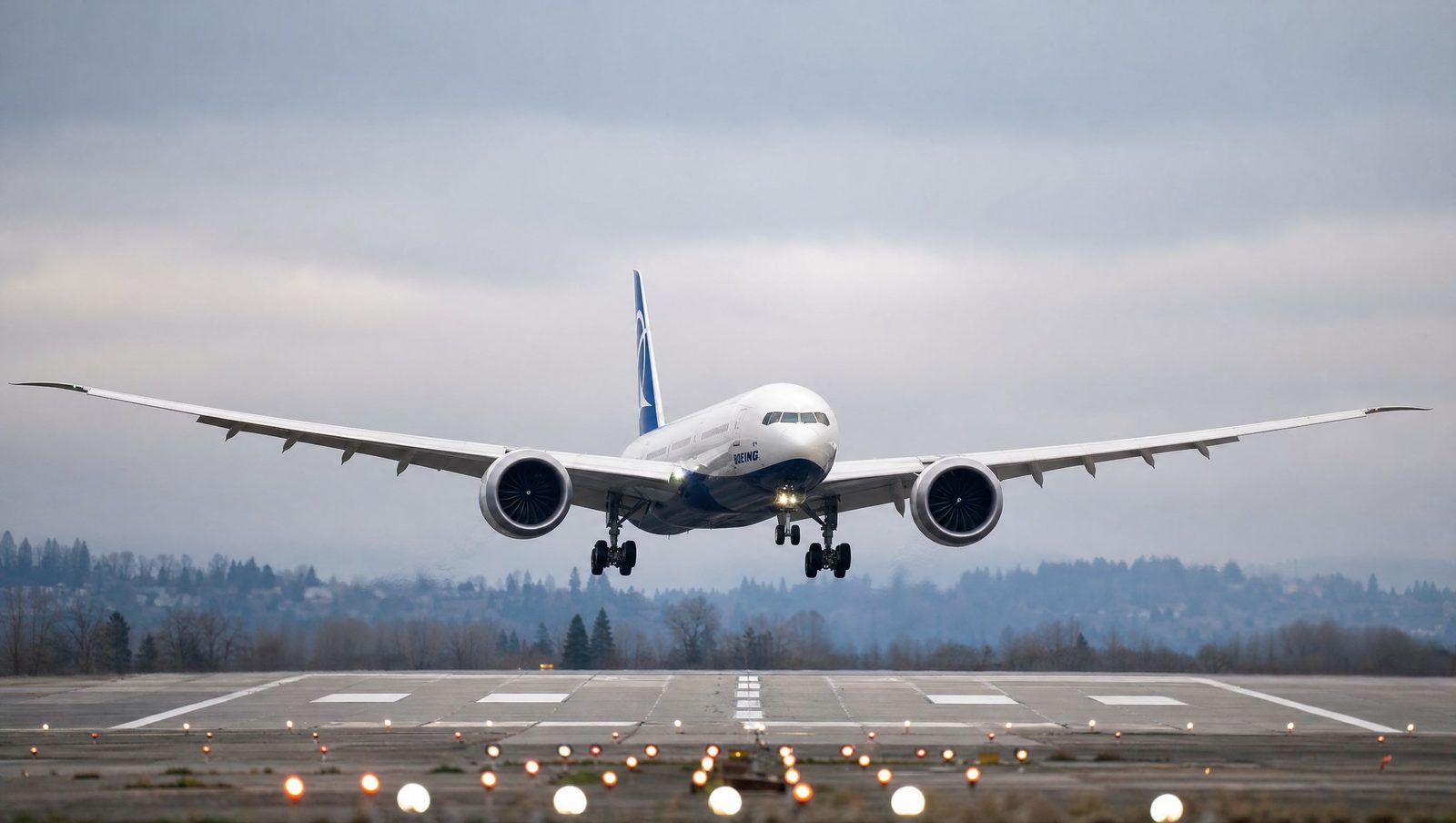
After years in certification limbo, Boeing's three newest airliners are finally close to service. The FAA issued an amended type certificate and updated Production Limitation Record for the 737 MAX 7 on August 3, 2026, clearing the smallest MAX variant almost a decade after it was first expected to enter commercial service in 2019. Deliveries are expected to begin in early 2027.
That approval matters for Southwest Airlines, the variant's primary customer, and for Boeing, because it is the first new Boeing aircraft certified in years. But the two aircraft that will move the needle commercially are the 737 MAX 10 and the 777-9, and both still have work to finish.
737 MAX 10: flight testing effectively done
Boeing has completed its final planned 737 MAX 10 certification flight test, a milestone the airframer says keeps it on track to achieve regulatory approval before the end of the year. Certification flight testing stands at 98% complete, covering roughly 2,060 flight hours, 972 test flights and 1,033 ground test hours.
What remains is paperwork-heavy rather than airborne: development assurance reviews and system safety assessments, reported at 60% and 32% complete respectively. Those disciplines cover how the aircraft's systems were designed, verified and analysed for failure conditions, and they have become a far larger share of the certification effort across the industry since the MAX programme's earlier problems.
777-9: the last major phase
On the widebody side, the FAA has cleared Boeing to begin Type Inspection Authorization phase 4b for the 777-9, described as the last significant block of work and focused predominantly on systems such as avionics. Beyond that, the remaining certification tasks include the final Type Inspection Authorizations and ETOPS demonstrations. Boeing is on course to certify the 777-9 later in 2026, with first deliveries targeted for early 2027.
ETOPS work is worth understanding for anyone following the programme. Extended-range twin-engine operations approval determines how far from a suitable diversion airport the aircraft may fly, and for a jet designed around long transoceanic sectors it is not an optional extra. Demonstrating it involves proving system reliability and diversion capability rather than simply flying more hours.
Why the sequence matters
The three aircraft are at different points on the same path. The MAX 7 has its certificate and now waits on delivery logistics. The MAX 10, the largest 737 and a popular choice at the top of the narrowbody line, has finished the flying and needs its analysis packages closed out. The 777-9, by far the most complex of the three, is entering the systems-focused endgame that typically consumes the most calendar time.
For airlines, certification is the gate that unlocks fleet planning: delivery slots, crew training timelines and route launches all sit behind it. For Boeing, clearing all three within roughly a year would close a chapter that has stretched far longer than anyone at the company planned.
Certification timelines are set by the regulator, and target dates have moved before on all three programmes.
Sources: FAA, FlightGlobal. Featured image: AI-generated by AviationShop. By Daniel Okafor.





Comments
Loading comments…