


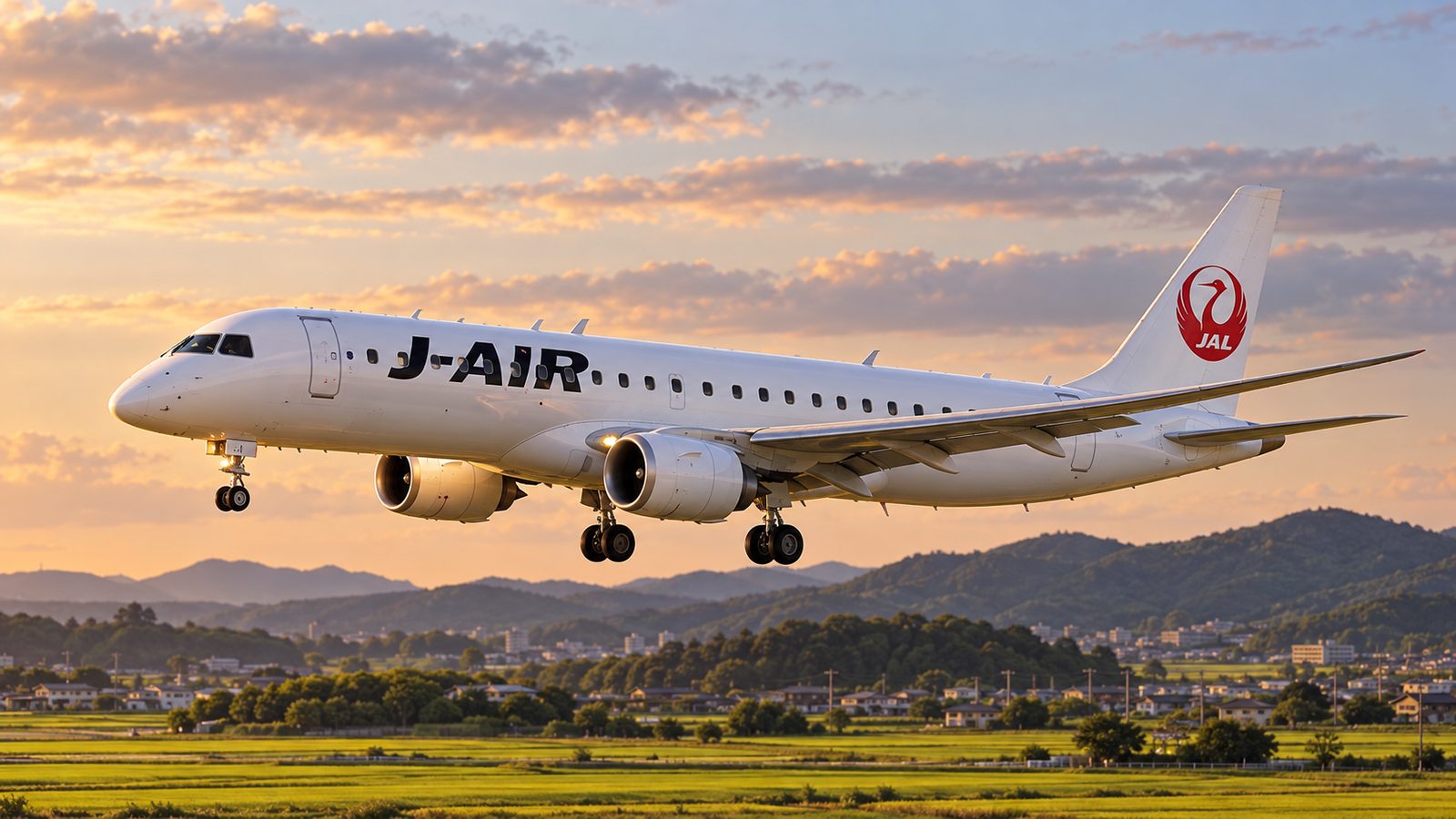
Japan Airlines has ordered up to 26 Embraer E190-E2 regional jets to renew the fleet of its subsidiary J-AIR. The order, announced on October 14, 2026, covers 16 firm aircraft and 10 options, with deliveries scheduled to begin in JAL's fiscal year 2029.
The E190-E2s will replace J-AIR's current first-generation Embraer E170 and E190 jets. According to Air Data News, the Osaka Itami-based carrier operates 32 Embraer aircraft, made up of 18 E170s and 14 E190s, mainly on domestic regional services within the JAL Group network.
A regional network under pressure
From its main base at Osaka International Airport, J-AIR flies jet services across Japan, from Memanbetsu in Hokkaido in the north to the Amami Islands in Kagoshima Prefecture in the south. JAL said the decision is part of wider changes to its domestic operations.
Japan's domestic market has been under pressure from declining business travel, long-term population changes and higher costs driven by inflation and the weak yen. Under its long-term strategy, the "JAL Group Management Vision 2035", the airline aims to keep its domestic network sustainable, describing it as essential infrastructure for the country.
JAL called the E190-E2 a core part of that plan for J-AIR, saying the aircraft suits future demand and environmental goals and will support regional economies. Mitsuko Tottori, JAL's president and group CEO, said the domestic network supports local economies and daily life across Japan, and that the new aircraft, with its environmental performance and economic efficiency, would help the group maintain and develop a sustainable air network for the next generation while giving passengers a more comfortable experience.
What the E190-E2 brings
According to JAL, the E190-E2's new-generation engines and redesigned wing deliver significant gains in fuel efficiency and a substantial reduction in carbon emissions compared with previous-generation aircraft. The jet is also much quieter, reducing the impact on communities near airports, and its reliability and durable components are expected to lower maintenance costs.
The E190-E2 is powered by Pratt & Whitney PW1900G geared turbofan engines and typically seats between 97 and 114 passengers. It has a range of 5,463 kilometres (2,950 nautical miles), a length of 36.3 metres, a wingspan of 33.7 metres and a height of 10.7 metres. It is the larger of the two aircraft currently offered in Embraer's E2 family. JAL has not yet disclosed the seating configuration it plans for the aircraft or a detailed retirement schedule for the existing E-Jets.
Both big Japanese groups now on the E2
The selection follows rival All Nippon Airways, which became the first Japanese customer for the second-generation E-Jet with a firm order for 15 E190-E2s, plus options for five more, in February 2025. ANA plans to introduce the aircraft from fiscal 2028, one year ahead of JAL's first deliveries, and Reuters reported that ANA earlier this year expanded its firm order to 23 aircraft. JAL's decision gives Embraer E190-E2 orders from both of Japan's largest airline groups. Embraer's E2 family is a major competitor to the Airbus A220.
The decision came after months of evaluating replacements for J-AIR's regional fleet. Bloomberg reported in September that the E190-E2 had emerged as the leading candidate, ahead of the A220.
After the SpaceJet
JAL had previously planned to introduce a locally developed regional jet. It signed an agreement in 2015 for 32 Mitsubishi Regional Jets, later renamed SpaceJet, but none were delivered before Mitsubishi Heavy Industries ended the programme in 2023.
J-AIR has flown Embraer aircraft since 2009, when it introduced the E170, and the larger E190 joined its fleet in 2016. JAL recently extended its component support agreement with Embraer for the current E170 and E190 fleet, and the E190-E2 order now sets out the successor for those jets as the carrier begins the next phase of its regional fleet renewal.




Comments
Loading comments…