


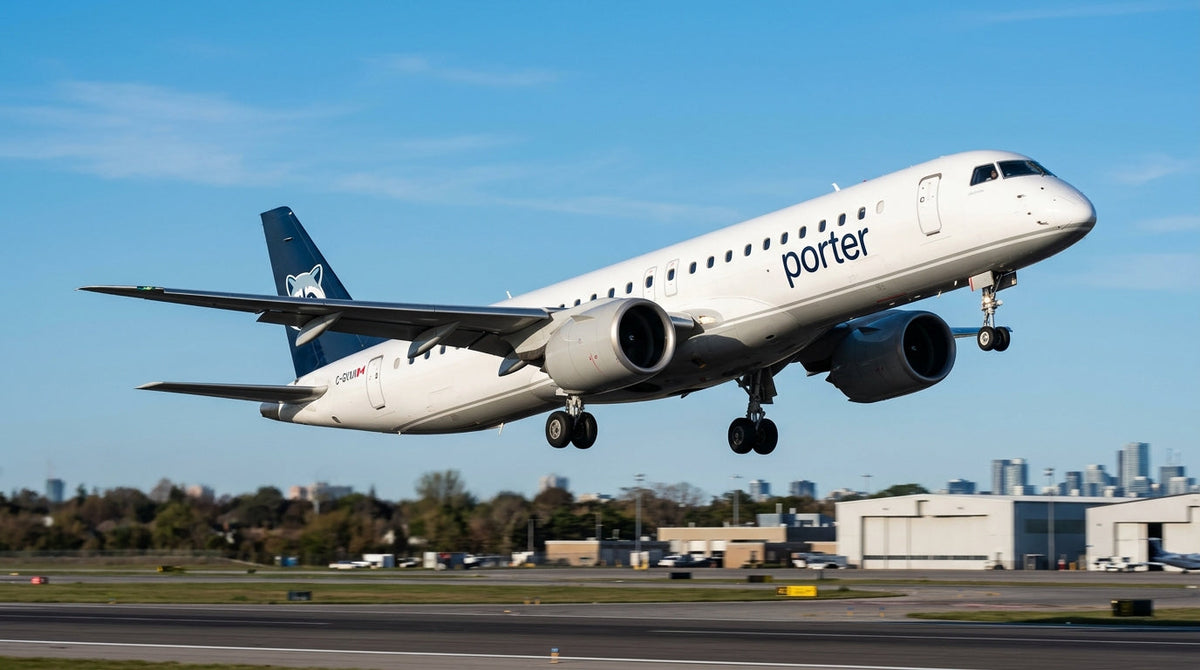
Porter Airlines is executing a significant network expansion this June 2026, launching 15 new routes across its network. The expansion marks a major milestone for the Toronto-based carrier as it continues to grow beyond its traditional Eastern Canadian operating footprint. The announcement reflects Porter's confidence in market demand and its fleet modernization strategy, which centers on the Embraer E195-E2 regional jet.
The new routes include service to Montreal Metropolitan Airport, signaling Porter's strategic push into Quebec's aviation market. This multi-route expansion demonstrates the carrier's ability to leverage its modern aircraft capabilities to serve both established markets and emerging secondary airports. The E195-E2, which offers a range of up to 4,600 kilometers and a 132-seat configuration, enables Porter to efficiently serve medium-distance corridors that were previously uneconomical for the carrier's older turboprop fleet. The aircraft's low operating costs and environmental credentials align with Porter's operational strategy as a regional carrier focused on point-to-point connectivity.
The Embraer E195-E2 represents a generational leap for Porter's fleet, offering improved fuel efficiency of up to 25 percent compared to earlier regional jet models. The type features advanced avionics, an expanded cargo hold, and enhanced passenger comfort amenities—elements that support the carrier's brand positioning in a competitive regional market. For a carrier historically known for focusing on underserved markets and secondary airports in Central and Eastern Canada, the E195-E2 provides the range, capacity, and economics necessary to justify service to markets that may lack the traffic density to support larger aircraft from major network carriers.
This June 2026 expansion timing is significant within the broader context of Canadian aviation recovery and growth. Regional carriers have increasingly become essential to the domestic network ecosystem, particularly as major carriers consolidate and focus on trunk routes and international markets. Porter's expansion into 15 new routes suggests the carrier has secured sufficient aircraft availability and crew resources to support rapid network growth. The Montreal Metropolitan Airport routes are particularly noteworthy, as secondary airports in major metropolitan areas represent high-potential markets where Porter can differentiate through schedule frequency and competitive pricing relative to larger carriers operating from downtown airports.
The expansion also carries implications for Porter's operational footprint and regulatory environment. Scaling to 15 new routes requires corresponding investments in ground infrastructure, crew basing, and maintenance capabilities. The choice of the E195-E2 suggests Porter has planned these expansions around a standardized fleet type, reducing pilot training complexity and maintenance costs—a critical advantage for a carrier scaling its operations rapidly. The aircraft type is also recognized for strong reliability and dispatch performance, factors essential for a regional carrier maintaining schedule integrity across an expanded network.
Industry observers view Porter's expansion as a validation of regional aviation's viability in the post-pandemic travel environment. The carrier's focus on secondary airports and underserved markets allows it to operate with lower landing fees and airport congestion than competitors based at major hub airports. This cost advantage, combined with the E195-E2's efficiency, creates a sustainable competitive model that can justify frequent service to markets with moderate but consistent demand. The 15-route expansion positions Porter to capture leisure and business travel demand that may have previously routed through larger carriers or driven customers toward alternative ground transportation.
Looking forward, the success of these June 2026 routes will likely inform Porter's future fleet and network decisions. The carrier's demonstrated ability to rapidly integrate new aircraft and launch new markets suggests it may continue to pursue growth opportunities throughout 2026 and beyond. For aviation industry observers, Porter's expansion serves as a case study in how regional carriers can leverage modern, efficient aircraft types to operate profitably in markets that might otherwise remain underserved by larger competitors focused on hub-based networks.
Sources: Simple Flying & Airways. Featured image: AI-generated by AviationShop. By James Holloway.








Comments
Loading comments…