


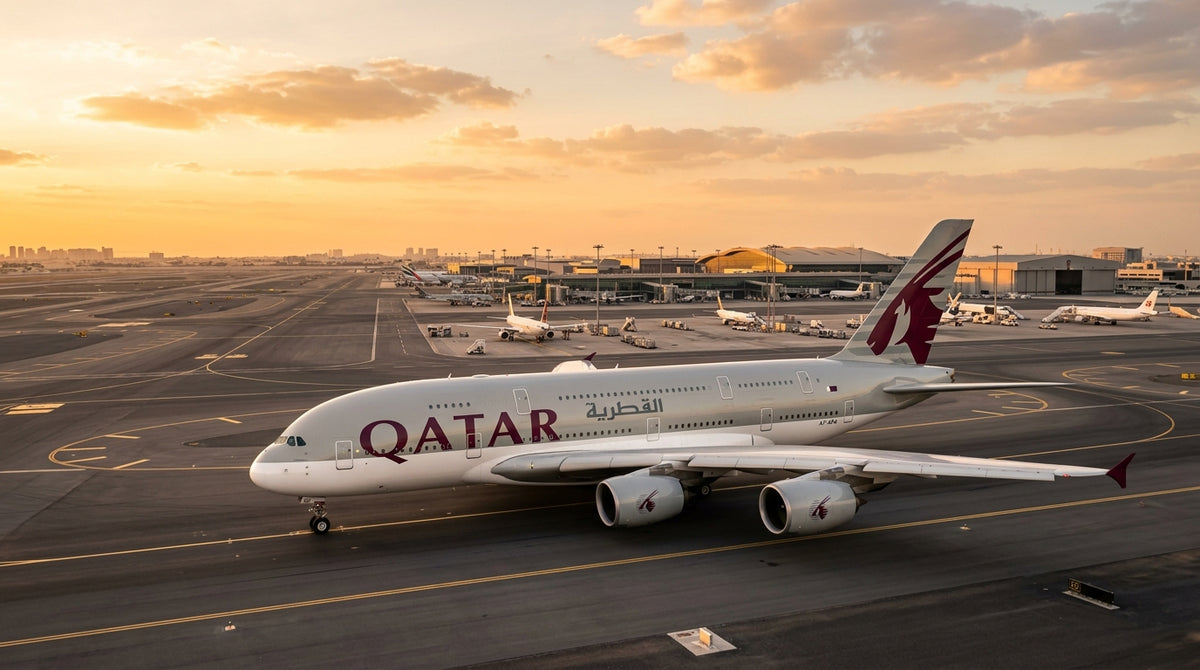
Qatar Airways has confirmed it will no longer operate the Airbus A380 on five major international routes, marking another major step in the gradual rollback of the Doha-based carrier's superjumbo programme. The airline still maintains a fleet of eight active A380s, each configured with 517 passenger seats in a four-class layout, but the type is now permanently absent from Perth, Melbourne, Guangzhou, Frankfurt and Atlanta.
The decision is the latest chapter in a fleet strategy that has shifted dramatically since the pandemic. Qatar Airways operated more than 1,500 A380 departures between Doha and Perth alone, with the Western Australian gateway hosting daily superjumbo service between May 2018 and March 2020, and then again from December 2022 until June 2025. Service to Guangzhou and Melbourne, the carrier's next two largest A380 markets, accounted for another 1,100 and 1,000 departures respectively before the type was withdrawn. Frankfurt received a daily A380 between March 2019 and March 2020, while Atlanta hosted just a single one-off A380 flight when the route launched on 1 June 2016.
Going forward, the routes will be served primarily by the Boeing 777-300ER, with occasional rotations operated by the Airbus A350-900 when capacity demands. The shift mirrors a wider industry trend in which carriers increasingly favour fuel-efficient twin-engine widebodies over the four-engine A380, a type that requires dedicated infrastructure, specialist crew qualifications and a heavier maintenance footprint than its smaller siblings.
Qatar Airways has been one of the most publicly conflicted A380 operators in the world. Former group chief executive Akbar Al Baker repeatedly described the type as a financial drag, while his successors have leaned on the superjumbo's premium-heavy cabin to absorb peak demand on a smaller set of trunk routes. Today, the type predominantly operates on London Heathrow, Paris Charles de Gaulle and Bangkok services, alongside seasonal deployments where curfew-driven slot constraints favour the higher capacity of the A380.
For passengers, the change means a downsizing of cabin choice on the affected routes, particularly in First and Business. The 777-300ER offers Qatar's award-winning Qsuite business product, but loses the spaciousness of the A380's upper deck and the carrier's onboard lounge. Industry observers expect Qatar Airways to keep evaluating its remaining A380 fleet through the second half of the decade, with the new Boeing 777-9 waiting in the wings as the eventual long-term replacement for the largest aircraft in the network.
Compiled from publicly available aviation news sources. Featured image: AI-generated by AviationShop. This article is original editorial content; facts have been verified across multiple public sources.



Comments
Loading comments…