


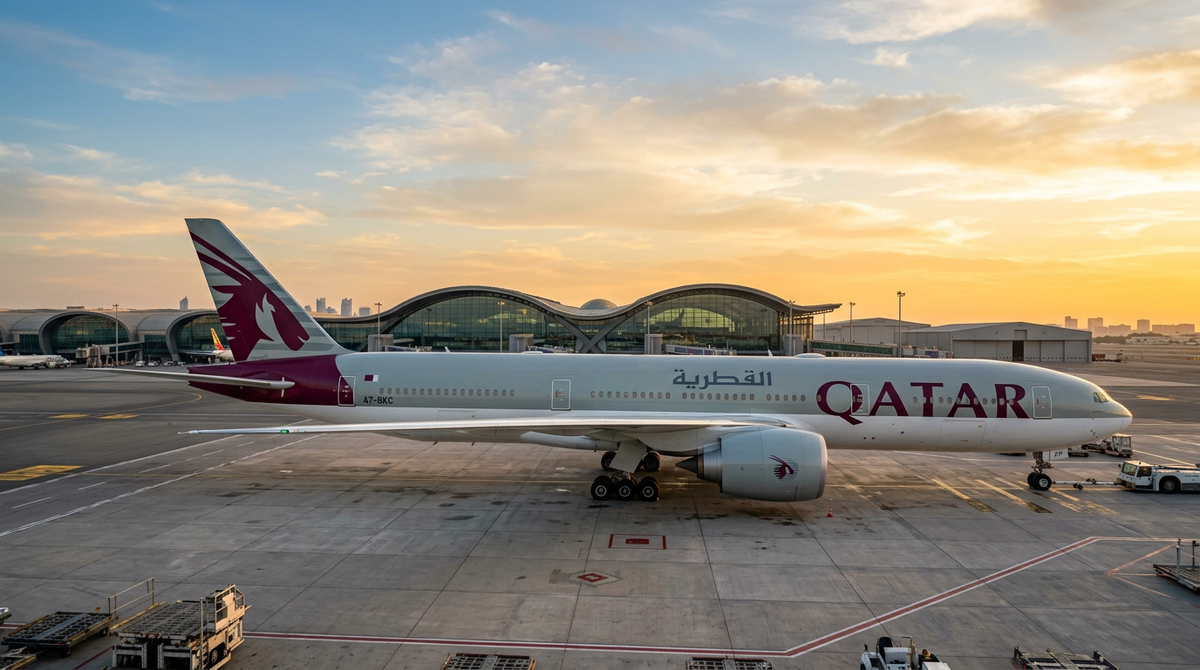
Qatar Airways has closed the 2025-26 financial year with a net profit of QAR 7.08 billion ($1.94 billion), a result the carrier delivered even after Qatari airspace was shut on February 28, 2026, following Iranian missile and drone strikes that briefly grounded close to 90% of its flights out of Doha Hamad International Airport. Net profit slipped roughly 7% year-on-year, but operating profit climbed to QAR 15.2 billion ($4.2 billion), the highest in the group's history and a sign that the underlying business outperformed even as geopolitics battered the final quarter.
The Doha-based flag carrier disclosed the figures alongside confirmation that its mega-order with Boeing remains a centerpiece of its long-term plan. Qatar Airways' record agreement covers up to 210 widebody aircraft, with 160 firm and 50 options. The firm book includes 130 Boeing 787 Dreamliners and 30 Boeing 777-9s, while the options cover additional 787s and 777X frames. Boeing has called it the largest widebody order in the manufacturer's history and the single largest 787 order ever signed. A parallel GE Aerospace deal for more than 400 engines, including 60 GE9X and 260 GEnx units plus spares, locks in propulsion for the entire wave of new metal.
The financial pressure during the final weeks of the fiscal year was severe. The Doha airspace closure froze the airline's super-connector hub, forced wholesale rerouting around the Gulf, and erased a chunk of the high-yield Asia and Europe transit traffic that normally flows through Hamad International. Fares shifted as airlines competed for the limited corridor capacity that remained, and several long-haul routes were temporarily suspended. Despite that backdrop, Qatar Airways has already restored daily service to Bahrain, Damascus, Baghdad, Basra, Erbil and Abu Dhabi, and signaled plans to operate more than 160 destinations by summer 2026.
What comes next is execution at scale. The 787 and 777-9 inductions will gradually replace older widebodies, drive a step-change in fuel efficiency, and enable the carrier to add range-restricted city pairs to the Americas and the South Pacific. Group CEO Badr Mohammed Al-Meer's team will be measured on how quickly it converts $4.2 billion in operating profit into network growth while geopolitical risk in the Gulf remains the most unpredictable variable on the balance sheet.
Compiled from publicly available aviation news sources. Featured image: AI-generated by AviationShop. This article is original editorial content; facts have been verified across multiple public sources.













Comments
Loading comments…