


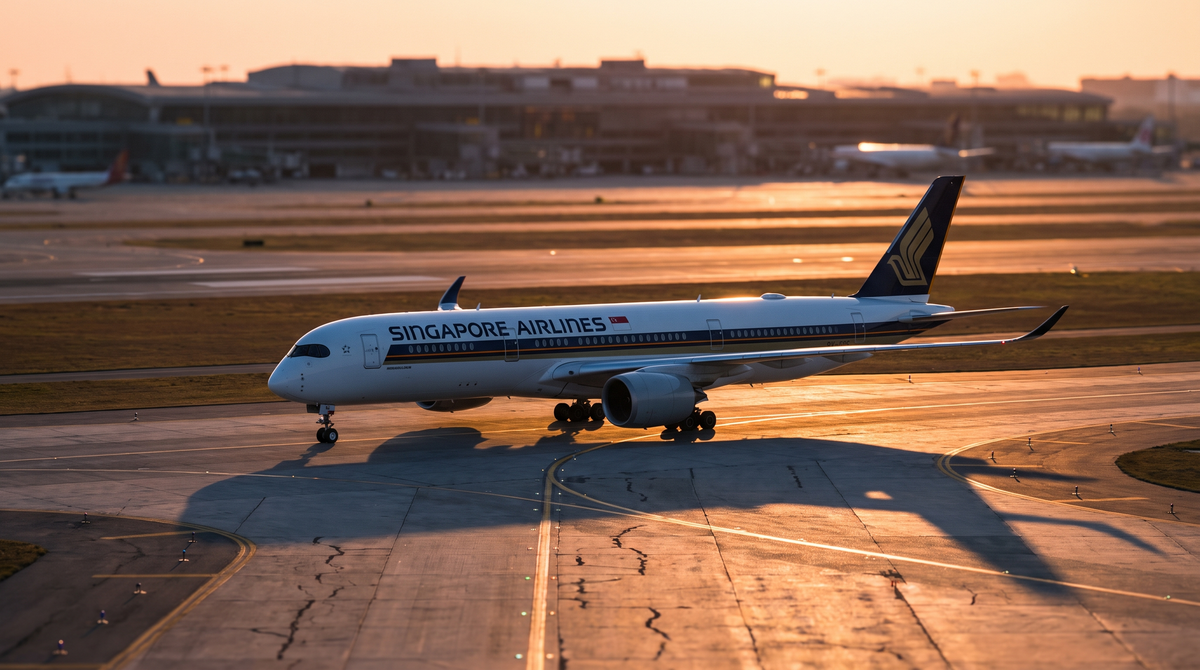
Singapore Airlines has quietly slimmed down its long-haul map. A new analysis shows that 16 long-haul destinations have dropped off the carrier's network over the past two decades, a reminder that even one of the world's most admired full-service airlines is constantly reshaping where it flies.
According to figures compiled by Simple Flying, which compared the airline's schedules from January 2006 through July 2026 against what is currently filed to operate between August 2026 and May 2027, the 16 discontinued markets are spread across four regions: Africa, the Americas, Europe and the Middle East. Singapore Airlines remains Asia's second-largest operator by international available seat miles, flying an exclusively international network with a widebody-heavy fleet and an average stage length of 2,363 nautical miles (4,376 km).
The most recent city to leave the route map is Houston's George Bush Intercontinental Airport. Singapore Airlines served the Texas hub between 2008 and 2025, carrying almost 1.4 million passengers over that stretch before withdrawing the route. Its departure highlights how even large, well-established markets are not immune when the numbers no longer add up.
Several of the older cuts reach back much further. Amritsar left the mainline schedule in 2009, Karachi and Lahore in Pakistan were both dropped in 2010, and Canberra and Wellington were each served until 2020. Together they illustrate a long, gradual pruning rather than a single dramatic retreat.
Crucially, not every dropped city means Singapore Airlines has walked away from the market entirely. At least two of the discontinued destinations, including Amritsar, were transferred to Scoot, the group's low-cost subsidiary. Scoot's leaner cost base makes it better suited to price-sensitive leisure demand, allowing the group to keep serving a city while shifting it to a more appropriate platform.
The pattern reflects the wider discipline behind Singapore Airlines' network planning. As a carrier without a domestic market to fall back on, every route must earn its place on long, expensive widebody sectors flown through the group's Changi hub. When demand softens or costs rise, capacity is redeployed toward stronger-performing markets rather than propped up out of tradition.
For passengers, the takeaway is nuanced. Some connections that once existed on the mainline network have disappeared or moved to Scoot, but the reshuffling is part of how a premium airline protects its profitability and keeps its widebody fleet flying where it earns the most. Route maps, even at the very top of the industry, are never static.
Sources: Simple Flying. Featured image: AI-generated by AviationShop. By Elena Vargas.







Comments
Loading comments…