


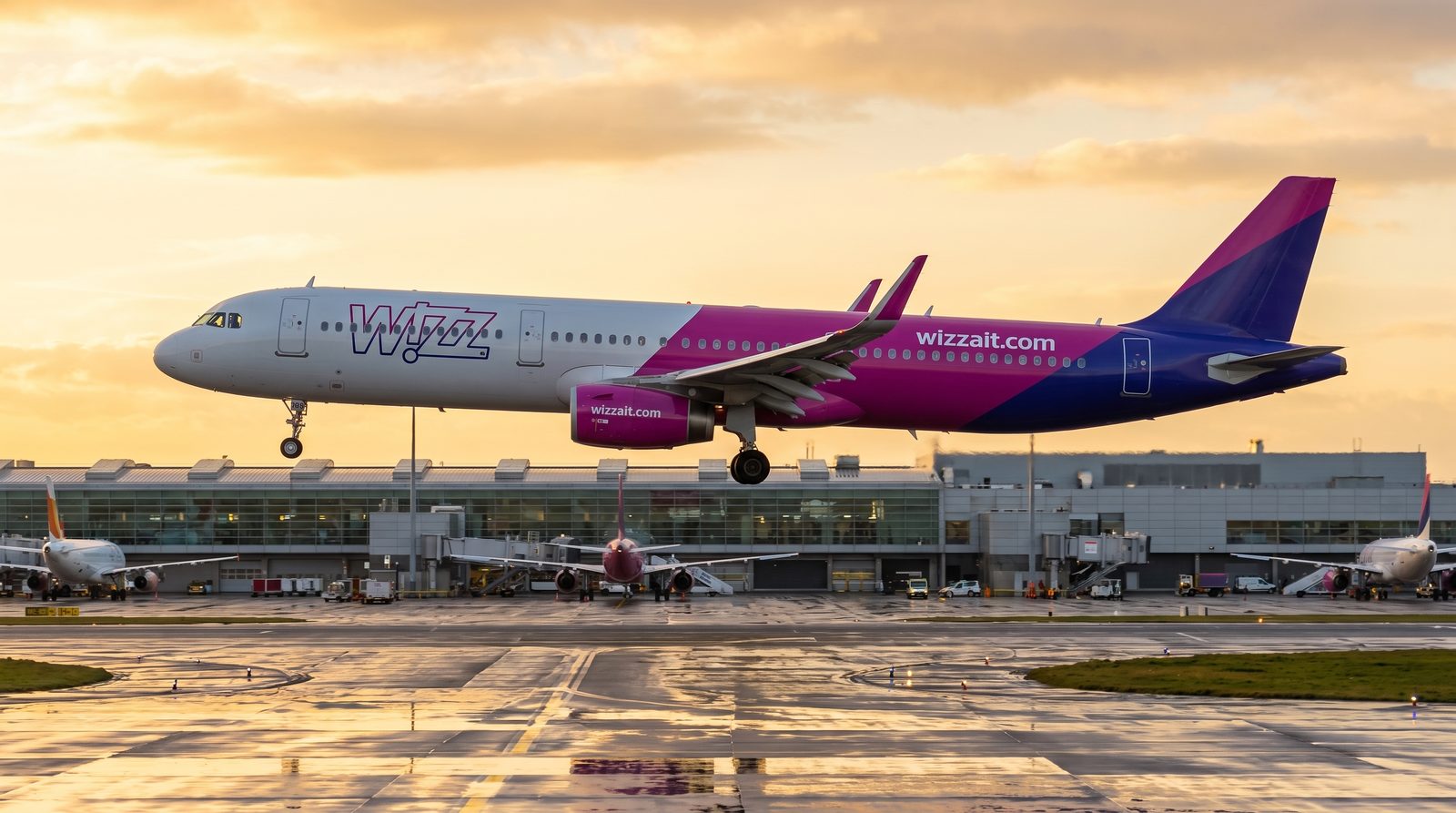
Wizz Air has stripped Pratt & Whitney engines from parked Airbus A321XLR jets and fitted them to standard A321neos, turning long-range airframes into spare-engine donors while GTF inspection groundings continue, aero.de reported on 17 September 2026, citing a Bloomberg account of a Wizz spokesperson. AeroCorner’s 14 September reconstruction of the same briefing says three XLRs now sit engineless in Poland, two more Gatwick jets are parked at Katowice, and only three of the airline’s roughly nine XLRs are still carrying passengers—all on short European hops.
The practical map is grim for a type sold as an 11-hour, 4,700-nautical-mile tool. AeroCorner places PH-XLA, PH-XLB, and PH-XLC at Bydgoszcz without engines; the former Gatwick pair at Katowice; a sixth XLR in Milan after ground damage; and the remaining three flying short-haul. Wizz still counts the Milan jet as in service even while it sits, the report notes—an accounting nuance that matters more to fleet statisticians than to passengers hunting a long thin route.
Strategy, not weather, drove the detour. Wizz took its first PW-powered A321XLR in May 2025 with 239 seats and Middle East connectivity in the brochure. By 14 July 2025 the carrier was already suspending Middle East flying from 1 September 2025 and “rationalizing” the XLR program. In November 2025 it converted 36 XLR orders into standard A321neos, leaving a planned sub-fleet of 11. Gatwick–Jeddah and Gatwick–Medina—about seven hours each—left sale in July 2026, Simple Flying had reported earlier.
Chief commercial officer Ian Malin, speaking at Routes Europe in May, put the pivot bluntly: after leaving Abu Dhabi, “the XLR didn’t fit our business model,” Aviacionline quoted. CEO József Váradi has argued the jet can still earn on short sectors: operate it like an A321neo and capture much of the economic benefit. That logic only works if engines are available—and they are not. As of 30 June 2026, Wizz still had 27 aircraft grounded by Pratt & Whitney GTF inspections, down from 41 a year earlier, with a plan to reach 15–20 by March 2027 and zero by end-2027.
Moving a pair of serviceable engines from a parked XLR onto a grounded neo returns the same 239-seat gauge to the schedule. The XLR airframe then becomes a parts shelf until GTF supply catches up or Wizz remounts engines and returns the long-range jets to short-haul Malta or UK AOCs—fleet-register notes already hint that G-XLRA, back briefly after a Prague tailstrike, may shift toward Wizz Air Malta.
For travelers, the story is not a new leisure city on the map. It is a reminder that Europe’s largest ultra-low-cost carrier ordered an intercontinental narrowbody, then discovered its network no longer needed the range—while still needing every available PW1100G it can borrow. United, by contrast, is preparing Atlantic XLRs to Amsterdam and Dublin from 1 December, underlining how differently operators value the same type.
Until Wizz publishes a refreshed XLR utilization plan, expect more short European sectors, more parked long-range metal in Poland, and engine swaps that keep A321neos flying while the XLR brochure promise waits on the ramp.
Sources: aero.de / AeroCorner / Bloomberg via spokesperson. Image: AI-generated, livery reference only.




Comments
Loading comments…