


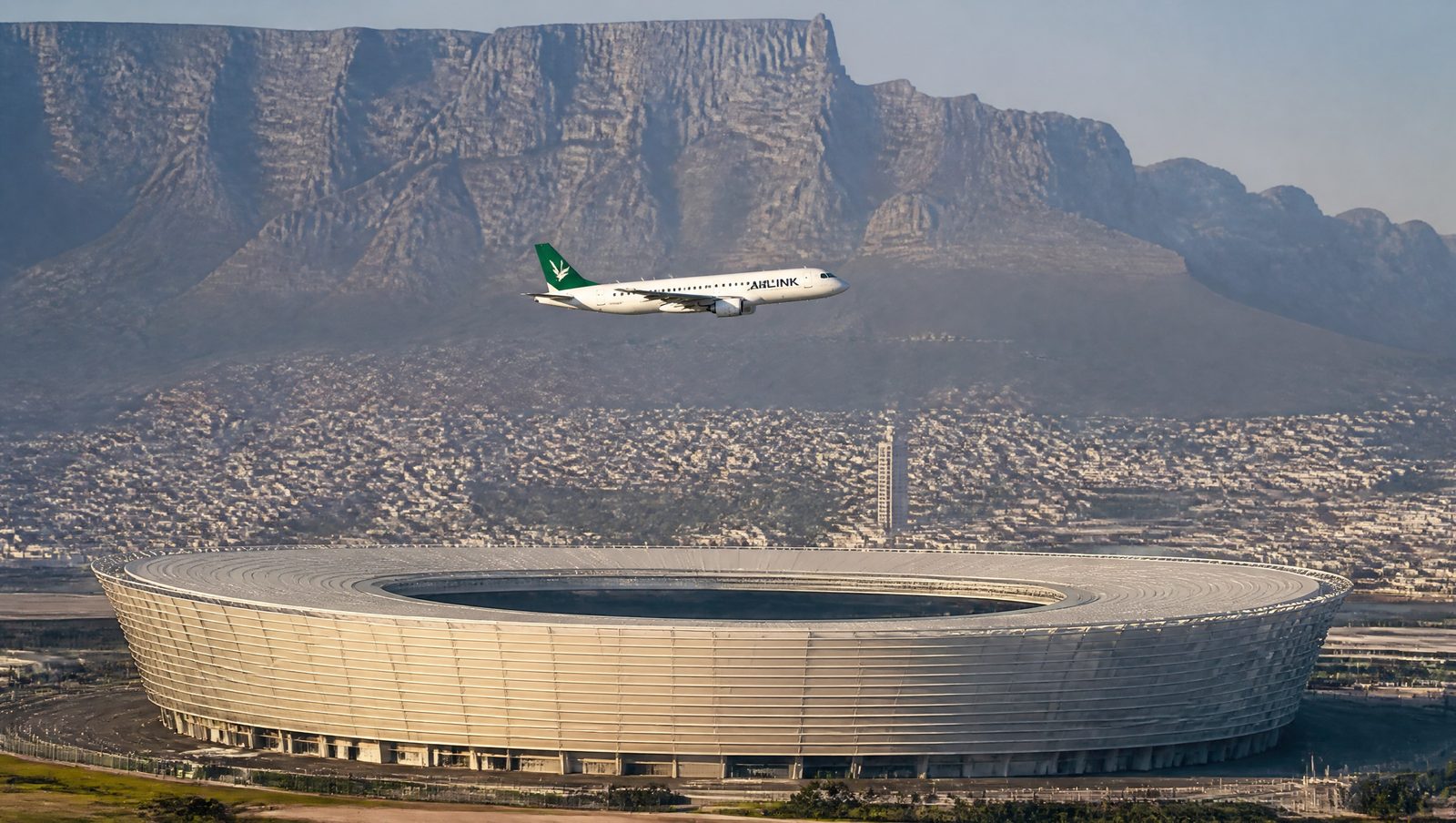
Two Airlink Embraer E-Jets performed a low-level flyover of Cape Town's DHL Stadium on Saturday, moments before kick-off between South Africa's Springboks and New Zealand's All Blacks. The pass was carried live on television across the country and was circulating widely online within minutes, largely because of how close the lead aircraft appeared to come to the stadium roof.
The two aircraft involved were Embraer E190 regional jets registered ZS-YAE and ZS-YDE, both wearing a special all-green scheme applied for the tour. Airlink was announced in June as the official airline of the series, branded 'Rugby's Greatest Rivalry', and its role extends well beyond the flypast: the carrier is also the exclusive airline for the squads, coaching staff, management and support personnel as they move around South Africa during the tour.
Why the footage caused a stir
The clip that spread fastest was taken from the official broadcast feed. In that angle, the first jet appears to pass perilously close to the stadium's roof structure, and the impression is sharpened when the aircraft begins to pitch up and the tail drops lower still. Reaction online ranged from admiration to alarm.
Camera angles are, however, notoriously deceptive with flypasts. Footage shot from the opposite side of the stadium suggests considerably more clearance between the aircraft and the roof than the broadcast angle implies. Long lenses compress distance, and a jet passing several hundred feet above a structure can look as though it is skimming it when viewed head-on through a telephoto.
A South African tradition
Low-altitude flyovers at major sporting events are a well-established part of South African match-day theatre. The tradition is usually traced to 1995, when a South African Airways Boeing 747 passed over Ellis Park Stadium before the Rugby World Cup final — an image that remains one of the most reproduced in the country's sporting history. It has been repeated regularly since, including a Qatar Airways Boeing 777 flypast for the Qatar Airways Cup.
The E190 is a natural choice for the modern version of the routine. It is a single-aisle regional jet with two underwing engines, considerably smaller and more manoeuvrable than the widebodies used for the earlier flypasts, and Airlink operates a substantial E-Jet fleet across its southern African network.
What happens next
Displays of this kind are normally flown to a briefed profile agreed in advance with the regulator and the event organisers, with minimum heights and escape routes set before the day. Neither Airlink nor South Africa's civil aviation authority had published a detailed account of the profile flown at the time of writing, and no incident has been reported in connection with the pass.
For now, the flyover has done exactly what a sponsor's flypast is designed to do — put the airline in front of a national television audience and keep it there for days afterwards. Whether the discussion about height settles as a matter of camera geometry or draws a formal look from regulators will depend on what the operator and the authority say next.
Sources: Simple Flying, Paddle Your Own Kanoo. Featured image: AI-generated by AviationShop. By Daniel Okafor.





Comments
Loading comments…