


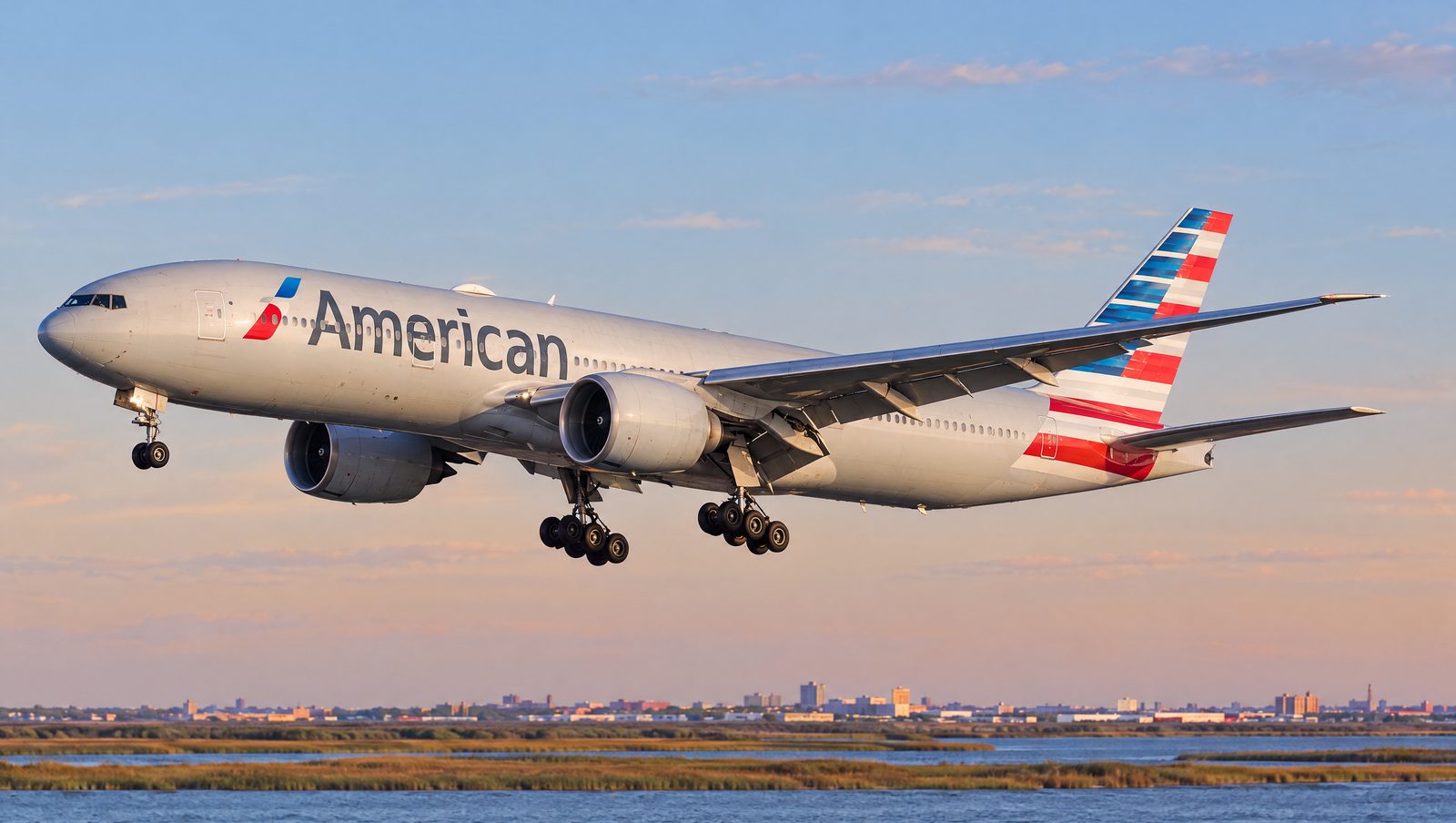
An American Airlines Airbus A321 carrying 133 people declared an emergency on approach to Dallas/Fort Worth International Airport (DFW) on the evening of Friday 21 August after a passenger's laptop overheated and caught fire inside the cabin. Between four and five people on board sustained burn injuries, and the aircraft landed safely amid a significant emergency response.
The aircraft was operating American Airlines flight AA2398 from Hartsfield-Jackson Atlanta International Airport (ATL) to DFW. The flight departed Atlanta at around 17:20 local time. Towards the end of the roughly three-hour sector, as the jet was already on approach to American's largest hub, the flight crew contacted air traffic control to report a fire in the cabin.
“We're hustling down now,” one of the pilots told a controller at DFW shortly after declaring the emergency, adding: “Cabin fire in the back of the airplane. The flight attendants are trying to put it out now.”
Shortly afterwards the crew advised the tower that the fire was under control, but requested medical assistance to meet the aircraft on arrival. The passenger whose laptop had caught fire had sustained burn injuries, along with between three and four other passengers seated nearby. One of the pilots told controllers that up to five people on board may have been burned.
The A321 landed without further incident and taxied to the gate at Terminal C, where the airport fire service was standing by to meet it. Passengers were able to disembark normally.
Lithium batteries in the cabin
The event is the latest in a growing string of incidents involving overheating personal electronic devices on commercial flights. Laptops, tablets, phones and portable power banks are all powered by lithium-ion cells, which can enter thermal runaway if they are damaged, defective or short-circuited. Once that process starts, the cell releases its stored energy very rapidly as heat, and neighbouring cells can be pushed into the same reaction.
Because of that risk, spare lithium batteries and power banks are not permitted in checked baggage on commercial flights – the reasoning being that an event in the cabin can be seen and dealt with immediately, whereas one in a cargo hold may go undetected. Cabin crew are trained specifically for these events, and many airlines now carry containment bags or fire-resistant pouches in addition to conventional extinguishers.
Several carriers have tightened their rules over the past two years, with a number of airlines in Asia and Europe restricting the use or charging of power banks in flight and requiring that devices be kept within sight rather than stowed in overhead bins. The Atlanta–Dallas event follows the same pattern that has driven those policy changes: a device carried by a passenger, in the cabin, igniting without warning during a routine phase of flight.
The aircraft
The Airbus A321 is the largest member of the A320 family and one of the backbone types of American's domestic narrowbody fleet, typically operating dense transcontinental and hub-to-hub routes such as Atlanta–Dallas. With 133 people on board, the flight was operating below the type's usual capacity.
American Airlines has not issued a detailed public statement on the sequence of events at the time of writing, and the injuries reported have been described only as burns. There has been no indication that the aircraft sustained damage requiring extended repair.
Sources: Simple Flying, Paddle Your Own Kanoo. Featured image: AI-generated by AviationShop. By James Holloway.


Comments
Loading comments…