


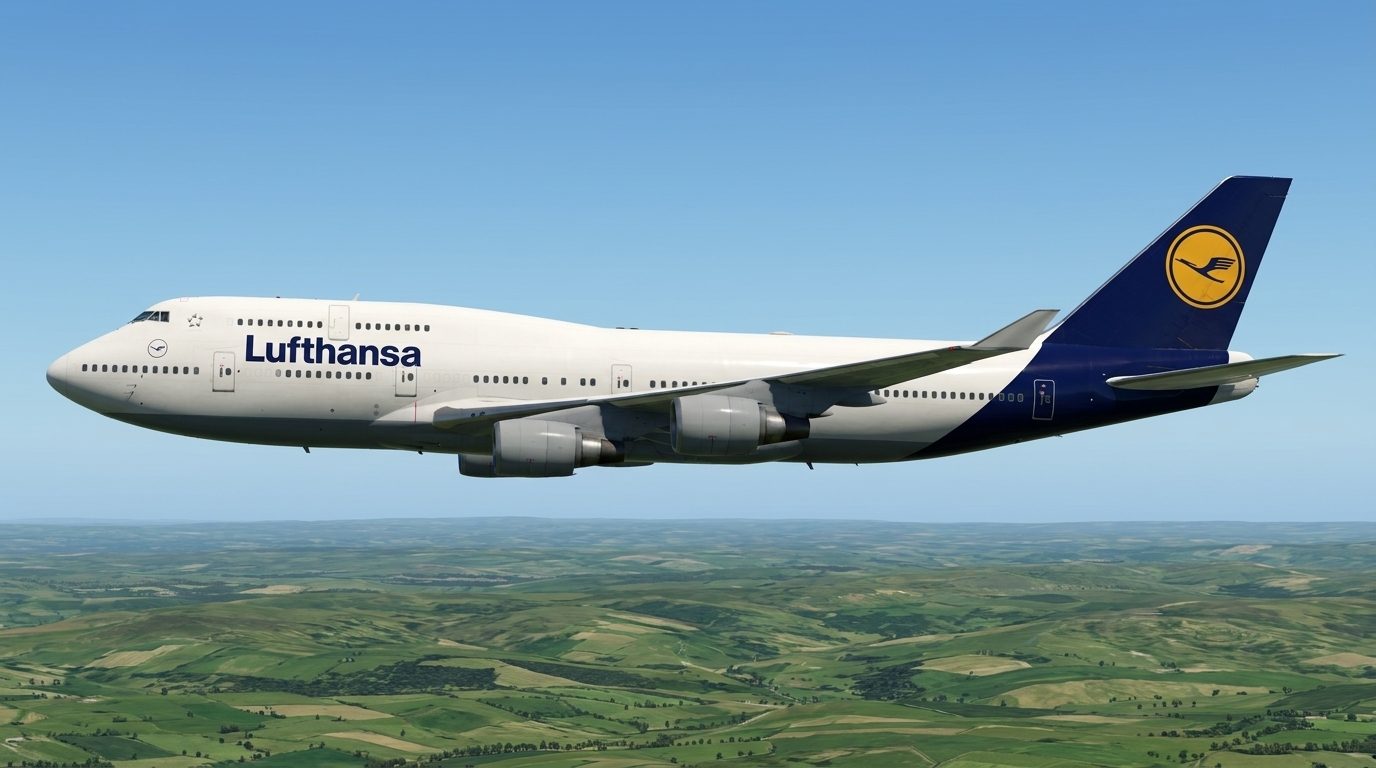
Few aircraft earn a nickname. Fewer still earn one as regal as the Queen of the Skies. For more than half a century the Boeing 747 has defined what a "big jet" looks like in the public imagination — that unmistakable forehead bulge, four engines slung under a swept wing, and a silhouette you can pick out of a crowded sky from miles away. To the travelling public it was the airplane that made the world feel smaller. To pilots, it was something more personal: a machine that flew far bigger than its size suggested, and one that almost everyone who sat in its left seat speaks about with a particular kind of affection.
This is a look inside the 747 — where it came from, why it was shaped the way it was, how it changed across five decades, and what it actually felt like to fly the Queen.
Why They Call It the Queen of the Skies
When the 747 entered service with Pan Am on January 22, 1970, on the New York–London route, nothing else in the air looked or carried like it. It roughly doubled the capacity of the jets that came before it, and it did so with a presence that was impossible to ignore. The "Queen" title stuck because the airplane combined sheer scale with a kind of graceful authority — long range, a smooth ride, and a flight deck perched a full storey above the tarmac.
That reputation wasn't marketing. The 747 genuinely reshaped global aviation, turning long-haul flying from an expensive rarity into something millions of people could do. The romance came later; the engineering came first.
A Jet Born From a Gamble
The 747 exists partly because Boeing lost a competition. In the mid-1960s the U.S. Air Force wanted an enormous strategic transport, and Boeing's design lost out to Lockheed's C-5 Galaxy. But Boeing kept two ideas from that losing bid: a full-width nose cargo door and a cockpit raised above the main deck so freight could be loaded straight through the front. Those two decisions would shape the most recognisable airliner ever built.
The commercial push came in April 1966, when Pan Am ordered 25 Boeing 747-100s for around US$525 million — an astonishing sum and an enormous risk for both companies. Boeing agreed to deliver the first aircraft by the end of 1969, which left engineers just 28 months to design a jet of unprecedented size: roughly two-thirds of the time such a program would normally take. To build it, Boeing erected the largest building in the world by volume at Everett, Washington. The prototype, registration N7470, first flew on February 9, 1969.
The Hump, Explained
Ask any avgeek what makes a 747 a 747 and the answer is the hump. But the upper deck wasn't styled for looks — it was a side effect of how Boeing expected the airplane to be used.
At the time, the industry widely assumed that supersonic transports would soon take over passenger flying, and that big subsonic jets like the 747 would spend most of their lives hauling cargo. By raising the cockpit onto a short upper deck, Boeing could fit that full-width hinged nose door for freight without the flight crew getting in the way. The "bump" behind the cockpit was simply the fairing that smoothed the upper deck back into the fuselage. Supersonic airliners never took over the market — but the design choice gave airlines a unique pocket of premium space, and gave the 747 a face the whole world would come to recognise.
Four Engines, Standard Runways
Every 747 ever built has four engines, and that has always been part of the airplane's character. Across the generations those engines came from Pratt & Whitney, General Electric, and Rolls-Royce, with the final 747-8 generation using four GE GEnx-2B67 turbofans producing roughly 66,500 pounds of thrust each — closely related to the engines on the 787 Dreamliner.
For all its size, the 747 was engineered to behave itself near the ground. Sophisticated triple-slotted trailing-edge flaps and split control surfaces let the airplane fly slow approaches and operate from standard-length runways rather than demanding special infrastructure. That combination — enormous payload, but civilised low-speed manners — is a big reason the type spread to airports all over the planet.
The Family: From Classic to the 747-8
The 747 isn't one airplane so much as a dynasty. Over its life the type's maximum takeoff weight grew from about 735,000 pounds (333 tonnes) on the original -100 to roughly 970,000 pounds (440 tonnes) on the final -8, while range stretched from around 5,300 nautical miles to about 8,000 nautical miles. A few milestones stand out.
The Classics (-100, -200, -300, SP)
The early "Classic" 747s established the formula and carried three-person flight crews. The 747-200 added payload and spawned the first dedicated freighter, the 747-200F, introduced by Lufthansa. The short, stubby 747SP traded fuselage length for extreme range — one later became the flying telescope platform for NASA's SOFIA observatory.
The 747-400
Launched in October 1985, the 747-400 was the big modernisation. It swapped the analog "steam gauge" panel for a glass cockpit, which let airlines drop the flight engineer and fly with a two-pilot crew. It added the tall winglets that became a visual signature, trimmed about 30% of the airframe wiring, and became the best-selling 747 of all. For a whole generation of long-haul travellers, "747" meant the -400.
The 747-8
The final chapter was the 747-8, stretched into the longest passenger jet Boeing ever built. The passenger 747-8 Intercontinental seats around 467 in a typical three-class layout — and well over 600 in a dense configuration — with a range near 7,790 nautical miles. By borrowing engine and aerodynamic technology from the 787, it became the quietest and most efficient Queen ever, even as the wider market moved toward big twins.
Flying the Queen: A Pilot's Perspective
Pilots who flew the 747 tend to describe it with the same word: honest. For an airplane of its mass, it was widely regarded as beautifully balanced and predictable in handling — it went where you pointed it and rarely surprised you. Sitting some three storeys above the runway changed your whole sense of the flare and touchdown; you learned to judge height differently because your eyes were so far above and ahead of the main gear.
The four-engine layout gave crews a deep reservoir of reassurance on long oceanic legs, where the nearest diversion airport might be hours away. And the cruise was the airplane's natural home: settled at high altitude around Mach 0.85, the Queen would carry a full load halfway across the planet in a quiet, stable hush that the people in the back never fully appreciated. Ask retired widebody captains to name their favourite type and the 747 comes up again and again — not because it was the easiest, but because it felt like flying something that mattered.
From Passengers to Pure Freight
The 747's designers always suspected it would end up hauling boxes, and they were right. That nose door turned out to be a gift to the air cargo world, letting freighters swallow long, awkward loads straight through the front. Dedicated freighters were built with an upward-hinging nose and a side cargo door, while retired passenger jets were converted by adding a side door and reinforcing the main-deck floor. Decades after the first passengers stepped aboard, 747 freighters remained the backbone of long-haul cargo for carriers around the world — the reason the type kept rolling off the line long after most airlines had retired their passenger Queens.
The Final Bow
All dynasties end. Boeing built 1,574 Boeing 747s in total — a number that includes the original prototype — before closing the line. The very last one, a 747-8 freighter, was delivered to Atlas Air on January 31, 2023, drawing a crowd of employees, retirees, and fans to Everett to watch the Queen take her final bow off the production line. The 747-8 generation alone accounted for 155 aircraft: 107 freighters and 48 passenger jets.
The airplane the 747 was meant to replace — the supersonic transport — never arrived in force, and the twin-engine widebodies it once towered over eventually inherited its long-haul routes. But more than fifty years after that first flight in 1969, 747s are still working the world's cargo networks, still flying as the U.S. presidential transport in their VC-25 guise, and still turning heads at every airport they visit.
Owning a Piece of the Legend
You don't have to hold a type rating to love the Queen. For the enthusiasts, modellers, and crews who grew up under her wing, a well-chosen piece of memorabilia is the next best thing to a window seat on the upper deck. Our curated Boeing 747 gifts collection gathers die-cast models, prints, and apparel built around the jumbo's unmistakable lines, and it sits alongside a broader range of aviation enthusiast gifts for anyone who simply loves machines that fly. If you're shopping for the pilot in your life, our gifts for pilots range is a good place to start.
The 747 reshaped how the world moves, then bowed out with the same quiet dignity it always carried at altitude. Supersonic dreams faded and fashions in airliner design moved on — but the Queen of the Skies earned her crown the hard way, and she wears it still.
Comments
Loading comments…