


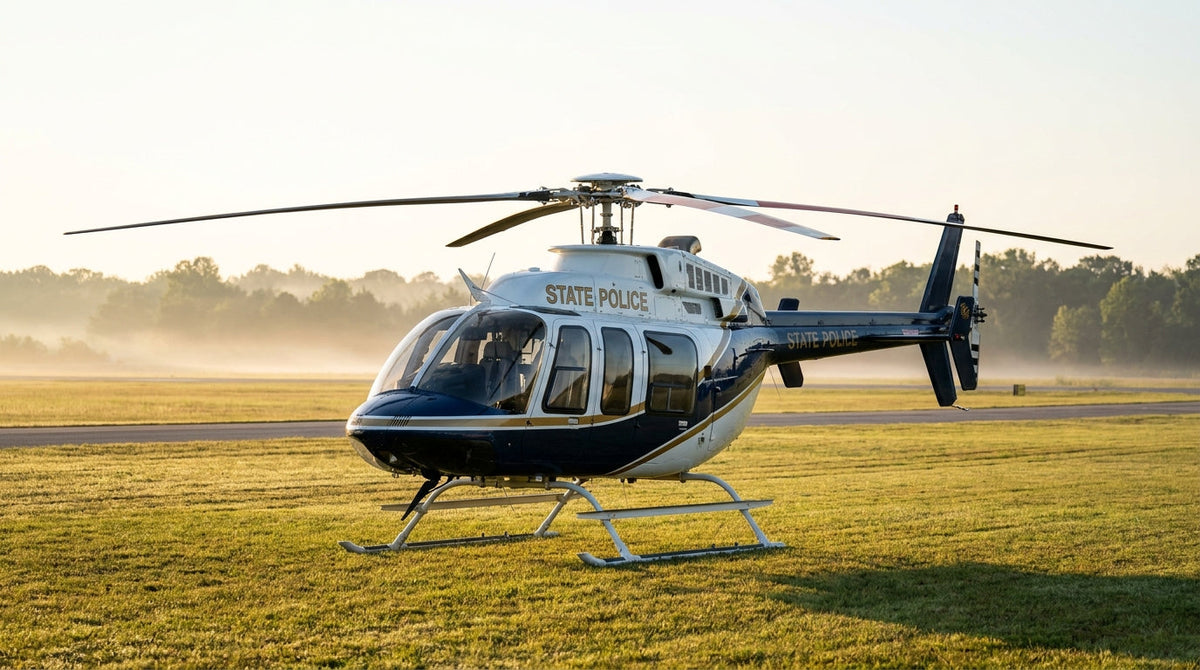
The pilot of a Cessna 150 was killed and two Pennsylvania State Police troopers were injured on Wednesday evening when the light aircraft collided with a State Police Bell 407 helicopter at Carlisle Regional Airport in Cumberland County, Pennsylvania. The collision happened at around 7:50 p.m. local time at the general aviation field, roughly 120 miles west of Philadelphia.
According to early accounts of the sequence, the two-man State Police helicopter crew was carrying out routine training on a grassy area adjacent to the runway, hovering a short distance above the ground, when the Cessna 150 travelled down the runway, veered to the right and struck the helicopter from behind. The pilot of the aeroplane was pronounced dead at the scene and has not been publicly identified.
The two troopers aboard the helicopter, both members of the State Police aviation unit, were named as Corporal Bryce Corman and Trooper Jason Mills. Both were hurt in the collision and are expected to recover. Accounts of the rescue describe both helicopter occupants being trapped in the wreckage until one of them was able to push out a window and help the other through the opening.
Two very different aircraft, one small airfield
The Cessna 150 is a two-seat, single piston-engine trainer, one of the most widely produced light aircraft ever built and a mainstay of flight schools and private owners at small fields like Carlisle. The Bell 407 is a single-engine, four-blade light utility helicopter that is a common choice for law enforcement aviation units in the United States, valued for its endurance, cabin space and ability to carry surveillance equipment.
Mixed operations of this kind are ordinary at uncontrolled general aviation airports. Fixed-wing traffic uses the runway while rotary-wing traffic often works from adjacent grass or designated helicopter areas, with separation maintained by pilots themselves through radio position calls and visual lookout rather than by an air traffic control tower. Investigators will be examining exactly how the two aircraft came to occupy the same piece of airfield at the same moment.
Federal investigation under way
The National Transportation Safety Board is leading the investigation with support from the Federal Aviation Administration, and two NTSB investigators were dispatched to the site. A field investigation of this type typically begins with documenting the wreckage positions, recovering any onboard recording or tracking devices, and collecting radio and witness accounts before the aircraft are moved for further examination.
The NTSB does not usually offer a probable cause at this stage. A preliminary report normally follows within a few weeks and sets out the factual sequence without analysis, while the final report and probable cause can take considerably longer. Until then, the accounts of the collision remain preliminary and subject to revision.
Midair collisions involving light aircraft and helicopters remain rare, but they are disproportionately concentrated in the airport traffic pattern and on the airfield surface, where aircraft of very different speeds and performance operate in close proximity. Collisions on or immediately above the runway environment have long been a focus of safety campaigns aimed at general aviation pilots, particularly the emphasis on clear radio calls at fields without a control tower and on maintaining a visual scan throughout the takeoff and landing phases.
Carlisle Regional Airport is a small general aviation facility serving central Pennsylvania. The runway was closed while emergency crews worked at the scene.
Sources: Simple Flying, CNN. Featured image: AI-generated by AviationShop. By Elena Vargas.

Comments
Loading comments…