


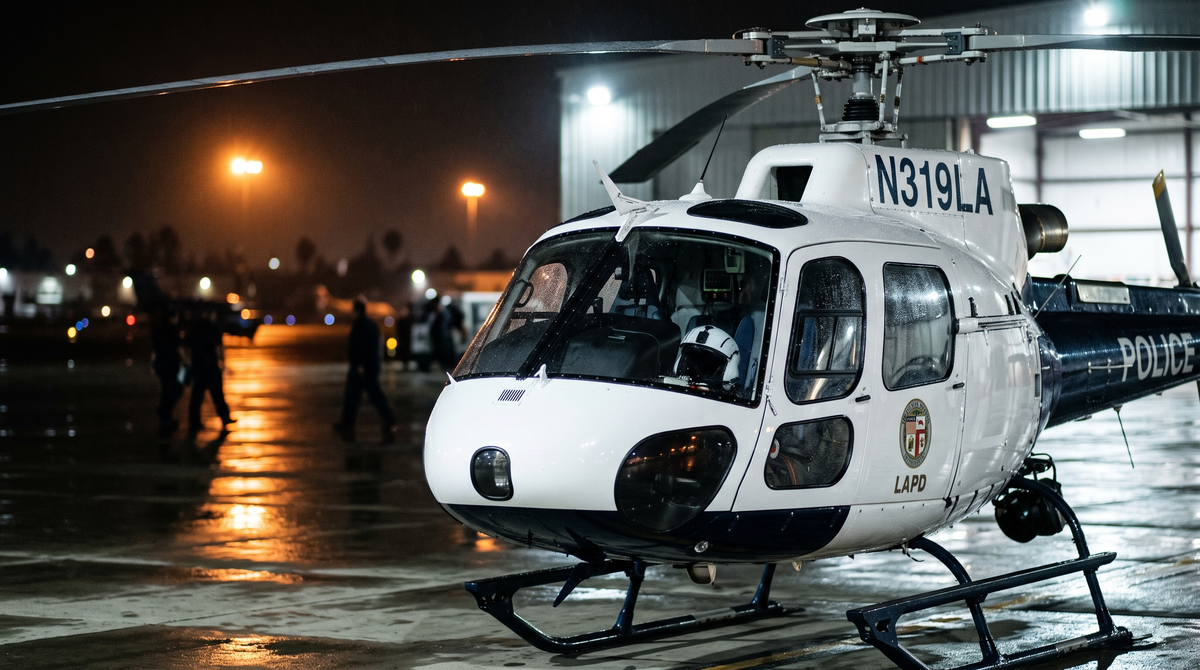
A large drone struck a Los Angeles Police Department helicopter during a patrol over the San Fernando Valley, damaging the aircraft's windshield and forcing the crew to make a precautionary landing. The collision has now drawn in both the Federal Aviation Administration and the FBI, and as of July 13 the person flying the drone had still not been identified.
The LAPD's Airbus AS350 was flying near the 101 Freeway and Reseda Boulevard in Tarzana shortly before 15:00 local time on July 7, 2026, when it hit the drone, according to the LAPD and a preliminary FAA report. The pilot landed safely at nearby Van Nuys Airport (VNY), and neither of the two officers aboard the helicopter was injured.
A drone far bigger than a hobbyist toy
Authorities described the drone as measuring approximately three feet by three feet — considerably larger than most hobbyist machines, and heavy enough to do real damage to a rotorcraft windshield at patrol speeds. Investigators have not identified its make or model, nor the person operating it. No photographs of the damaged helicopter or video of the collision itself have been released.
Context matters here. The collision happened as firefighters were battling a brush fire near the Encino Reservoir. An LAPD official said the drone operator may have been attempting to record the fire, although authorities have not determined whether the aircraft was deliberately flown near the helicopter. That distinction — reckless versus deliberate — is likely to shape what charges, if any, follow.
Why drones and firefighting aircraft cannot share airspace
For pilots, this is one of the most frustrating hazards in modern low-level flying. Drones operating near wildfires can bring aerial firefighting operations to a complete halt, because crews cannot safely share the airspace with an unidentified aircraft that carries no transponder, talks to nobody, and manoeuvres unpredictably. When a water-dropping helicopter or air tanker is working a fire at a few hundred feet, there is no margin to see and avoid a three-foot object.
The FAA generally limits drones to 400 feet above the ground, with additional restrictions around airports and emergency operations. Those rules exist precisely because police and fire aircraft spend much of their working lives in that same slice of airspace.
A warning from City Hall
Los Angeles Mayor Karen Bass called the incident “completely unacceptable” and warned drone operators against interfering with police and firefighting aircraft.
“This is a warning to anybody who's flying a drone that interferes with Fire or Police: We will find you, you will be arrested, and you will be prosecuted,” Bass said.
Both the FBI and the FAA have opened investigations into the collision.
Rare, but no longer unthinkable
The incident is the latest collision involving a drone and a crewed aircraft in US airspace. The FAA receives thousands of reports each year involving drones operating near airplanes and helicopters, although confirmed midair collisions remain relatively rare. That rarity is doing a lot of the safety work at the moment: the sheer volume of near-encounters suggests the outcome in Tarzana was closer to a statistical inevitability than a freak event.
For law enforcement aviation units, which fly low, slow and often at short notice over exactly the kind of incident that attracts amateur camera operators, the exposure is structural. A cracked windshield and a precautionary landing is the good version of this story. The version where a drone goes through a windscreen, or into a tail rotor, is the one that keeps rotary-wing crews awake.
Sources: AeroTime. Featured image: AI-generated by AviationShop. By James Holloway.
Comments
Loading comments…