


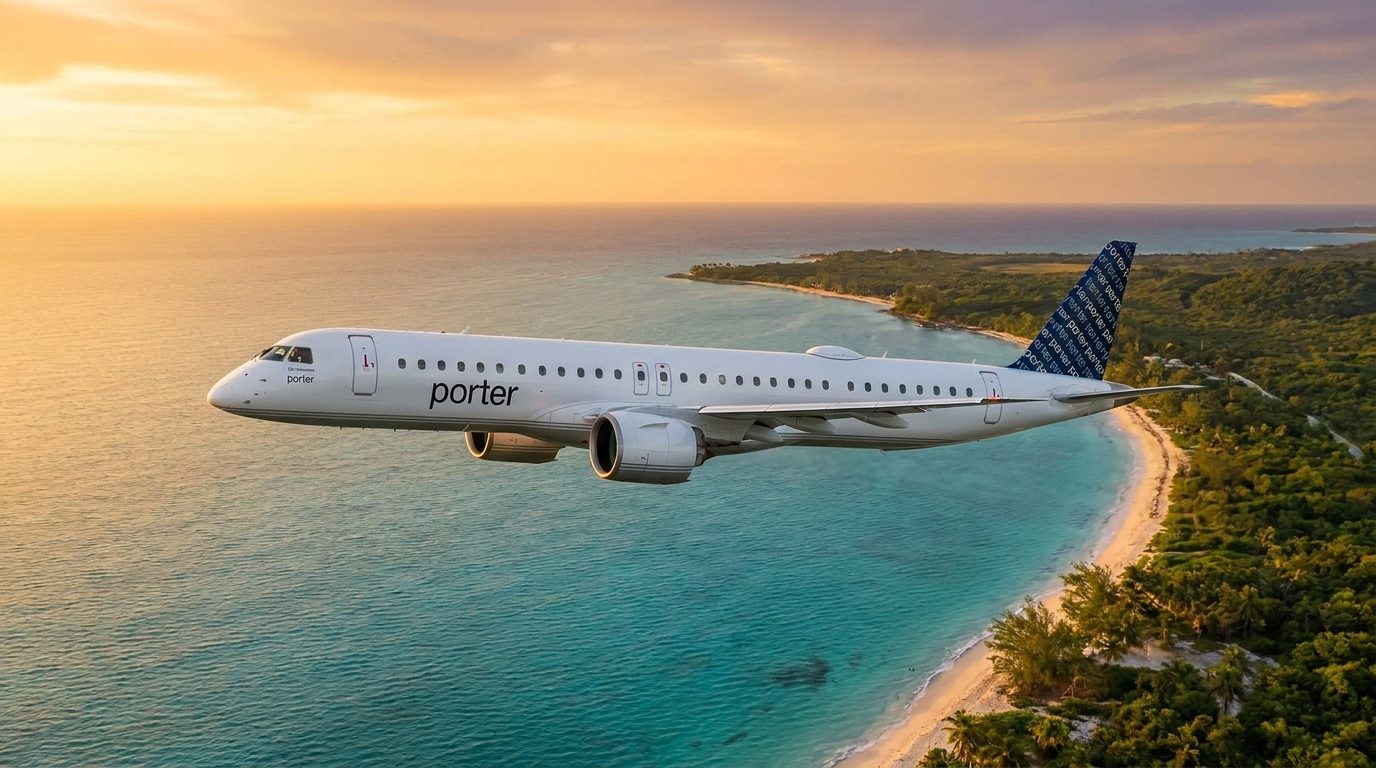
The Embraer E195-E2 is quietly rewriting what a “regional” jet can do, hauling leisure passengers on sectors beyond 2,000 nautical miles for carriers such as Porter Airlines and Airlink that need range without A320-sized risk.
Embraer’s largest E2 typically seats about 120 to 132 passengers and advertises up to roughly 3,000 nautical miles of range, with cruise near Mach 0.82 and a ceiling around 41,000 feet. Embraer says the type burns up to 29% less fuel than prior-generation E-Jets, which is the economic hinge: airlines can open thin vacation markets that would leave a 737 or A320 half empty.
Porter Airlines has pushed the envelope hardest in North America. The Toronto-based carrier now flies E195-E2s deep into Mexican and Caribbean leisure cities, including Cancún, Puerto Vallarta, Nassau and Grand Cayman. As of late September 2026, Porter’s two longest flights were Ottawa–Puerto Vallarta and Ottawa–Cabo San Lucas, each about 2,126 nautical miles—missions once reserved for mainline narrowbodies.
Across the Atlantic and Indian Oceans, other operators are running the same playbook. TUI fly Belgium uses the E2 from runway-limited Antwerp on five-hour leisure sectors. South Africa’s Airlink will open Cape Town–Mauritius on October 2, 2026, covering about 2,226 nautical miles with the E195-E2 on two of seven weekly frequencies while an A320 covers the rest—matching capacity to midweek demand against Air Mauritius’ daily A330.
The pattern is consistent. Point-to-point leisure traffic values a nonstop more than a hub connection, yet many resort markets cannot support daily widebody or even full narrowbody gauge. A 124-seat-class jet with true 2,000-mile legs lets network planners trial frequency, protect load factor, and still offer a jet product travelers accept for five- to six-hour sectors.
Limits remain. Hot-and-high airports, strong headwinds and full passenger loads shrink practical range below brochure numbers. Payload-range trade-offs still matter on the longest legs, and cabin amenities must feel acceptable for flights that can exceed five hours. Embraer’s order book nevertheless points to more of this flying: Avelo holds 50 E195-E2s from 2028 with a secondary-city leisure DNA, while SAS and Finnair have dozens on order that fit Nordic-to-Canaries style missions.
For aviation enthusiasts and shoppers following fleet news, the takeaway is simple. The E2 is no longer just a CRJ or E175 replacement for short hops. In 2026 it is a strategic aircraft for thin long leisure routes, and Porter’s Ottawa–Mexico pair plus Airlink’s Mauritius launch are the clearest commercial proof yet.
Cabin product still has to sell a five-hour leisure sector. Porter markets a refined single-aisle experience that leisure travelers accept for Mexico and Caribbean nonstops, while Airlink’s mixed E2/A320 Mauritius roster shows how gauge can flex by day of week. Embraer’s published fuel burn advantage versus older E-Jets is what makes those schedules solvent when jet fuel is high and resort demand is seasonal.
Fleet watchers should treat 2026 as the year the E195-E2 left the regional niche in the public imagination. Whether the next wave comes from Avelo’s US secondary cities, SAS and Finnair leisure hanging, or more Porter Mexico flying, the aircraft type—not just the airline brand—is now part of the long thin leisure story. That is why route maps measured in nautical miles suddenly matter as much as seat counts when Embraer publishes its next delivery slate.
Comments
Loading comments…