


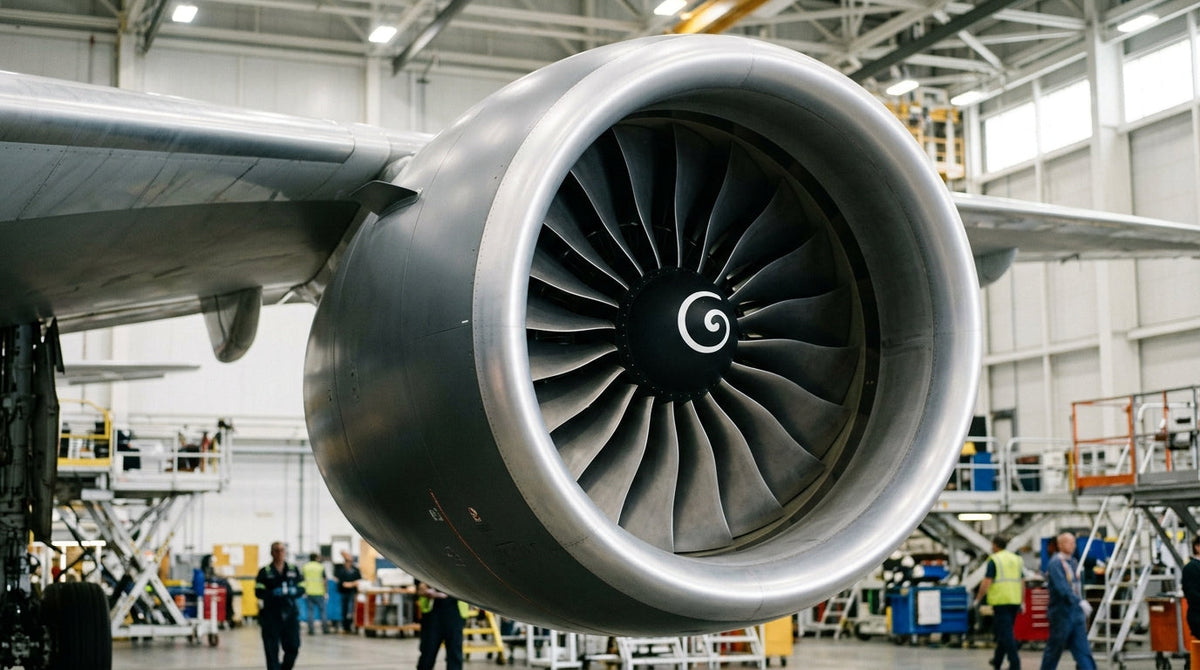
The GE9X is the largest commercial jet engine ever built, and the only engine offered on the Boeing 777X. It is also, for now, one of the hardest engines in the world to get overhauled. The global shop network that will support it is small, and that has consequences for the airlines taking the first aircraft.
A short list of shops
GE Aerospace's plant at Nantgarw in Wales is the flagship overhaul facility for the GE9X. Beyond that, the network is being assembled piece by piece. GE has agreed with HAECO on a future facility in Xiamen, broken ground on an on-wing support base in Dubai, arranged repair and support capability in Singapore, and is working with Lufthansa Technik on a new site in Poland.
That is a credible list, and it is deliberately placed close to the 777X's biggest customers. It is also, by the standards of an in-service widebody programme, a very small number of doors an engine can be taken through. GE Aerospace has said it has invested more than $1 billion in maintenance, repair and overhaul infrastructure, covering tooling, training and upgrades across its support network.
Why the network starts small
Every new engine type goes through this. A shop cannot simply decide to overhaul a GE9X: it needs the tooling, the technical data, the trained technicians, the test-cell capability and the regulatory approvals, and each of those takes time and capital. Building that capacity ahead of a fleet that does not yet exist is expensive, so capacity tends to arrive just behind demand rather than ahead of it.
The GE9X compounds the problem by being physically enormous. Its fan is wider than the fuselage of a Boeing 737, which constrains which existing shops can even accommodate it without rebuilding bays and handling equipment. Its composite fan blades and advanced hot-section materials also require repair techniques that are specific to this engine.
What it means for early operators
For the first 777X operators, a thin shop network means less slack in the system. If an engine comes off wing unexpectedly, there are fewer places to send it and fewer spare engines circulating to cover the gap. Turnaround times in the early years of any programme tend to be longer than they will be at maturity, simply because the shops are still climbing their own learning curves.
This is a transitional constraint rather than a structural one. The network is expected to widen as the fleet grows and as more MRO providers qualify for the type. Boeing has been running 777-9 maintenance familiarisation work with operators and MRO partners in parallel, and the airframe side of the support picture is broader than the engine side.
Still, it is a reminder that introducing a new widebody is not only about the aircraft. The industrial base that keeps it flying has to be built too, and right now that base is a handful of buildings.
Sources: Simple Flying, Aviation Week. Featured image: AI-generated by AviationShop. By Daniel Okafor.














Comments
Loading comments…