


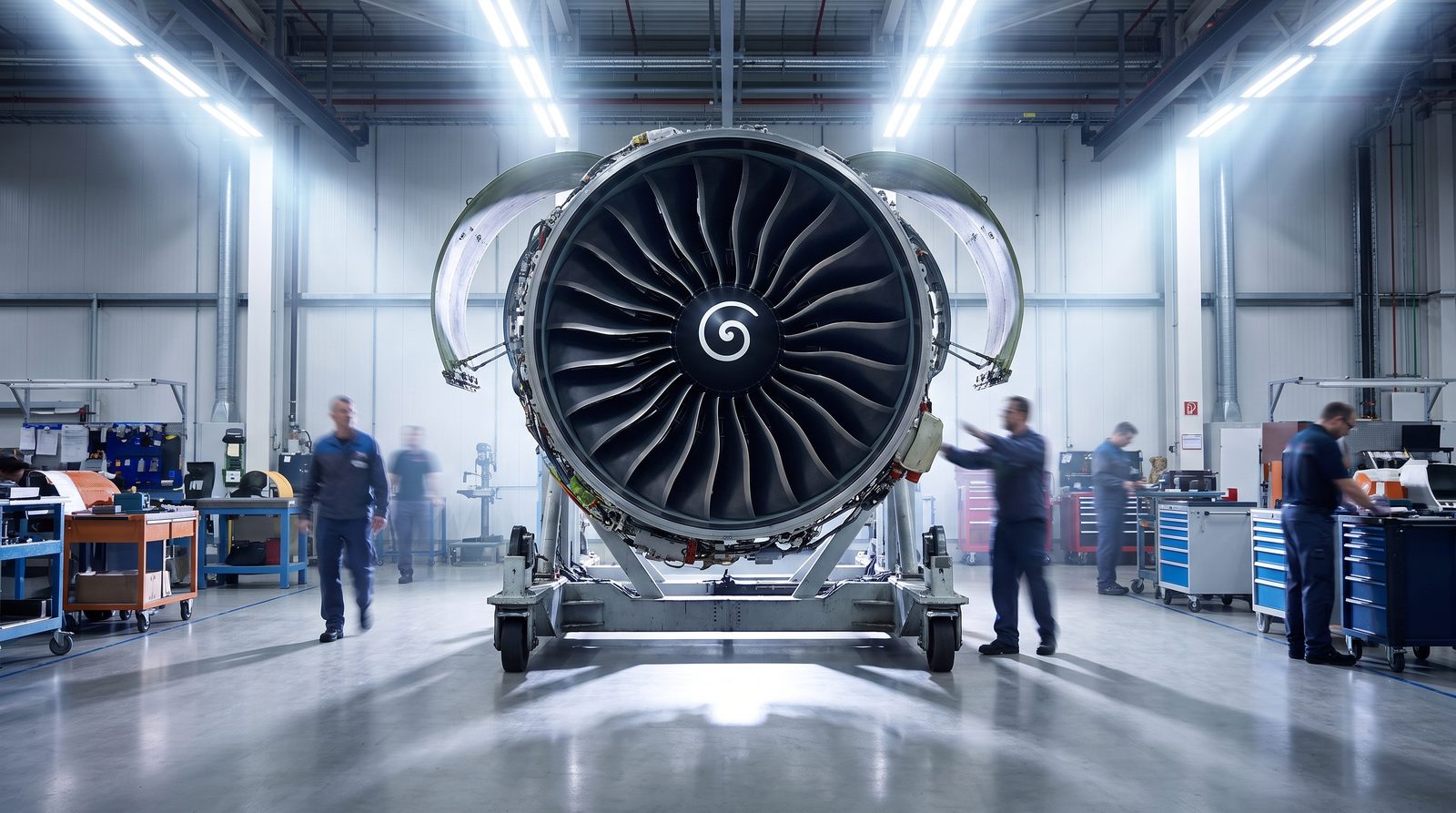
GE Aerospace has begun rolling out AI-assisted borescope inspection templates that cut GEnx engine blade inspection time roughly in half, according to Simple Flying’s October 2, 2026, report on the manufacturer’s latest MRO tooling.
Developed with Waygate Technologies, the new Menu Directed Inspection templates target the GEnx-1B on the Boeing 787 and the GEnx-2B on the Boeing 747-8. Simple Flying said automated and manual 3D measurements—including line, area and profile—help technicians inspect high-pressure turbine blades with AI-assisted image overlays, finishing blade inspections in about 1.5 hours versus roughly three hours previously.
Image and video quality is described as higher than prior software, with results stored in real time through Waygate’s InspectionWorks Insight Cloud. GE and Waygate position the templates as relatively easy for technicians to learn, extending a line of AI inspection tools that began with the Advanced Blade Inspection Tool GE first fielded for the GEnx in 2023 and later adapted for the CFM LEAP and GE9X.
The GEnx remains GE’s volume commercial widebody engine outside the CFM joint venture. Simple Flying noted that the GEnx powers about two-thirds of 787s in service and more than 80 percent of the remaining backlog, a share built as Rolls-Royce’s Trent 1000 faced durability issues. Cutting shop-visit inspection time without modifying engine hardware is meant to protect that installed base’s maintenance economics for airlines and lessors.
Competitors are pursuing similar AI-assisted inspection software at Pratt & Whitney and Rolls-Royce. GE’s pitch is that software overlays and cloud storage deliver measurable wrench-time savings while its core turbofan reliability story—GEnx versus Trent 1000, LEAP versus PW1100G—continues to drive orders on widebody and narrowbody programs alike.
Simple Flying framed the templates as first announced in April 2026 and now entering wider use. The October 2 article does not claim a change to engine thrust ratings or hardware; the story is MRO process, not a new GEnx variant. Airlines and MRO shops should treat the 1.5-versus-3-hour blade inspection comparison as the manufacturer’s stated template performance rather than a guarantee for every shop visit or every module.
Looking ahead, GE is preparing GE9X support sites as the Boeing 777X approaches service, while still earning aftermarket revenue from the GEnx on the 787 and the remaining 747-8 freighter and passenger fleets. Faster, higher-quality borescope work is one way to keep those engines attractive as Trent 1000 XE and GTF Advantage improvements try to close reliability gaps.
Independent confirmation rests on Simple Flying’s October 2 feature citing GE’s Waygate partnership and the stated inspection-time cut. No contradictory OEM denial has appeared. This desk separates the tooling story from GE’s earlier CPP acquisition coverage already on the site so readers can track MRO software and supply-chain deals as distinct threads.
For airline engineering teams, the practical takeaway is shorter GEnx blade inspection blocks and cloud-stored measurements—if the templates perform as advertised once fully deployed across their MRO network and training pipelines.











Comments
Loading comments…