


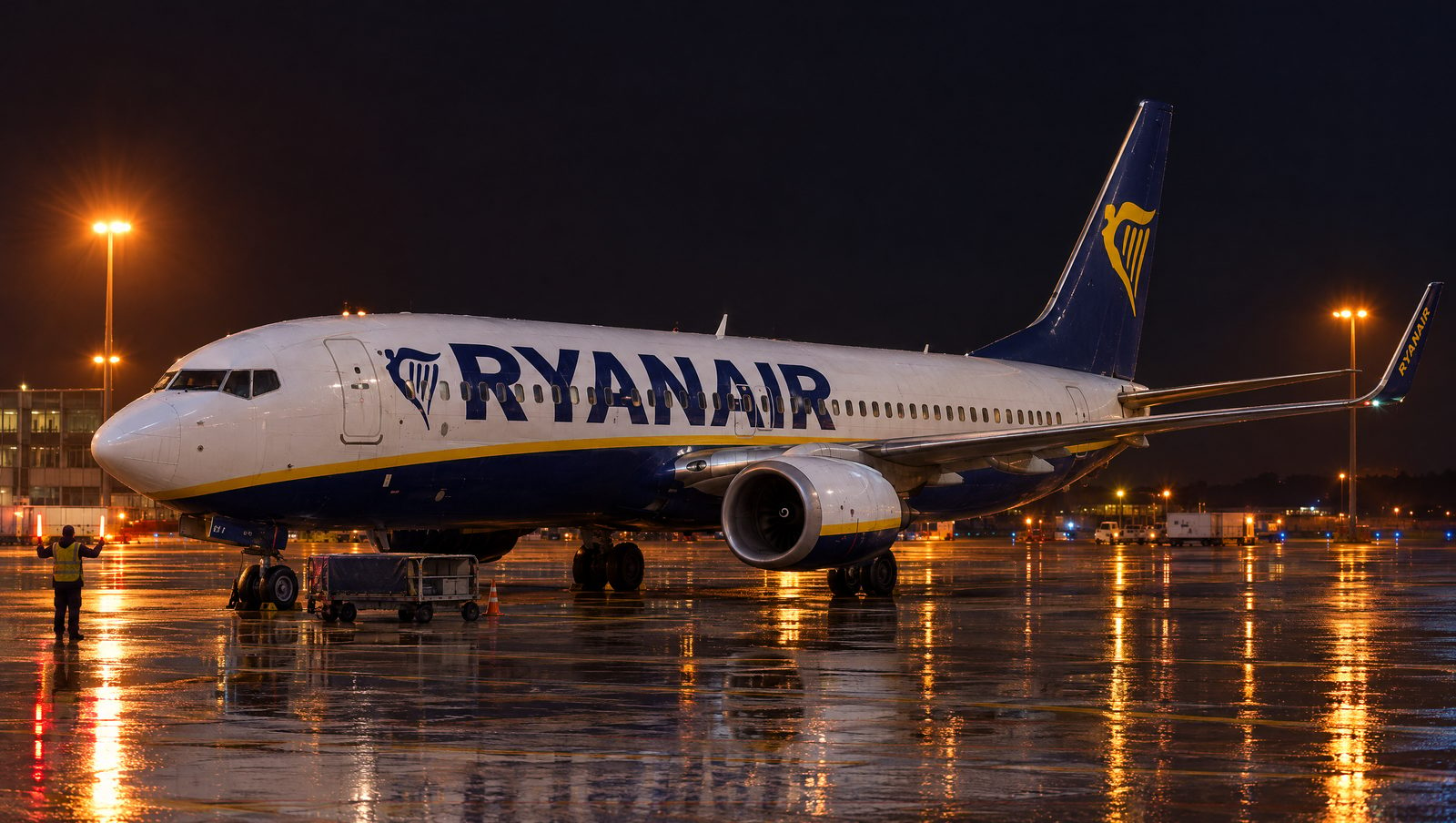
A Ryanair Boeing 737-800 was forced to declare a low-fuel emergency and divert to an alternate airport on the evening of July 6 after an unrelated emergency landing shut the only runway at its destination in western France.
The aircraft was operating flight FR5448 from Seville (SVQ) in southern Spain to Nantes-Atlantique Airport (NTE). After departing Seville at around 5:35 PM, the jet was on final approach to Nantes just after 7:00 PM local time when it was ordered to abandon the landing. Nantes has only a single runway available for commercial traffic, and moments earlier that runway had been blocked by another aircraft in distress.
The disruption was triggered by Iberia Regional flight IB1222, a CRJ-1000 regional jet, which experienced an engine problem during its own departure. According to reporting on the incident, one engine was shut down after suffering damage from foreign object debris believed to have come from a tire that burst on takeoff, scattering debris across the runway surface and forcing the smaller jet into an emergency return.
With the runway closed and debris on the pavement, the Ryanair crew had no option to land at Nantes. Running lower on fuel than planned after the go-around and holding, the pilots squawked 7700 — the transponder code that signals a general emergency to air traffic control — and set course roughly 150 miles north-west toward Brest Bretagne Airport (BES). Controllers prioritized the flight, and the 737 landed safely at Brest without further incident.
Declaring a fuel emergency is a formal step that guarantees a crew priority handling and a clear path to the nearest suitable airport. It is not the same as running out of fuel; rather, it is a precautionary measure taken when remaining reserves fall toward the minimums that regulations require an aircraft to land with. In this case the diversion unfolded as intended, with the aircraft and its passengers reaching the ground safely.
The knock-on effect of a single blocked runway illustrates how tightly the system is stretched at airports served by only one strip of usable pavement. When Nantes closed, arriving aircraft had nowhere local to go, and crews already committed to the approach had to reach for their diversion plans. The runway at Nantes was reopened roughly four hours after the Iberia jet's rough landing, with normal traffic resuming later that night.
The Boeing 737-800 remains the backbone of Ryanair's fleet, and the carrier operates one of the largest 737 operations in the world across its European network. Events like this, while dramatic in the moment, are examples of standard emergency procedures working as designed: a crew recognizing a developing situation, communicating it clearly, and diverting to a safe alternate well before fuel became critical.
Sources: Simple Flying, AirLive. Featured image: AI-generated by AviationShop. By Elena Vargas.



Comments
Loading comments…