


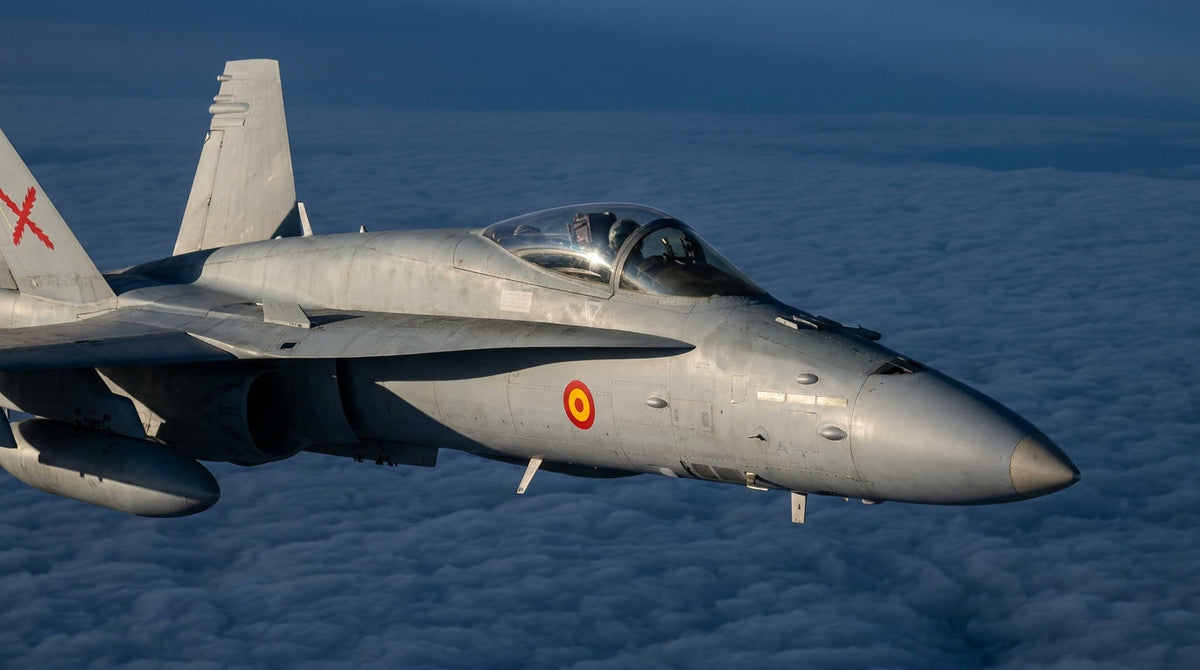
A Spanish Air and Space Force F/A-18 Hornet shot down a drone over southeastern Romania in the early hours of 16 August 2026, the fourth unmanned aircraft destroyed over Romanian territory this year.
The Romanian Ministry of National Defense said its surveillance systems detected an aerial target entering national airspace at 04:44 local time from the direction of the Republic of Moldova, around 24 kilometres (15 miles) north of Galati. An F/A-18 Hornet assigned to air policing duty at the 57th Air Base at Mihail Kogalniceanu was already airborne on a monitoring mission, established radar contact and received approval to engage. The drone was destroyed at 05:01, 17 minutes after detection.
A probable debris impact point was identified between the villages of Baleni and Cudalbi in Galati County, in an unpopulated area. The air alert for the county was lifted at 05:20. No injuries or damage were reported, and the ministry did not identify the drone's type or operator.
An approach route through Moldova
Notably, the target did not cross directly from Ukraine, despite Romania's 614-kilometre (382-mile) land border with the country. It arrived over Moldova, which is not a NATO member, fields no fighter aircraft and takes part in no allied air policing arrangement.
Moldovan airspace has been penetrated repeatedly during August 2026. A drone exploded near Crocmaz in the Stefan Voda district on 9 August, prompting Chisinau to recall its ambassador from Moscow. The following night, Moldova's Air Operations Service tracked an aircraft crossing over Priozerne for about a minute and assessed its characteristics as consistent with a Geran-3, the jet-powered Shahed variant now common in Russian strike packages against Odesa.
For air traffic managers, that geography is the operationally significant part. A track that transits a non-NATO gap before entering allied airspace compresses the time available for detection, identification and an intercept decision, which is why the 17-minute window between detection and engagement is the number worth noting in this case.
Spanish Hornets two weeks into the rotation
Spain took over the mission from Italian and British detachments at a ceremony at the 86th Air Base in Borcea on 31 July 2026. The contingent operates seven F/A-18M Hornets and around 200 personnel from Mihail Kogalniceanu, supported by an A400M tanker, with three NH-90 helicopters assigned to counter-drone tasks due in the final phase of the deployment.
The rotation runs to the end of November 2026. It is Spain's fourth deployment to Romania, following tours in 2021, 2024 and February 2026, and the detachment flew its first live Alpha scramble on 12 August 2026 — four days before this engagement.
A pattern along the eastern flank
Romanian F-16 pilots shot down three drones on three consecutive days between 24 and 26 July 2026, the first such engagements inside national airspace. Taken together with the 16 August intercept, that makes four unmanned aircraft destroyed over Romania so far this year.
The practical consequence for civil operations is the alerting cycle rather than the intercepts themselves. County-level air alerts, temporary airspace restrictions and short-notice reroutings around the northern Black Sea have become a routine planning factor for crews and dispatchers working the region, and the Galati alert on 16 August was lifted 19 minutes after the drone was destroyed.
Sources: AeroTime. Featured image: AI-generated by AviationShop. By Marco Bianchi.












Comments
Loading comments…