


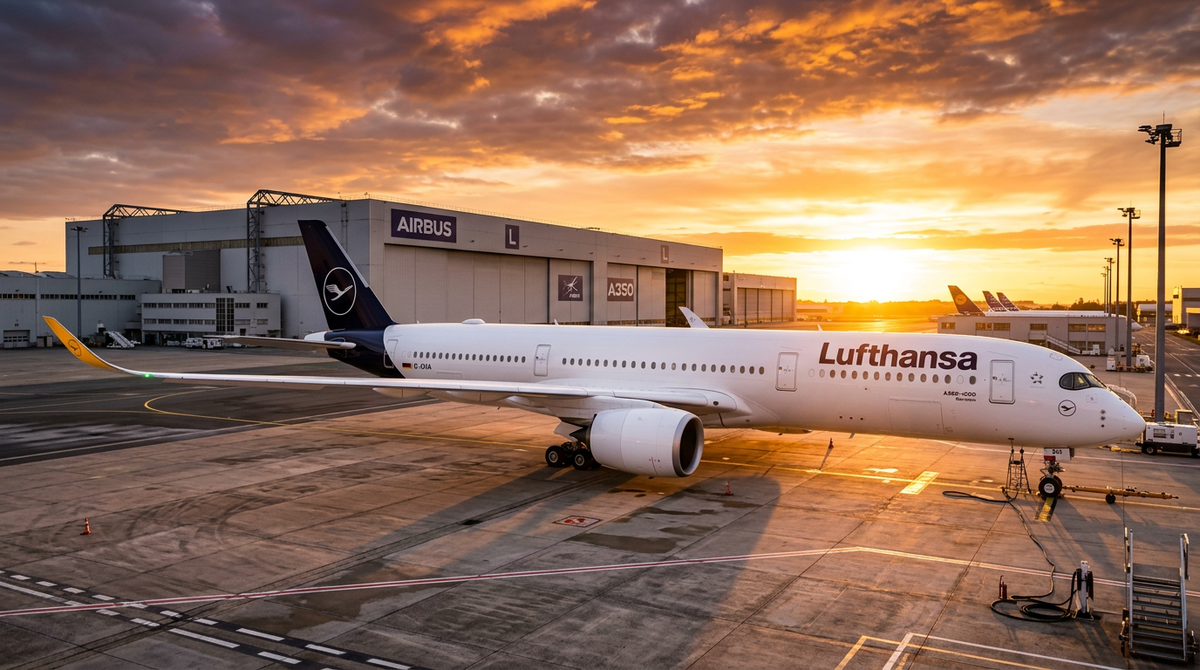
Airbus has quietly told a number of its A350 customers that delivery delays will now stretch all the way into 2030, dragging the program's recovery timeline far beyond what was forecast just a year ago. The warning, attributed to Airbus commercial aircraft chief Christian Scherer, lands on top of a delivery rate that is already running 35% below plan and turns what had been a one-off supply chain hiccup into a structural problem for half of the world's widebody fleet planners.
Lufthansa First A350-1000 Pushed To 2027
The single most visible casualty is launch customer Lufthansa. The German flag carrier's first Airbus A350-1000 — originally scheduled for delivery in 2025 as the centerpiece of its premium Allegris cabin rollout — is now expected in 2027, with the remaining 14 frames of the 15-unit order stretched across 2028, 2029 and 2030. That is up to a five-year slip on a fleet renewal program Lufthansa had built its long-haul product strategy around.
Spirit AeroSystems Tooling Crisis At The Center
Airbus has placed the blame squarely on the former Spirit AeroSystems facilities in Wichita, Kinston and Subang, which the European manufacturer took control of as part of its Spirit acquisition. After internal audits, Airbus concluded that the prior owner had under-invested in tooling, jigs and supporting infrastructure for years, and that a higher-than-expected number of experienced staff have left during the transition. Fuselage components and other major Spirit-built structures are now the binding constraint on A350 output.
The Numbers Tell A Hard Story
Through the first five months of 2026, Airbus delivered just 15 A350s — an average of 3.75 aircraft per month versus the nominal program rate of six. At the current run-rate, the manufacturer will fall well short of its 2026 widebody guidance and continue to lag the Boeing 787 in monthly output for at least another year.
Why It Matters
For carriers like Lufthansa, Qantas, JAL and IAG that have built network strategies around Airbus's next-generation widebody, the new timeline forces difficult trade-offs: extending leases on aging A340s and 747s, redeploying existing A350-900s to A350-1000 routes, or accepting capacity gaps on key long-haul markets. With Boeing 777X entry into service also slipping into 2027, the global widebody bottleneck just got significantly tighter.
Compiled from publicly available aviation news sources. Featured image: AI-generated by AviationShop. This article is original editorial content; facts have been verified across multiple public sources.















Comments
Loading comments…