


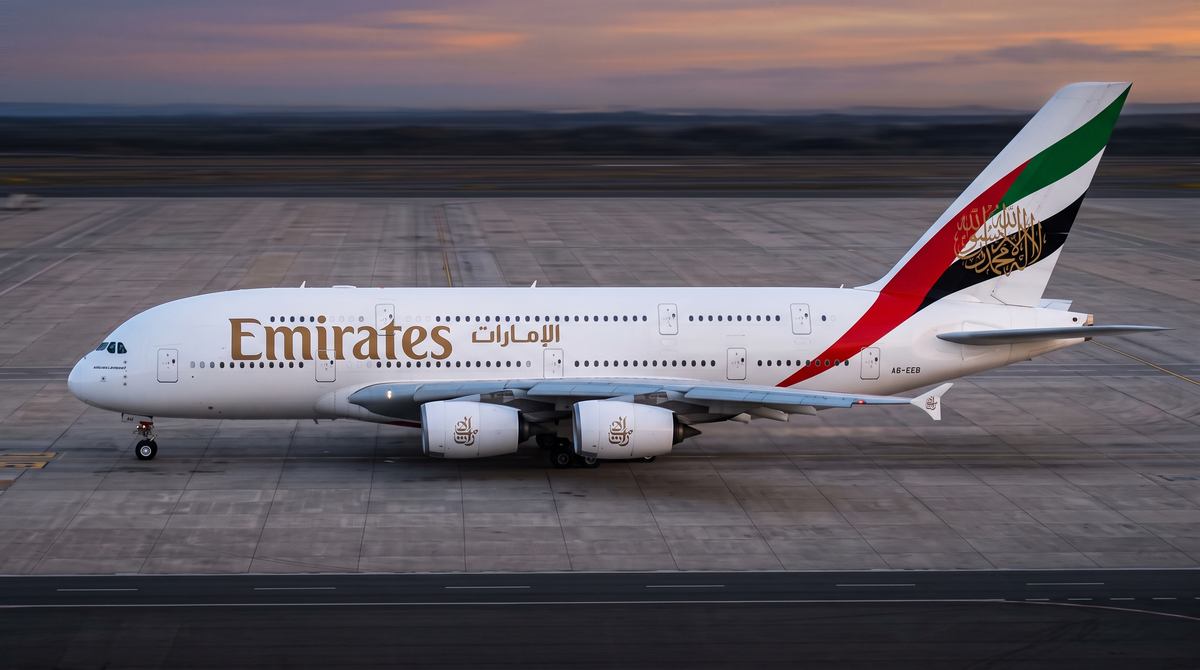
Emirates has confirmed that its Airbus A380 will not operate to five major destinations during August, extending a run of superjumbo cutbacks that has reshaped the airline's network through the summer. According to Simple Flying, the carrier will not fly the A380 from Dubai International Airport (DXB) to Glasgow, Hong Kong, Osaka Kansai, Perth or Prague in what is one of the busiest months of the year.
For most of those markets, August had been the month the double-decker was due back. That return has now been postponed again, with the airline pointing to the operational fallout from regional airspace disruption in the Middle East alongside its long-running A380 refurbishment programme, which keeps a portion of the fleet out of service at any given time.
A Network In Constant Motion
The five affected routes span four continents, which is precisely what makes the change awkward for passengers. Glasgow and Prague are European leisure and visiting-friends-and-relatives markets where the A380's sheer seat count does useful work in peak season. Hong Kong and Osaka Kansai are premium-heavy Asian business markets. Perth is a long, thin sector where the aircraft's range and cabin comfort have been part of the selling proposition.
Emirates has not withdrawn from any of these cities. The flights continue — they simply operate with a smaller aircraft, most commonly a Boeing 777, which typically means fewer seats and, on some services, a different premium cabin product than the one passengers booked expecting.
Why The Superjumbo Keeps Moving
Emirates remains by far the largest A380 operator in the world, and its fleet decisions ripple across the entire type's remaining service life. The airline has been progressively cycling aircraft through a major cabin retrofit programme, and each jet that goes into the shop is one that cannot be assigned to a route. Add the airspace and routing complications that have affected Gulf carriers this year, and the schedule becomes a moving target.
The current plan, per Simple Flying, is for the five markets to see the A380 return from September 1. Given how often the relaunch date has already slipped, seasoned Emirates watchers will treat that as a target rather than a promise.
What It Means For Passengers
Anyone holding an August booking on these routes who specifically chose Emirates for the A380 experience — the onboard lounge, the shower spa in first class, the quieter upper-deck cabin — should check what aircraft is now scheduled on their flight. Equipment swaps of this size usually trigger seat reassignments, and premium cabin configurations differ meaningfully between the A380 and the 777.
The wider signal is more interesting than the individual cancellations. Emirates has spent years insisting the A380 remains central to its strategy, and it is investing heavily in refurbishing the fleet to keep it flying into the 2030s. But the aircraft's availability is now shaped by a maintenance and retrofit pipeline that leaves less slack than the airline once enjoyed — and when something has to give, it is the schedule that moves.
Sources: Simple Flying, AeroRoutes. Featured image: AI-generated by AviationShop. By Elena Vargas.















Comments
Loading comments…