


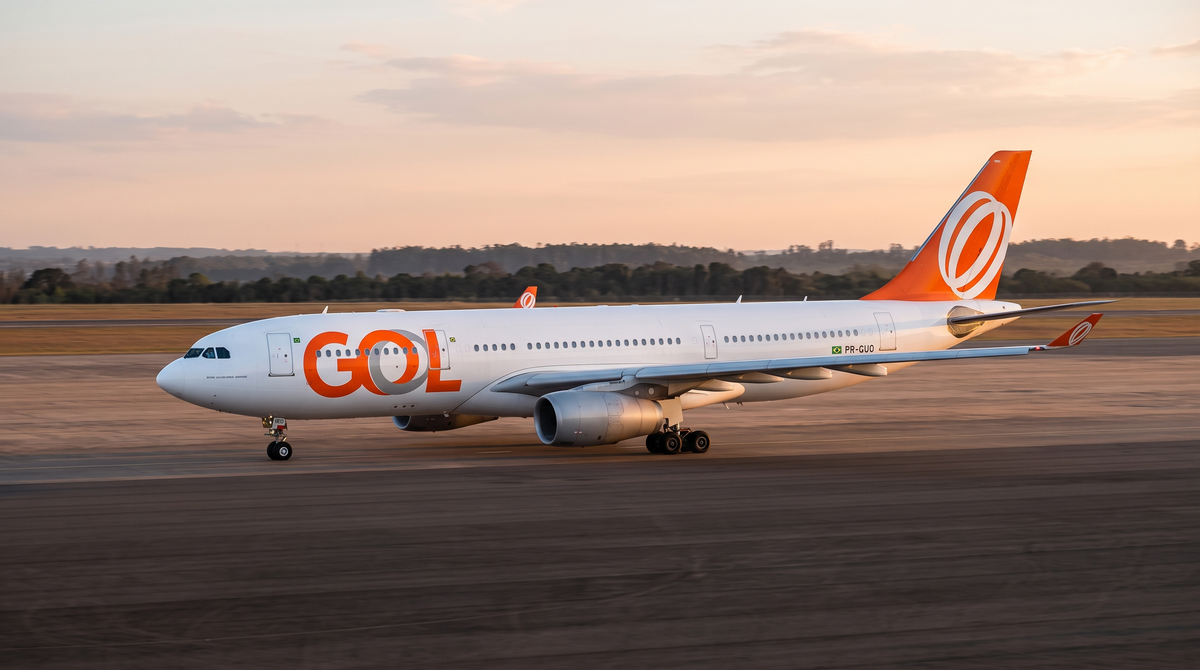
Brazilian low-cost carrier GOL Linhas Aéreas Inteligentes has completed the first long-haul flight in its history, opening a nonstop link between Rio de Janeiro and New York and pushing a carrier built entirely around the Boeing 737 into widebody territory for the first time.
Flight G37000 departed Rio de Janeiro-Galeão (GIG) on July 8, 2026 at 22:15, arriving at New York's John F. Kennedy International Airport the following morning at 06:53, local times throughout. The inaugural was completed on July 9, 2026.
A GOL flight number on someone else's aircraft
The detail that makes this launch unusual is what actually flew it. Although the service carried a GOL code, the inaugural was operated by Spanish carrier Wamos Air, which deployed an Airbus A330-200 registered EC-NBN and fitted with 280 seats for the rotation.
Wamos Air — like GOL — is part of the Abra Group, and it is providing capacity from its own fleet under an ACMI arrangement. In plain terms, GOL sells the seats and puts its name on the flight while Wamos supplies the aircraft, crew, maintenance and insurance. It is a stopgap, and an explicitly temporary one: it bridges the gap until GOL takes delivery of the five Airbus A330-900neos it has on order.
Those A330neos are part of a larger Abra Group order for seven aircraft, with delivery expected within the next couple of years. The remaining two are earmarked for Avianca, another carrier inside the group.
Why this matters for a 737 airline
Until now GOL flew only within Brazil and around South America, using an all-Boeing 737 fleet. That is a perfectly good business, and the 737 is a superb tool for it — but it is a narrowbody, and a narrowbody sets a hard ceiling on how far and how profitably you can fly.
The step to a twin-aisle A330 changes the arithmetic entirely. It brings the range to reach North America nonstop, the cabin volume to carry a meaningful premium load, and the belly capacity to move cargo on a route where freight economics are genuinely lucrative. For an airline whose network has been bounded by the 737's legs, that is a structural shift rather than a cosmetic one.
Rio's flagship route
The new service also says something about airports. Rio de Janeiro-Galeão has long been overshadowed by São Paulo's Guarulhos as Brazil's international gateway. A nonstop to JFK gives Galeão a flagship long-haul service of its own, and it plants GOL directly on one of South America's most contested corridors, where it will compete against established operators on the Brazil–New York market.
GOL plans to operate the Rio–New York rotation three times weekly. Lisbon is confirmed as the next long-haul destination in the plan, again in collaboration with Wamos, from September 16, 2026 — which suggests the airline sees the ACMI arrangement not as an embarrassment to be hidden but as a deliberate ramp: build the network first, slot the owned A330neos in behind it.
The pragmatic route to widebody flying
There is a temptation to be sniffy about launching a "first long-haul route" on a leased aircraft in someone else's colours. It is worth resisting. Standing up a widebody operation from scratch — crews, training, maintenance programmes, ETOPS approvals, spares — is genuinely hard and genuinely slow, and the aircraft themselves are years out.
Wet-leasing lets GOL establish the route, build the booking curve and learn the market now rather than in 2028. When its own A330-900neos arrive, they will slot into a route that already exists and already has a customer base. That is the pragmatic path, and it is one an increasing number of ambitious mid-size carriers have taken.
Sources: AeroTime, GOL. Featured image: AI-generated by AviationShop. By Elena Vargas.








Comments
Loading comments…