


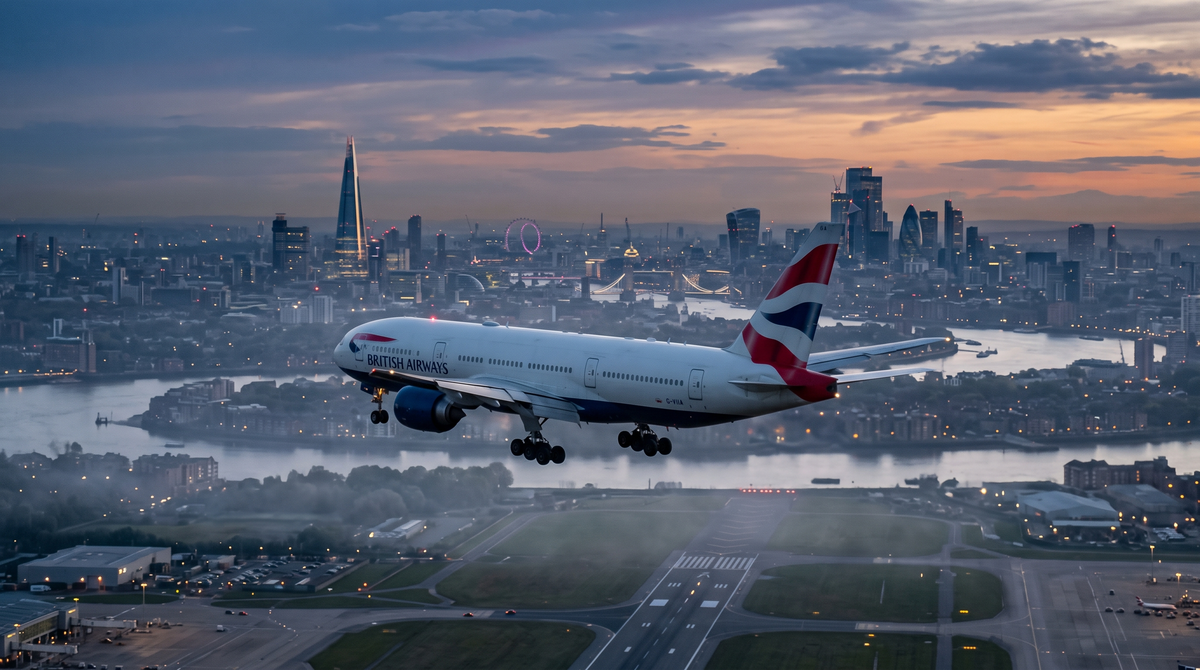
British Airways has had to turn two United States-bound Boeing 777-200s back to London Heathrow on consecutive days, an unusual back-to-back sequence that left one transatlantic service cancelled outright and passengers scrambling for rebookings.
The second and more widely tracked of the two events involved flight BA183, bound for New York's John F. Kennedy International Airport. The aircraft, a Boeing 777-200ER registered G-RAES, departed Heathrow at 8:30 PM on Friday, July 10, 2026. Flight tracking data showed an unusual profile almost immediately: rather than continuing a normal transatlantic climb, the aircraft stopped its initial climb at 20,000 feet.
The crew later adjusted altitude to 25,000 feet before declaring a technical issue and initiating a turnaround while flying over the Irish Sea. The 777 landed safely back at Heathrow roughly two hours after it had departed. British Airways subsequently cancelled the flight.
A near-identical event 24 hours earlier
What makes the BA183 turnback notable is that it came almost exactly 24 hours after a strikingly similar event. On Thursday, July 9, British Airways flight BA229 — also a Boeing 777-200, bound for Baltimore/Washington International — aborted its Atlantic crossing and returned to Heathrow under comparable circumstances, with the crew electing not to press on across the ocean after encountering a technical problem while west of Ireland.
British Airways has not said whether the technical issues affecting the two flights were related. Both aircraft are part of the airline's long-haul widebody fleet. No injuries were reported in either event, and both aircraft landed routinely.
Why crews turn back rather than continue
To an outside observer a turnback can look dramatic, but the decision-making behind it is deliberately conservative and entirely routine in airline operations. A transatlantic crossing takes an aircraft hundreds of miles from any suitable diversion airport for a sustained period. If a system has degraded — even one with redundancy built in — the calculus changes: a defect that is merely inconvenient within range of Heathrow can become operationally limiting in the middle of the North Atlantic.
That is why the geography of both events matters. In each case the aircraft was still close to Ireland, with Heathrow and a full engineering base comfortably within reach. Turning back at that point is the cheap option. Continuing, and then needing to divert to a remote airfield with no British Airways engineering presence, no spare parts and no easy way to move a few hundred passengers onward, is the expensive one.
The airframes at the centre of it
The Boeing 777-200ER has been a backbone of British Airways' long-haul network for decades, and the type remains central to the airline's US flying. G-RAES, the aircraft involved in the BA183 turnback, is one of the more recognisable frames in the fleet among enthusiasts.
Widebodies of this generation are heavily instrumented and carry layers of redundancy, which is precisely why a single reported technical issue rarely means anything approaching danger. It does, however, mean paperwork, engineering inspections and — as BA183's passengers discovered — a cancelled flight, because an aircraft that returns with an unresolved defect cannot simply be turned around and dispatched again.
Coincidence or pattern?
Two turnbacks on the same route group, on the same aircraft type, on consecutive days invites the obvious question. So far there is no basis for treating it as anything more than coincidence: British Airways has not indicated that the defects share a cause, and no regulator has publicly linked them.
Airlines of British Airways' size operate an enormous number of long-haul departures every week, and technical turnbacks are a normal, if infrequent, part of that volume. Clustering happens. What draws attention here is simply the timing — and the fact that both aircraft were the same type, heading the same way, and made the same call over the same stretch of water.
Sources: Simple Flying, AIRLIVE. Featured image: AI-generated by AviationShop. By James Holloway.






Comments
Loading comments…