


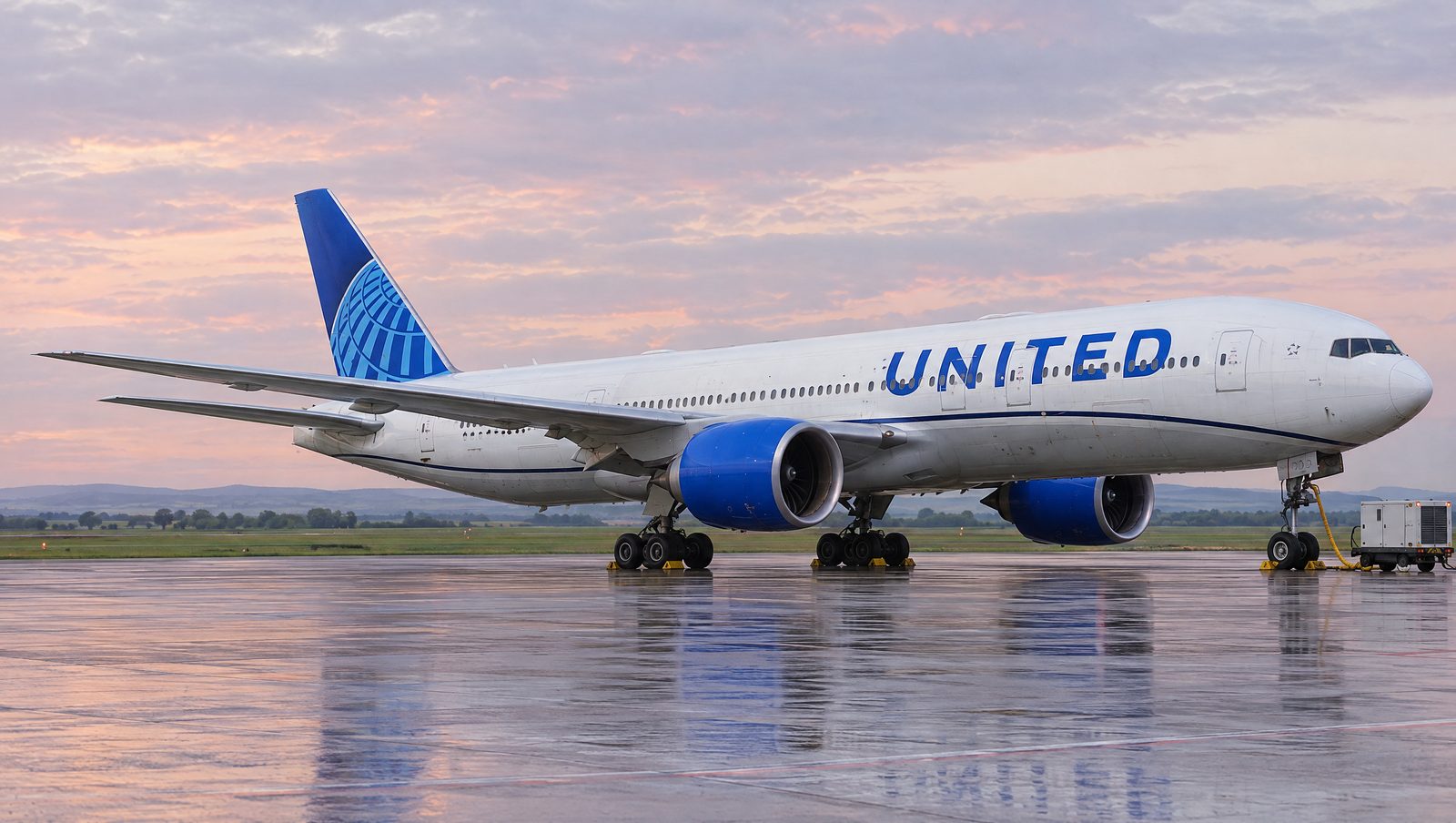
A United Airlines Boeing 767-400ER diverted to Shannon Airport in Ireland on July 11, 2026 after the crew reported a vibration in the right engine and a smell in the cabin, cutting short an Atlantic crossing well before the aircraft reached the point of no return.
According to accounts of the event, the pilot reported the vibration in the right engine and the crew advised air traffic controllers that there was a smell in the cabin. At the time the aircraft was roughly 400 kilometres south of Ireland and around 550 kilometres from Shannon when the crew alerted controllers to the problem and requested clearance to divert.
The 767 landed safely at 15:57 and was followed along the runway by airport fire and rescue vehicles — a standard precaution whenever a crew reports an engine anomaly or an unidentified smell, not an indication that anything was burning.
Why Shannon, specifically
Shannon's role here is not incidental. The airport sits on Ireland's west coast at the eastern edge of the North Atlantic track system, and it has served for decades as the natural first-available diversion field for aircraft heading west that develop a problem early, and the natural last-available one for aircraft heading east.
It has a long runway, full emergency cover, and — crucially — the ability to handle a widebody full of passengers without the whole operation collapsing. For a crew several hundred kilometres out over water with an engine behaving oddly, Shannon is very often the obvious answer, and it is the reason the airport appears in aviation incident reports far more often than its passenger numbers alone would suggest.
Vibration and smell: what crews are actually reacting to
An engine vibration indication and a cabin smell are two symptoms that, individually, are usually minor — and that together justify a conservative decision.
Modern turbofans are monitored continuously for vibration, and a rising indication can point to anything from a minor fan imbalance to something requiring real inspection. A smell in the cabin, meanwhile, can have entirely mundane causes, but because cabin air on this generation of aircraft is bled from the engines, an engine anomaly and a cabin odour reported at the same time are a combination crews are trained to take seriously rather than reason away.
Neither symptom, on its own, means an engine is failing. But at 400 kilometres from land with the whole Atlantic ahead, the calculus is not "is this survivable?" — it is "do I want to find out over the ocean, or over Ireland?" Crews answer that question the same way every time.
The 767-400ER, the rare one
The aircraft involved is a Boeing 767-400ER, the stretched and least common member of the 767 family. Only a modest number were ever built, and United operates one of the two significant fleets of the variant, using them primarily on transatlantic routes where a 767's capacity is right but a 777's is too much.
The type is easy to pick out on the ramp: it is noticeably longer than the more familiar 767-300ER, and it carries raked wingtips rather than the winglets retrofitted to many earlier 767s. For enthusiasts, it is one of the more satisfying spots at a European gate precisely because there are so few of them left flying.
A routine outcome
The aircraft landed safely, the fire service met it as procedure requires, and the event ended without injury. What it produces is an engineering inspection, a delayed set of passengers and a maintenance write-up — which is exactly what the system is designed to produce when a crew notices something early and acts on it.
Sources: AVHerald, Simple Flying. Featured image: AI-generated by AviationShop. By Marco Bianchi.










Comments
Loading comments…