


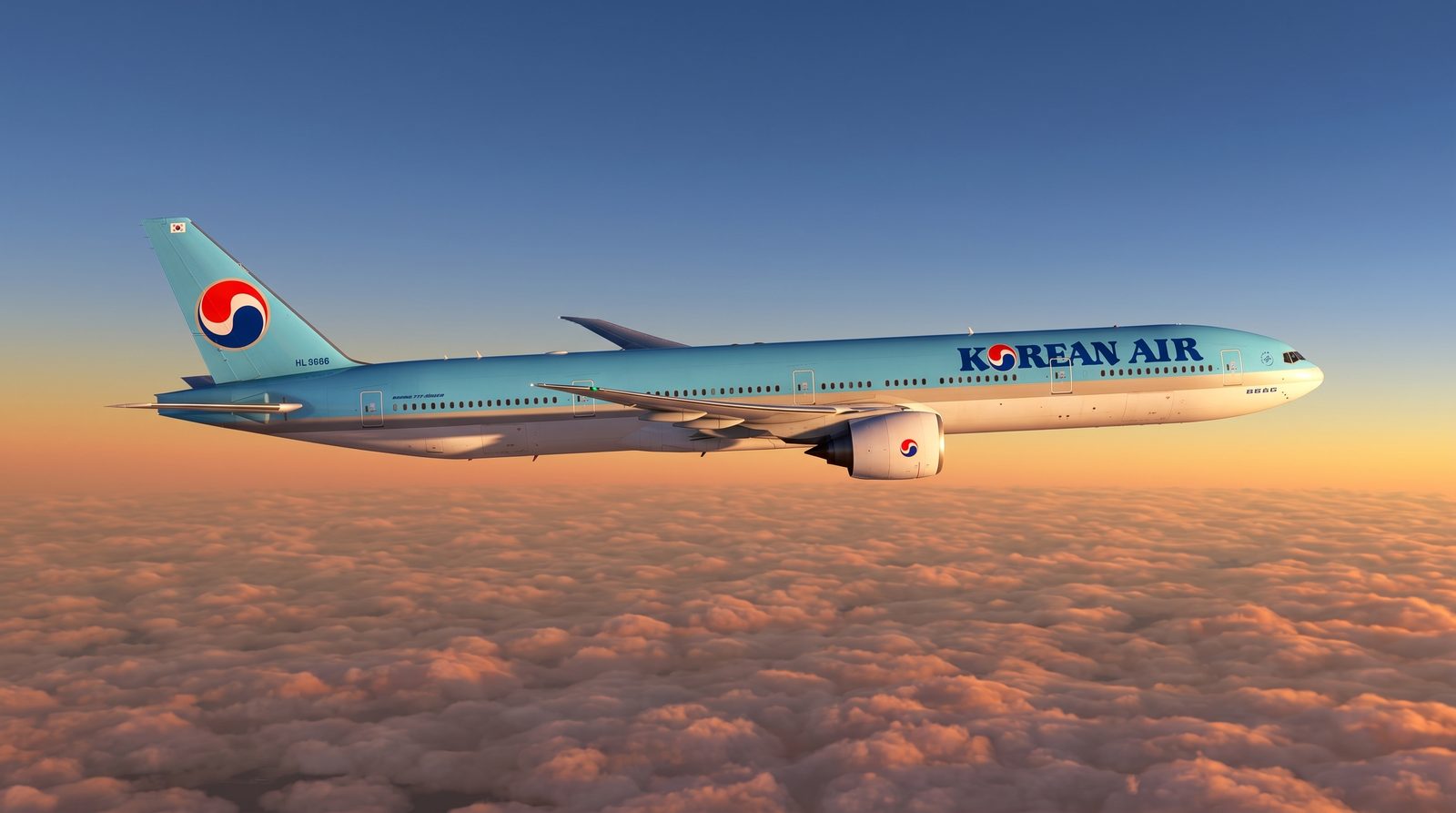
Korean Air has signed its largest aircraft order. Simple Flying and FlightGlobal reported that on 16 September 2026 in Seoul the carrier finalized a 103-aircraft Boeing deal valued at about $44.6 billion at list prices, converting an August 2025 intent-to-order into firm metal across passenger and freighter types.
The passenger split is 20 Boeing 777-9s, 25 Boeing 787-10s, and 50 Boeing 737 MAX 10s—95 passenger jets in total. The remaining eight aircraft are Boeing 777-8F freighters. Boeing called the package its largest-ever widebody commitment from an Asian airline; Korean Air said the deal expands its widebody fleet by roughly 46% and nearly doubles narrowbody count as Asiana Airlines integration continues.
Chairman and CEO Walter Cho tied the buy to fleet modernization, fuel burn, and passenger experience across the global network. The new 777-9s lift Korean Air’s total 777-9 order book to 40 airframes once prior commitments are included, positioning the type as a long-haul flagship after certification—currently discussed for early 2027 in the same reporting. The 787-10s are framed for high-demand medium-haul Asia missions where a full 777X is unnecessary.
On the narrowbody side, 50 MAX 10s sit beside Korean Air’s existing 737 family mix (737-800/-900/-900ER and MAX 8 per planespotters.net figures cited by Simple Flying). MAX 10 certification timing is likewise described as early 2027 in that coverage, so delivery cadence still depends on Boeing’s certificate calendar.
Cargo is not an afterthought: eight 777-8Fs add long-haul freighter lift with an advertised structural payload gain of about 11 tonnes versus today’s 777F at a 5,000 nm range in Boeing’s comparison language relayed by Simple Flying. Korean Air already flies a large 777F fleet and still operates 747 freighters; it also holds seven Airbus A350F freighter orders, so the Boeing freighters expand—not monopolize—the cargo roadmap.
Replacement pressure is explicit. Korean Air still operates passenger 747-400 and 747-8 jets and a smaller A380 fleet (with Asiana A380s in the merger perimeter). Management has previously pointed to 747 passenger exits into the early 2030s as next-generation widebodies arrive. None of that retires a specific tail tomorrow; it explains why 103 firm Boeings showed up in a trade-and-fleet package now.
Until Boeing and Korean Air publish delivery-year tables by subtype, treat 103 and $44.6 billion as the signed headline, not a month-by-month inductions chart. For competitors on Transpacific and intra-Asia routes, the signal is clear: Korean Air is stocking 777X, 787-10, MAX 10, and 777-8F capacity for a post-Asiana network.
Trade context sits behind the ceremony: reporting links the package to U.S.–Korea bilateral discussions, which helps explain why a single announcement bundled 777X, 787-10, MAX 10, and 777-8F rather than a drip of smaller campaigns. List-price $44.6 billion will not equal transaction price after escalators and discounts, but it sizes the ambition for investors and competitors.
Integration with Asiana makes the freighter and narrowbody legs of the order especially relevant. Combining cargo networks raises the value of efficient long-haul freighters, while MAX 10s give the merged short-haul system a next-gen dense single-aisle once certification clears. Delivery years will slip or bunch with Boeing’s production reality; the firm count of 103 is the commitment that landed on 16 September.
Sources: Simple Flying; FlightGlobal (15–16 Sep 2026).
Comments
Loading comments…