


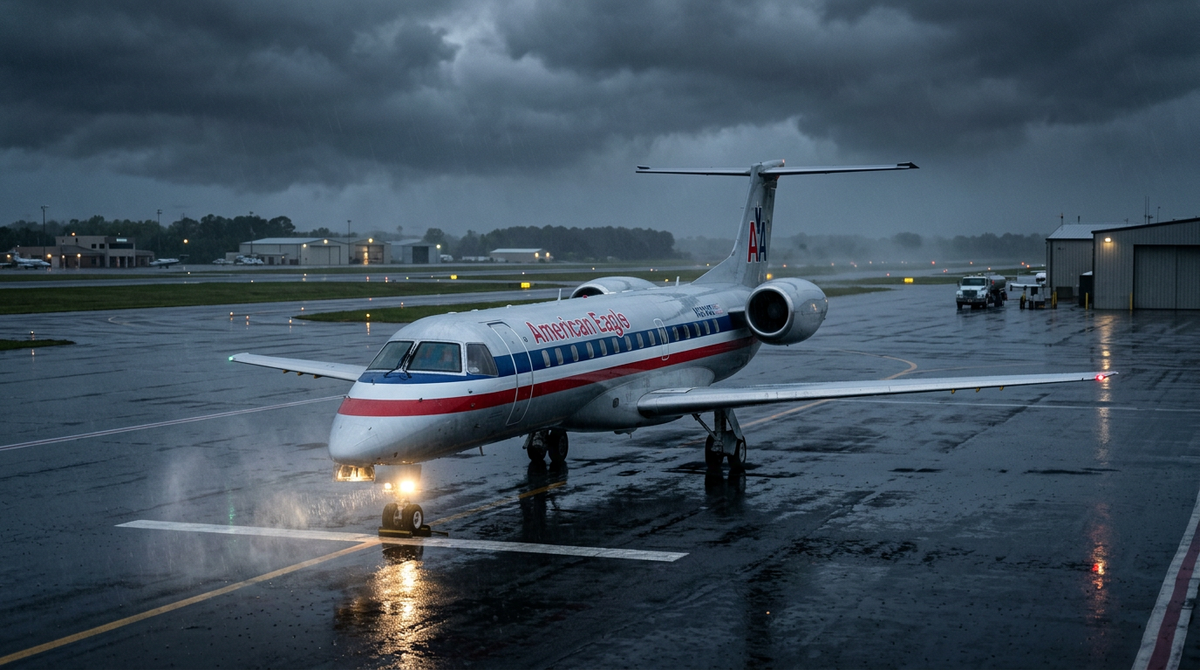
An Embraer ERJ-145LR operating Piedmont Airlines flight PDT5908 — published to passengers as American Eagle AA5908 — made an unexpected emergency diversion to Salisbury Regional Airport (SBY) on May 27, 2026, after the crew declared a cockpit emergency in cruise. The aircraft was originally scheduled to operate the Greenville-Spartanburg International Airport (GSP) to Philadelphia International Airport (PHL) leg, a routine regional rotation flown several times daily on American's hub-and-spoke network.
Flight tracking data shows the 50-seat regional jet leveling off at its assigned cruise altitude before initiating a rapid, controlled descent and turning toward Salisbury, on Maryland's Eastern Shore. SBY — a relatively small commercial field with a single 5,500-foot main runway — is not a typical diversion destination for an ERJ-145 in scheduled service, and the move points to a need to land at the nearest suitable airport rather than continue to PHL.
Piedmont Airlines, a wholly-owned American subsidiary, and American Airlines mainline coordinated emergency response and re-accommodation, with all passengers and crew confirmed safe after landing. Specific details of the cockpit emergency have not been disclosed; however, ERJ-145s have been the subject of recent industry attention over avionics reliability as the fleet ages.
The Embraer ERJ-145LR is a workhorse of regional American Eagle operations, capable of seating 50 passengers in a single-class cabin and operating short-to-medium routes that are critical feeders to American's hubs at PHL, CLT, and DCA. With production having ended over a decade ago, many of these airframes are now well past 20 years of service, and replacement plans — through new orders of larger Embraer E175s and possibly future-generation regional jets — remain a moving target on the airline's capital plan.
The incident also highlights how SBY has quietly evolved into a tactical emergency-diversion option for flights traveling along the busy New York–Washington corridor. Its runway, while shorter than what most regional and narrowbody jets prefer, is more than long enough to safely accept an ERJ-145 in distress, and the field's ATC and ARFF capabilities make it a credible Plan B for a band of airspace where Philadelphia, Baltimore, and Washington are otherwise the natural alternates.
For passengers aboard PDT5908, the diversion is the latest reminder of how rapidly a routine 90-minute hop can transform into hours of uncertainty when older regional aircraft encounter unexpected technical problems. With American Eagle averaging well over 4,000 daily flights system-wide, even a low base-rate of cockpit emergencies translates into multiple incidents per week — most of which never make headlines.
Compiled from publicly available aviation news sources. Featured image: AI-generated by AviationShop. This article is original editorial content; facts have been verified across multiple public sources.



















Comments
Loading comments…