


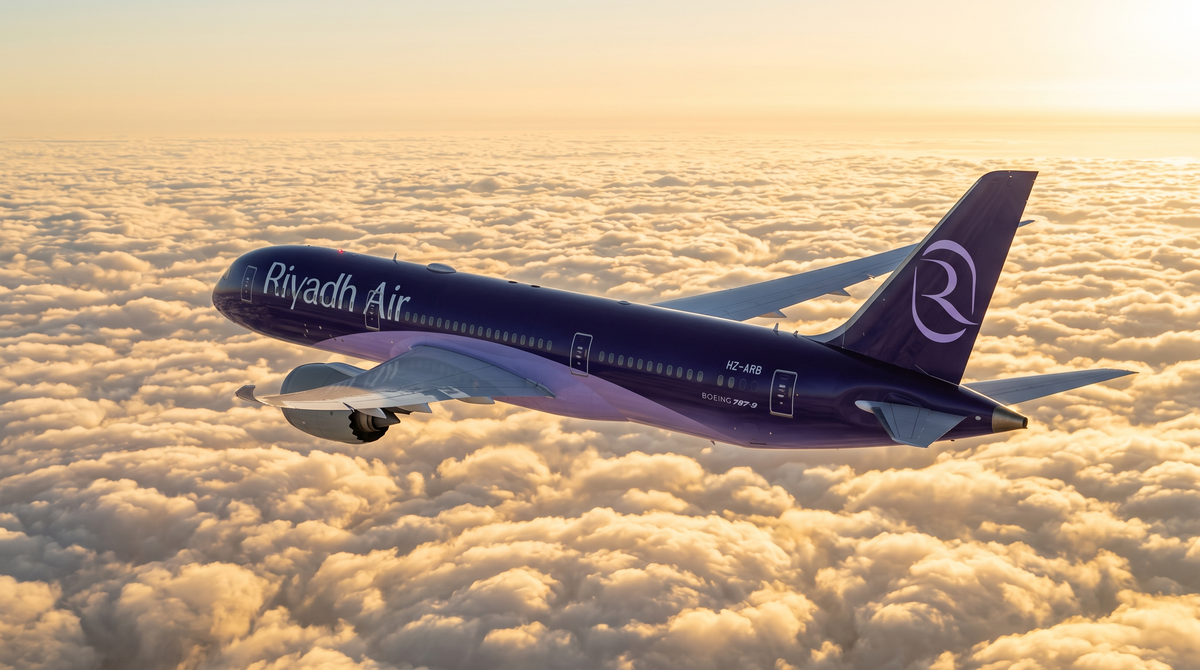
Riyadh Air has secured regulatory approval from China to launch nonstop flights to Beijing and Shanghai, opening a second major long-haul frontier for the Saudi start-up barely a month after it began commercial operations.
The Civil Aviation Administration of China (CAAC) has authorised the carrier to operate three flights a week to Beijing Daxing International Airport (PKX) and four flights a week to Shanghai Pudong International Airport (PVG). The approval clears the regulatory hurdle that stands between an airline's ambitions and an actual timetable — traffic rights in China are tightly rationed, and newcomers rarely walk in unopposed.
Two of the hardest markets to crack
Beijing and Shanghai are not casual additions to a route map. They are among the most competitive long-haul markets in the world, already served from the Gulf by deeply entrenched network carriers with years of feed, loyalty programmes and corporate contracts behind them. A three-weekly Beijing service and a four-weekly Shanghai service are a measured opening rather than a land grab — enough frequency to build a corporate and connecting base, without betting the fleet on it.
The choice of airports matters, too. Beijing Daxing is the Chinese capital's newer mega-hub, while Shanghai Pudong is the country's principal international gateway. Both are natural connecting points for onward traffic across mainland China, which is precisely the kind of network depth a start-up needs if it wants Riyadh to work as a genuine transfer hub rather than a point-to-point destination.
A fast start for a young airline
Riyadh Air began revenue service in June 2026, launching its first flight to London Heathrow with a Boeing 787-9. Chief Executive Tony Douglas said at the time that deliveries would grow the fleet to eight aircraft by the end of July and allow the airline to serve 22 destinations by March 2027.
The carrier is owned by Saudi Arabia's Public Investment Fund and was established in 2023 as the kingdom's second national airline alongside Saudia. Its stated ambition is to serve more than 100 destinations by 2030, part of a broader Saudi push to turn the country into an aviation and tourism hub rather than a place airlines merely fly over.
The aircraft doing the work
The 787-9 is the type that will fly these routes in the near term. Riyadh Air has configured its Dreamliners with 290 seats across business, premium economy and economy — a layout with enough premium capacity to chase the corporate traffic that makes Beijing and Shanghai financially viable, and enough range to link them to Riyadh comfortably.
Larger jets are coming. The airline ordered 60 Airbus A321neo-family aircraft in 2024 and signed a firm agreement for 25 Airbus A350-1000s at the Paris Air Show in June 2025, which will add capacity as its long-haul network matures.
For now, the CAAC approval gives Riyadh Air something more valuable than aircraft: permission. Slots and traffic rights are the scarce commodity in Chinese aviation, and having them in hand — three weekly to Beijing, four to Shanghai — puts the airline in a position to fly against carriers that have had a decade's head start.
Sources: Simple Flying. Featured image: AI-generated by AviationShop. By Daniel Okafor.















Comments
Loading comments…