


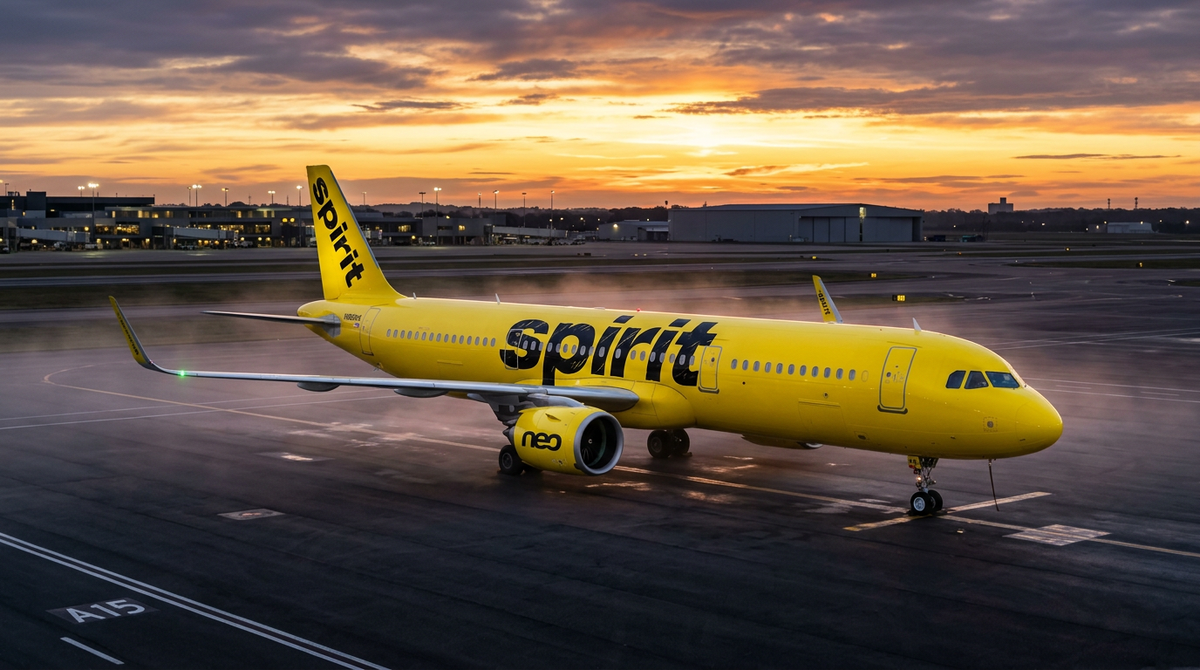
Spirit Airlines has filed an emergency motion in the U.S. Bankruptcy Court for the Southern District of New York seeking approval for a $275 million debtor-in-possession (DIP) financing package — money tied directly to the proposed $553.5 million sale of 20 Airbus A320 and A321 aircraft to lessor CSDS Asset Management. The hearing was scheduled for May 27, 2026, marking one of the most pivotal moments of the carrier's bankruptcy proceedings.
The financing structure is unusual because the DIP loan and the aircraft sale are functionally linked: proceeds from the sale will repay senior obligations, while the DIP package gives Spirit's parent, Spirit Aviation Holdings, Inc., the working capital needed to manage an orderly wind-down following the cessation of all passenger operations on May 2, 2026 — a day that ended 33 years of Spirit flying.
The numbers laid out in the court filings are striking. Spirit operated 114 Airbus A320 family aircraft on the petition date: 66 held under lease arrangements and 28 owned outright by the carrier, with another batch of 20 jets — those involved in the CSDS deal — already greenlit for sale in a separate motion last month. Combined, these movements represent the largest single narrowbody portfolio shake-up in recent U.S. aviation history.
Spirit told the court that 'a massive and sustained increase in fuel prices' driven by recent geopolitical events had triggered a rapid liquidity collapse. The airline incurred nearly $100 million in incremental fuel costs between March 1 and April 30 alone — a figure that proved catastrophic for a margin-thin ultra-low-cost carrier whose business model leaves almost no buffer for sudden energy spikes.
For the wider industry, the implications are enormous. Sixty-six leased A320s are now flowing back to lessors, dozens of owned aircraft are entering the secondary market, and CSDS Asset Management is preparing to redistribute 20 modern narrowbodies — many of them only recently delivered. JetBlue, Frontier, Allegiant, and Southwest are all positioning to absorb Spirit's vacated routes, with airport slot reshuffles already underway at Fort Lauderdale, Orlando, Atlantic City, and Las Vegas. Analysts argue the bankruptcy will compress U.S. ultra-low-cost capacity by 12–15% through the end of 2026, a structural shift that could reset fare floors on dozens of leisure markets across the Americas.
The court's decision on the $275 million DIP package — and on the $553.5 million CSDS Asset Management aircraft sale — will determine the pace of the wind-down, the fate of thousands of employees, and the speed at which competitors can deploy Spirit's former fleet on their own networks.
Compiled from publicly available aviation news sources. Featured image: AI-generated by AviationShop. This article is original editorial content; facts have been verified across multiple public sources.
















Comments
Loading comments…