


For more than two decades, the fastest way to cross an ocean got slower. When Concorde flew its last commercial flight in 2003, the airline world quietly accepted a strange truth: passengers in the 21st century would travel no faster than their parents did in the 1970s. Concorde cruised at Mach 2.04, but it burned fuel ferociously, carried only about 100 passengers, and — crucially — was banned from flying supersonic over land because of its window-rattling sonic boom. The economics never closed.
Now, supersonic flight is staging a genuine comeback. Two very different aircraft sit at the center of the story: NASA's X-59, an experimental jet built to prove that a boom can be tamed into a soft "thump," and Boom Supersonic's Overture, a commercial airliner aiming to put paying passengers back above the speed of sound. Behind both, the regulatory wall that killed Concorde's overland ambitions is finally starting to move.
Why supersonic travel stalled for 50 years
The barrier was never really the airplane. It was the noise. When an aircraft flies faster than sound, it drags a cone of pressure waves behind it that reaches the ground as a sharp double-crack — the sonic boom. Concorde's boom was loud enough that, in 1973, U.S. regulators wrote a flat prohibition on civil supersonic flight over land into the rules as 14 CFR 91.817. That single regulation confined supersonic airliners to ocean routes, shrinking the map of profitable city pairs to a handful.
Add in thirsty engines, high maintenance costs, and a tiny cabin, and Concorde became a beautiful commercial dead end. For the next 50 years, "faster" was a problem nobody could make pay. The comeback now underway is built on attacking both halves of that problem at once: making the boom quiet enough to be legal over land, and making the engines and airframe efficient enough to be profitable.
NASA's X-59: turning the boom into a thump
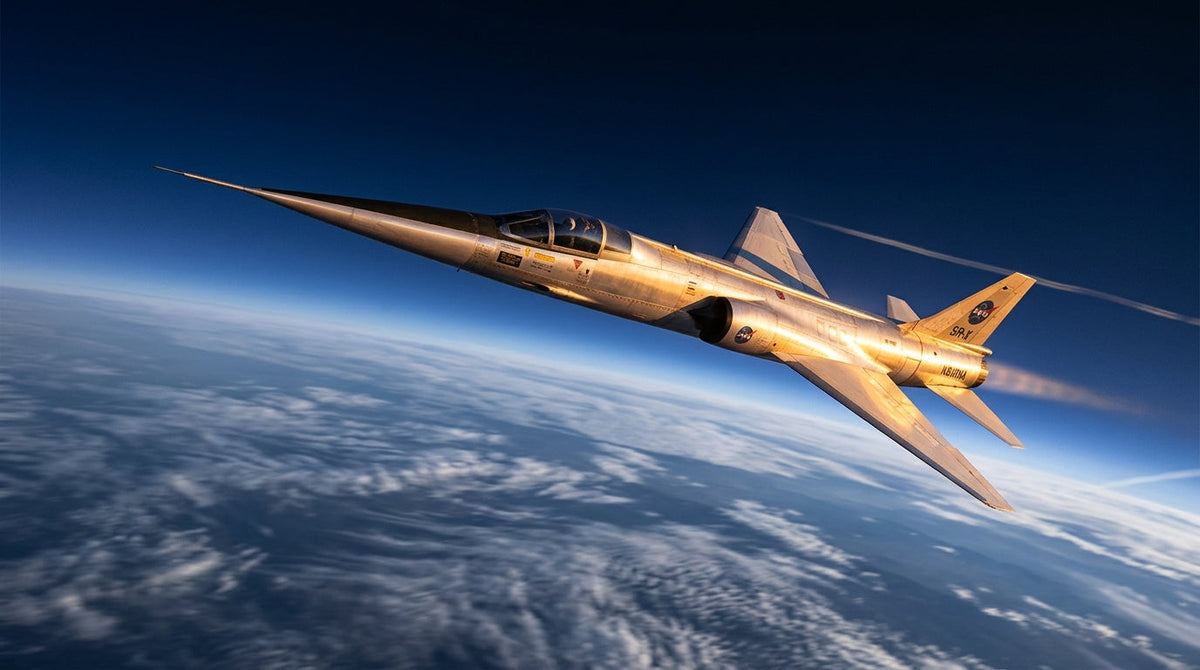
NASA's answer is the X-59, developed with Lockheed Martin's legendary Skunk Works for the agency's Quesst mission. The design is unmistakable — an extremely long, slender needle nose and carefully shaped fuselage engineered so the shock waves the aircraft creates never coalesce into a single sharp boom. Instead, they are meant to reach the ground spread out and softened into a muffled "sonic thump." NASA's target is roughly 75 perceived-level decibels, closer to the muffled thud of a distant car door than the startling crack of a traditional boom.
The flight test campaign has moved quickly. The X-59 made its first flight on October 28, 2025, then broke the sound barrier for the first time in early June 2026, reaching about Mach 1.1. Just days later, in June 2026, it hit its designed "mission conditions" for the first time — Mach 1.4 (about 924 mph) at 55,000 feet, the exact speed and altitude it will use when it flies over American communities.
That last point is the whole purpose of the program. The X-59 is not a prototype airliner and will never carry passengers. It is a flying data-gathering instrument. Once envelope expansion and acoustic validation are complete, NASA will fly it over several U.S. towns and survey how residents react to the thump. Those human-response measurements will be handed to the FAA and international regulators to help build a data-driven noise standard — a number that would let any sufficiently quiet aircraft fly supersonic over land, replacing the blanket ban with a performance test.
Boom Supersonic: the commercial bet
While NASA works the regulatory science, Boom Supersonic is building the business case. The Colorado company first had to prove it could reach supersonic speed at all, and it did so with the XB-1 demonstrator, nicknamed "Baby Boom." XB-1 made its maiden flight on March 22, 2024, and on January 28, 2025 it became the first privately developed jet to break the sound barrier — a milestone Concorde's makers, all national champions, never had to achieve on a startup's budget. The little trijet used three General Electric J85 engines to get there.
XB-1 was always a stepping stone to Overture, the airliner Boom actually intends to sell. Overture is designed to cruise at Mach 1.7 (about 1,304 mph) — not as fast as Concorde, but a deliberate choice that eases the thermal and structural demands on the airframe. It is sized for 64 to 80 passengers with an anticipated range of about 4,500 nautical miles, which Boom says opens more than 600 mostly over-water routes such as New York to London or San Francisco to Tokyo. The company has been assembling its "Superfactory" in Greensboro, North Carolina, plans to roll out the first Overture in 2026, and targets certification and entry into service around 2030. Airlines including United and American have already placed orders and options against those promises.
The engine problem — and the Symphony answer
The hardest part of any supersonic airliner is the powerplant, and here Boom made a bold call. Rather than wait for an engine maker to build one, it is developing its own, called Symphony. It is planned as a two-spool, medium-bypass turbofan producing around 40,000 pounds of thrust at takeoff, designed to sustain Overture's Mach 1.7 cruise without an afterburner — a key efficiency advantage over Concorde, which relied on fuel-hungry reheat to punch through the sound barrier. Symphony is also being designed to run on up to 100% sustainable aviation fuel, a direct response to the obvious criticism that going twice as fast means burning far more fuel per seat.
Building a clean-sheet jet engine is a famously expensive, risky endeavor, and it remains the single biggest question mark hanging over Overture's timeline. But it also shows how different this generation of supersonic dreamers is from the state-backed Concorde consortium: the economics have to work from day one, or the money stops.
The rule that could change everything
None of this matters commercially if supersonic airliners are still stuck over the ocean. That is why the most important development of all is happening not in a wind tunnel but in Washington. On June 6, 2025, an executive order titled "Leading the World in Supersonic Flight" directed the FAA to repeal the overland ban in 14 CFR 91.817 and to establish an interim, noise-based standard in its place.
The agency has followed through. On July 2, 2026, the FAA published a Notice of Proposed Rulemaking, "Enabling Supersonic Overland Flight," in the Federal Register. The proposal would scrap the flat speed-based prohibition and replace it with a performance test: operators would have to ensure that sonic-boom overpressure at the surface does not exceed 0.11 pounds per square foot. In plain terms, if your aircraft's shock wave is quiet enough at ground level, you could fly it supersonic over land — exactly the regulatory door the X-59 was built to open. The public comment period runs through August 17, 2026, with a separate noise-certification standard to follow.
It is worth being clear-eyed here: an NPRM is a proposal, not a done deal, and the numbers could shift before anything becomes final. But for the first time since Concorde, the legal ceiling on overland supersonic flight is genuinely in play.
So how soon will you fly supersonic?
Realistically, not tomorrow. Overture still has to finish its factory, fly a full-scale prototype, prove out the Symphony engine, and earn certification — a path that stretches toward the end of the decade even in an optimistic scenario. The X-59 still has months of testing and community overflights ahead before regulators have the data they need. And rulemaking, once started, tends to move at its own deliberate pace.
What has changed is direction. Five years ago, supersonic passenger travel was a nostalgic "what if." Today there is a quiet-boom research jet hitting its design speed in the skies over California, a startup bending metal on a commercial airframe, a bespoke engine in development, and a regulator actively rewriting the rule that grounded the whole idea. For anyone who loves aviation, it is one of the most exciting technology races in the sky right now — the kind of story that makes browsing aviation enthusiast gifts or hunting for gifts for pilots a lot more fun when the future of flight suddenly feels fast again. And if watching these machines climb makes you want to be the one at the controls, our guide to becoming an airline pilot is a good place to start.
The bottom line
The supersonic comeback is no longer a matter of if, but how quiet and how affordable. NASA's X-59 is proving the boom can be tamed. Boom's Overture is testing whether the business finally adds up. And the FAA's proposed repeal of the overland ban is dismantling the legal wall that stopped Concorde's successors before they started. The last great leap in airline speed happened half a century ago. The next one is closer than it has been in a very long time.
Comments
Loading comments…