


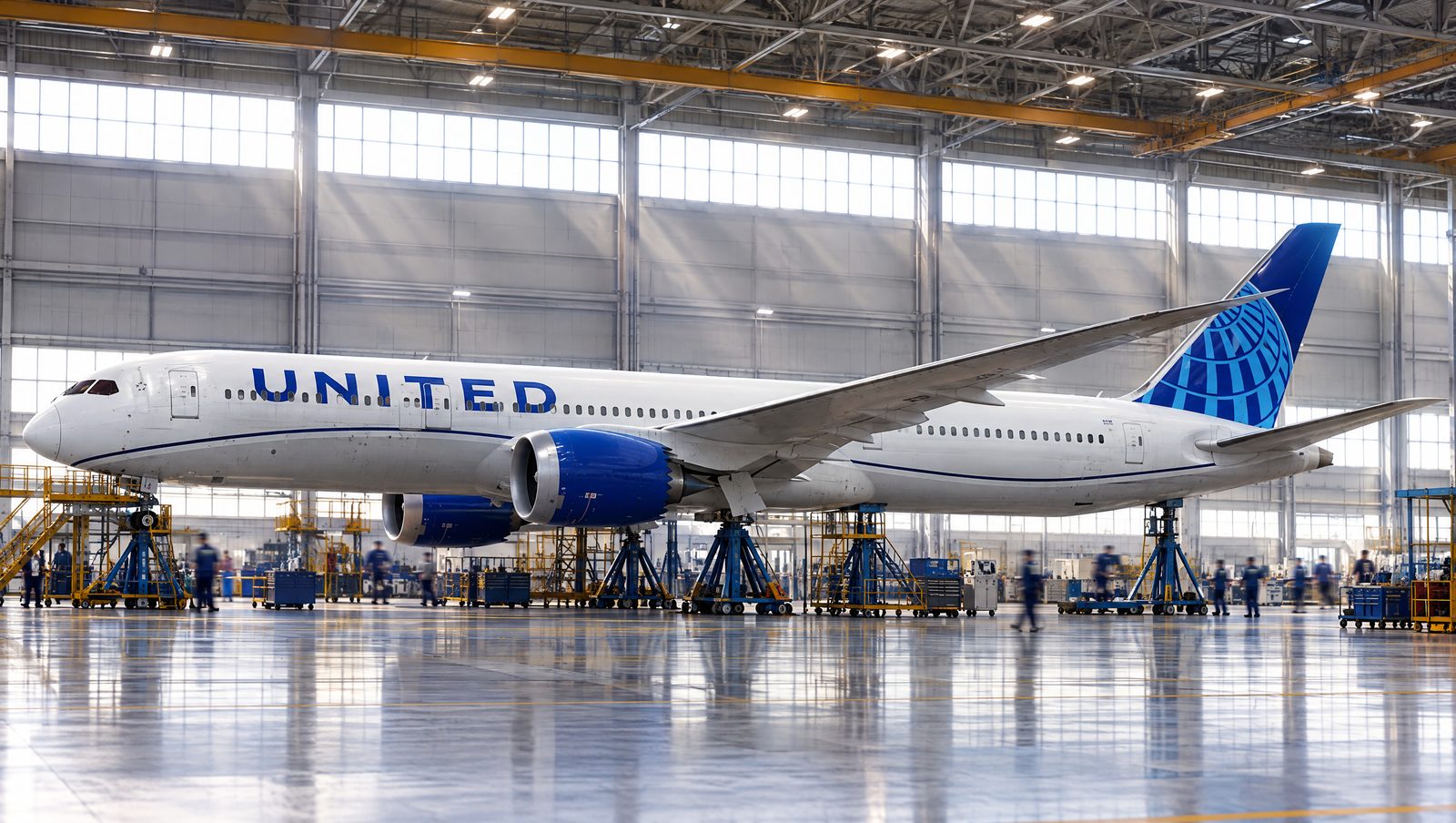
United Airlines’ largest Dreamliner is getting more operational room. Simple Flying reported on 4 October 2026 that the Boeing 787-10’s FAA-certified increased maximum takeoff weight (iMTOW) lifts allowable takeoff weight by about 14,000 lb (6,350 kg) to 574,000 lb (260.3 tonnes), enough for roughly five metric tonnes of extra payload or more than 400 nautical miles of additional range depending on the mission. Boeing’s own March 2026 certification note confirms the same figures for the 787-10 and a 10,000 lb gain for the 787-9.
The 787-10 was always the capacity member of the Dreamliner family: Boeing stretched the 787-9 by roughly 18 feet while keeping similar fuel volume, so airlines traded some range flexibility for more seats. United already pushes the type toward the long end of its envelope on sectors such as Chicago O’Hare–Tokyo Haneda, about 6,300 miles, and also uses 787-10s on Los Angeles–Haneda and Newark–Tel Aviv flying. The higher weight does not turn the -10 into an ultra-long-haul twin, but it moves the point at which planners must default to a 787-9 or an Airbus A350.
Boeing did not redesign the Dreamliner from scratch. The March FAA package builds on structural margins already in production aircraft assembled since December 2025, with targeted reinforcements to landing gear, composite wing structure and midbody plus Flight Management System software updates. Airlines can activate the certified weight per airframe. United took the first iMTOW-configured 787-9 (N81105) in May 2026, less than two months after clearance, according to earlier Simple Flying coverage that cited The Air Current; the October analysis focuses on what the heavier 787-10 means for United’s denser long-haul missions.
Fleet context matters. Planespotters.net figures cited by Simple Flying put United at 21 787-10s versus 59 787-9s and 12 787-8s, with more 787-9s still on order. The -9 remains the range workhorse for markets such as San Francisco–Singapore and Houston–Sydney, including United’s premium-heavy Elevated 787-9 product. iMTOW mainly expands the middle ground: high-demand Asia and South America sectors where passenger and cargo loads justified the -10’s cabin but fuel and wind margins previously favored the -9.
Boeing CEO Kelly Ortberg said in mid-September that 787 production had stabilized at eight aircraft per month after an earlier engine-driven pause, with a desired step to ten still gated on engine deliveries, while cabin certification continues to make some handovers “lumpy.” This desk is not inventing United route assignments for the heavier -10; no new city pair was announced with the October analysis. The certified weight simply widens the set of missions United’s existing 787-10 subfleet can fly without changing the basic Dreamliner type rating.
For passengers, the visible change will be subtle: the same 787-10 cabin on missions that previously needed payload trade-offs or a smaller Dreamliner. For network planners, five tonnes of payload or roughly 430 nautical miles of range is an incremental lever on cargo-heavy or wind-limited days rather than a new ultra-long-haul product. United’s dual Dreamliner strategy stays intact—the -9 for the longest sectors, the heavier -10 where seats and belly cargo pay.
Comments
Loading comments…