


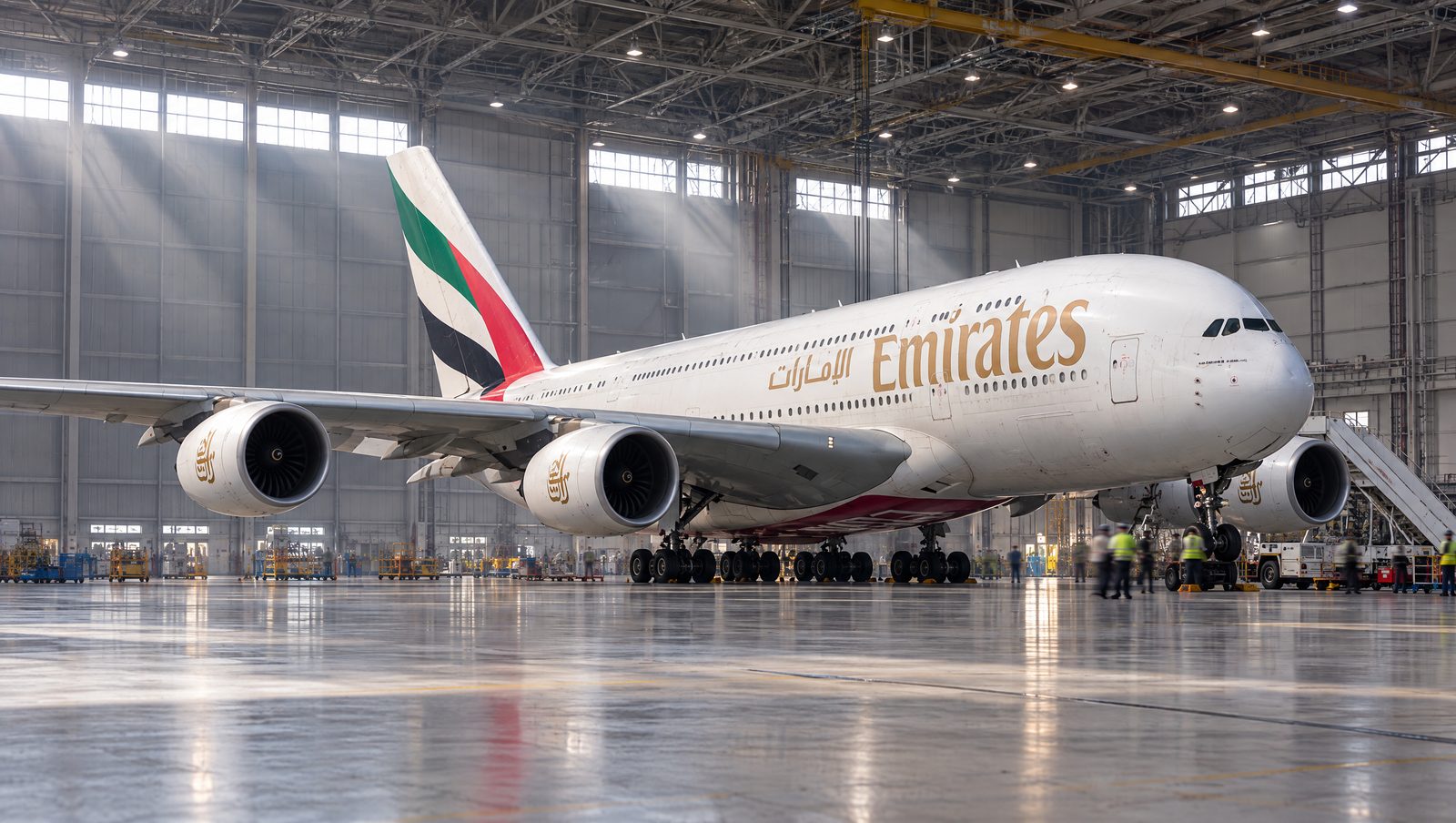
Emirates is taking the Airbus A380 off its short Dubai–Jeddah shuttle for the entire Northern Hemisphere winter. Cirium schedule data reported by Simple Flying on October 12, 2026, show the last A380 flights on October 24, after which all three daily round trips switch to the Boeing 777-300ER until March 28, 2027, when three daily A380s are planned to return.
Three daily flights, new metal
Emirates currently flies EK801/802, EK803/804 and EK805/806 between Dubai International and Jeddah's King Abdulaziz International Airport with A380s on a schedule of roughly three hours each way. From October 25, the winter season start, those same frequencies move to the 777-300ER. Jeddah will go more than five months without an Emirates superjumbo.
Before the change, Jeddah was one of only seven Emirates destinations with at least three daily A380 departures from Dubai in November. At about 1,057 miles (1,701 km), Dubai–Jeddah is the shortest route on Emirates' A380 map; once the type leaves, Mumbai becomes the shortest A380 sector at about 1,197 miles (1,926 km).
Timing and wider A380 tweaks
Simple Flying noted the Cirium updates landed over the same weekend as the October 10 attack on Riyadh's King Khalid International Airport. Emirates has not publicly tied the Jeddah equipment swap to Saudi security events. Separately for winter, the airline is also putting 777-300ERs on Dubai–Washington Dulles throughout the season and cutting Düsseldorf to one daily A380 between December 1, 2026, and January 31, 2027.
Jeddah was the first Middle Eastern city outside Dubai to receive Emirates A380 service, in early 2010, and the first Saudi airport to see the type. Emirates also flew A380s to Medina until early January 2026. When A380s return to Jeddah at the end of March 2027, Simple Flying said the airline plans to use its 489-, 517- and 519-seat configurations across the three daily flights.
What passengers should expect
Winter travellers on Dubai–Jeddah will find twin-aisle 777 cabins instead of the double-deck A380, with correspondingly different premium and economy footprints. Seat maps and aircraft types should be rechecked closer to departure. Delhi gains an Emirates A380 on October 25, one day after Jeddah loses the type, adding another short-to-medium A380 sector on the Indian subcontinent.
Emirates did not issue a standalone press release in the Simple Flying report; the story rests on Cirium schedule filings. For now, the operational fact is clear: the superjumbo is stepping off one of its busiest short Arabian routes for winter 2026/27, and passengers should expect 777 product on all three daily flights through late March.
Equipment swaps of this size on a high-frequency short-haul trunk usually reflect a mix of cabin demand, maintenance rotation and network-wide A380 utilisation. With several long-haul A380 markets still rebuilding after years of grounded superjumbos, Emirates may be concentrating the type where the double-deck cabin earns more than on a three-hour sector that can be covered by the dense 777 fleet.
For Jeddah passengers, the 777-300ER remains a widebody with Emirates' multi-class product, but it is not the A380 experience. Families and groups who preferred the upper-deck layout will notice the difference. Corporate and visiting-friends-and-relatives traffic between the UAE and the Hejaz should still have three daily banks, so schedule convenience is largely preserved even as the aircraft type changes.
Watch March 28, 2027, on the Cirium filings: if the three daily A380s reappear as planned, this winter will look like a temporary redeployment rather than a permanent downgauge. If the 777s stick, Jeddah will have joined the list of Emirates cities that lost year-round superjumbo service after the pandemic reshaped how the airline uses its largest jets.





Comments
Loading comments…