


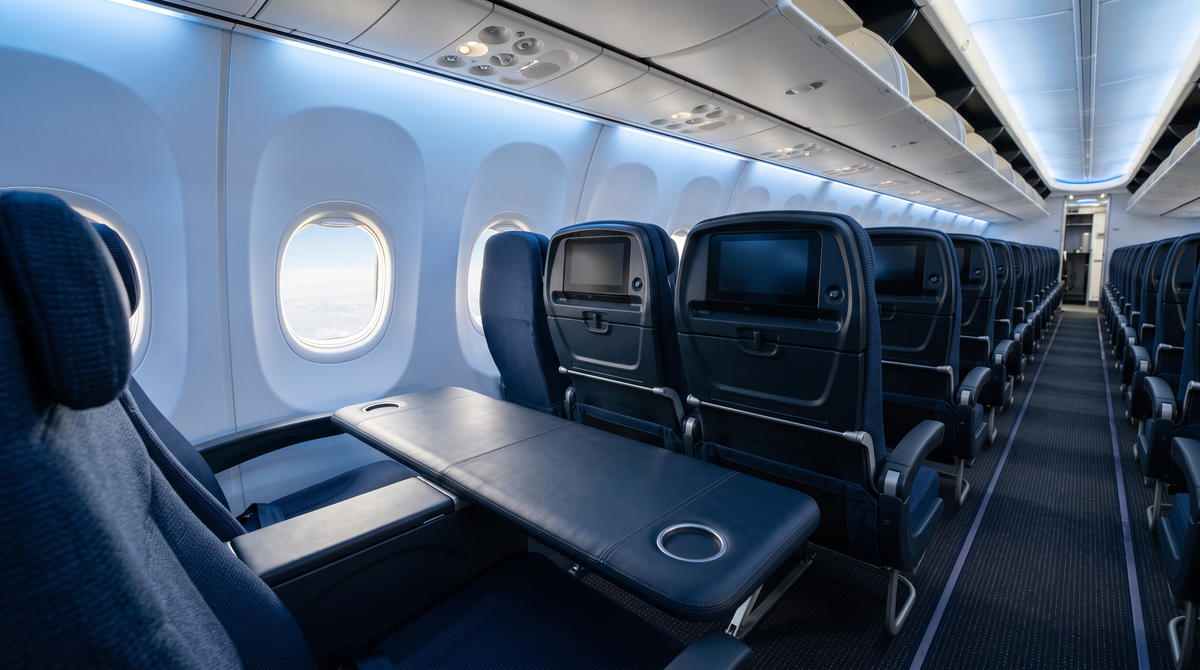
United Airlines has announced that all 50 of its new Airbus A321XLR aircraft will include a special row in Economy Plus where the middle seat is left open and repurposed as a shared surface with a large custom table.
Each XLR will have one row fitted with a large, custom-designed table stretching from armrest to armrest across the open middle seat, giving the passengers in the window and aisle seats extra room to spread out on longer international flights. The table is permanently fixed rather than stowable, finished in a soft leather-like covering, and moulded with two indentations to hold cups.
The middle seat, monetised
The idea is neat precisely because it is so simple. Airlines have spent two decades trying to sell more comfort inside the economy cabin without surrendering seat count, and most of the answers have involved shaving inches: a little more pitch here, a slightly wider armrest there, a different seat pan. United's answer is to take a seat out of the equation entirely on a single row and charge the two remaining passengers for the space it leaves behind.
That trade only works on the right aircraft. On a short domestic hop, giving up a seat is expensive relative to what anyone will pay to avoid a neighbour. On a transatlantic narrow-body flight of seven or eight hours, where the alternative is being wedged three-abreast for the length of an ocean crossing, the calculus changes. The A321XLR — built precisely for those thin, long, narrow-body routes — is where the maths works.
When it arrives
The new Economy Plus option goes on sale later this year. The first domestic flights with the updated seating arrive later this year as well, with international service beginning by early 2027. United expects to fit the configuration across its entire order of 50 A321XLRs, and says it is exploring offering similar seating on other aircraft types in the future.
United also expects to be the only US airline offering this seating option — a claim that says as much about the competitive positioning as the product. In a market where every carrier's premium economy looks broadly like every other carrier's premium economy, a visibly different physical product is worth something on the booking page even before anyone sits in it.
Where it sits in United's cabin ladder
The move continues a steady thickening of United's front-of-cabin offering. The airline has been layering ever finer gradations between basic economy and business class, and this new row extends that ladder one more rung: a seat that is technically economy, priced above standard Economy Plus, and sold on space rather than service.
Whether passengers accept the framing is another matter. The row is not premium economy; there is no separate cabin, no upgraded meal service and no additional recline implied by the announcement. What is on offer is elbow room and a table — which, on an eight-hour narrow-body sector, may well be exactly what a certain kind of traveller is willing to pay for.
The wider XLR question
United's A321XLR fleet is the vehicle for a genuine strategic shift: long, thin transatlantic routes flown with a single-aisle aircraft, at costs a widebody cannot match. The commercial risk in that strategy has always been the cabin. Passengers accept narrow-body economy for two hours; asked to accept it for eight, they may look elsewhere.
Seen that way, the open-middle row is less a gimmick than an admission. United needs the XLR's economics, and it needs a cabin story good enough that the aircraft's biggest limitation — that it is, ultimately, a narrow-body — stops being the reason travellers book someone else.
Sources: Bloomberg, Simple Flying. Featured image: AI-generated by AviationShop. By James Holloway.
















Comments
Loading comments…