


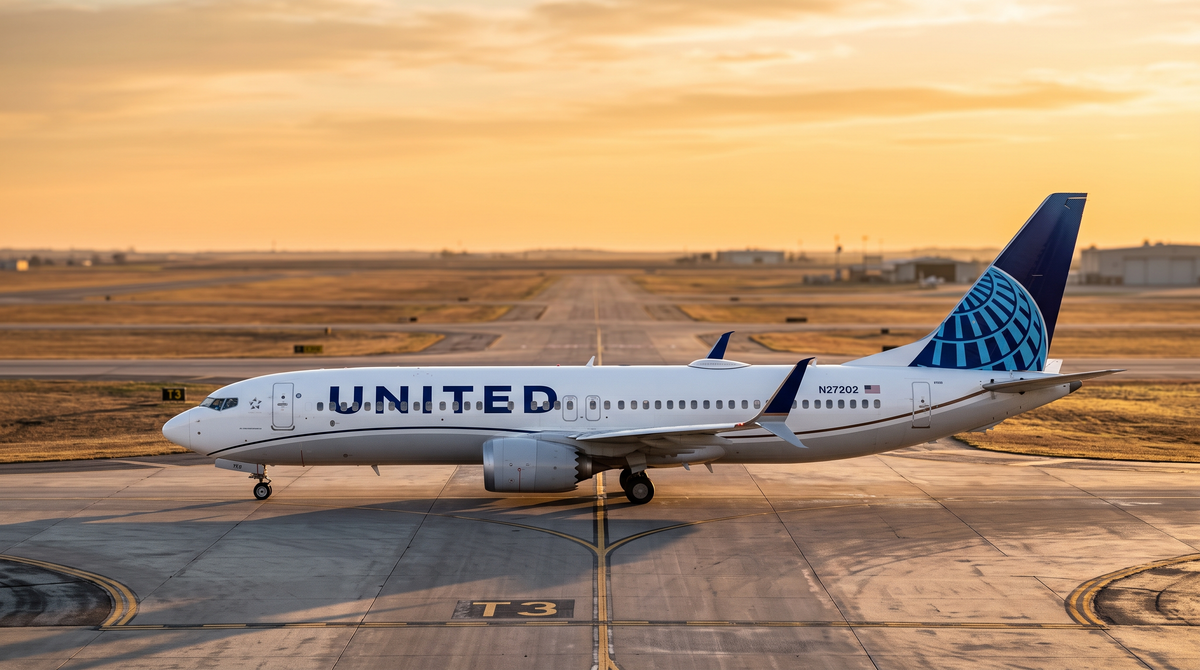
United Airlines' network has grown to 375 destinations in the third quarter of 2026, up from 363 in the same period last year, after the carrier added 17 airports to its map. The figures come from United's schedule submission to Cirium Diio, and they confirm the Star Alliance member serves more airports than any other airline in the world.
Seven of the 17 additions are international. United returned to Bangkok and Ho Chi Minh City in October 2025, both served daily with a Boeing 787-9 from Los Angeles via Hong Kong. In December 2025 the airline added Tepic in Mexico from Houston, operated weekly by Mesa with an Embraer E175 — a city that had never previously seen US flights from any carrier.
Europe accounts for the rest. Split joined the map in April 2026 with three weekly Boeing 767-300ER flights from Newark, followed in May by Bari (four weekly, 767-300ER), Glasgow (daily, Boeing 737 MAX 8) and Santiago de Compostela (three weekly, 737 MAX 8). United was the first North American airline to serve Bari, Santiago de Compostela and Split, and after Neos ended its Bari–New York JFK flights, it now provides the only long-haul operation to all three.
Two of the international additions are revivals rather than debuts. United flew to Bangkok until 2014, when the route ran daily via Tokyo Narita using the Boeing 747-400 and, at times, the 777-200ER. Glasgow was served until 2019 with the 757-200ER, while Ho Chi Minh City last saw United in 2016 via Hong Kong, initially on the 747-400 and later the 777-200ER.
Ten Small US Cities Join The Map
The other ten additions are domestic, and all launched or restarted between February and July 2026. Every one is flown by United Express, and all but two of the routes use SkyWest's 50-seat CRJ200 — the small regional jets that passengers rarely rank among their favourites.
Paducah returned in February with daily SkyWest CRJ550 service from both Chicago O'Hare and Houston, and Roswell followed the same month with two daily CRJ200 flights from Denver. March brought Abilene (Denver and Houston) and Carlsbad, the latter served with SkyWest E175s from both Denver and San Francisco. Lynchburg was added from O'Hare and Washington Dulles, and April saw Clarksburg (O'Hare and Dulles) and Montgomery (Houston) join. Alexandria followed in May, Lancaster in June, and Natchez, Mississippi, in July.
Natchez is the standout. The Mississippi city had no scheduled airline service at all for more than 30 years until United Express arrived. Lancaster, Lynchburg, Montgomery and Roswell had also never seen United on a scheduled basis before, and the airline's arrival has doubled the number of carriers at several of those airports.
Five Destinations Have Dropped Off
Network growth is never one-directional. Comparing the third quarter of 2025 with the same period this year, five airports have disappeared from United's schedule. Dakar's Blaise Diagne International Airport was served until January 2026; Dominica has switched from year-round to winter seasonal and returns in October; Dubai is suspended because of the war in Iran, with flights due back in October 2026; Havana and Stockholm Arlanda both ended in September 2025.
Dakar is the clearest commercial casualty. United flew Washington Dulles–Dakar between May 2025 and January 2026 and carried 21,949 passengers, but the load factor was just 55.8% — making it the airline's second-worst-performing long-haul market by that measure.
Taken together, the churn shows a carrier pushing simultaneously in two directions: long-haul European cities no other North American airline touches, and small US towns that have gone decades without a jet on the ramp. Both strategies feed the same hub machine, and both depend on aircraft — the 737 MAX 8 across the Atlantic, the CRJ200 across the heartland — being deployed where bigger jets cannot pay their way.
Sources: Simple Flying. Featured image: AI-generated by AviationShop. By James Holloway.















Comments
Loading comments…