


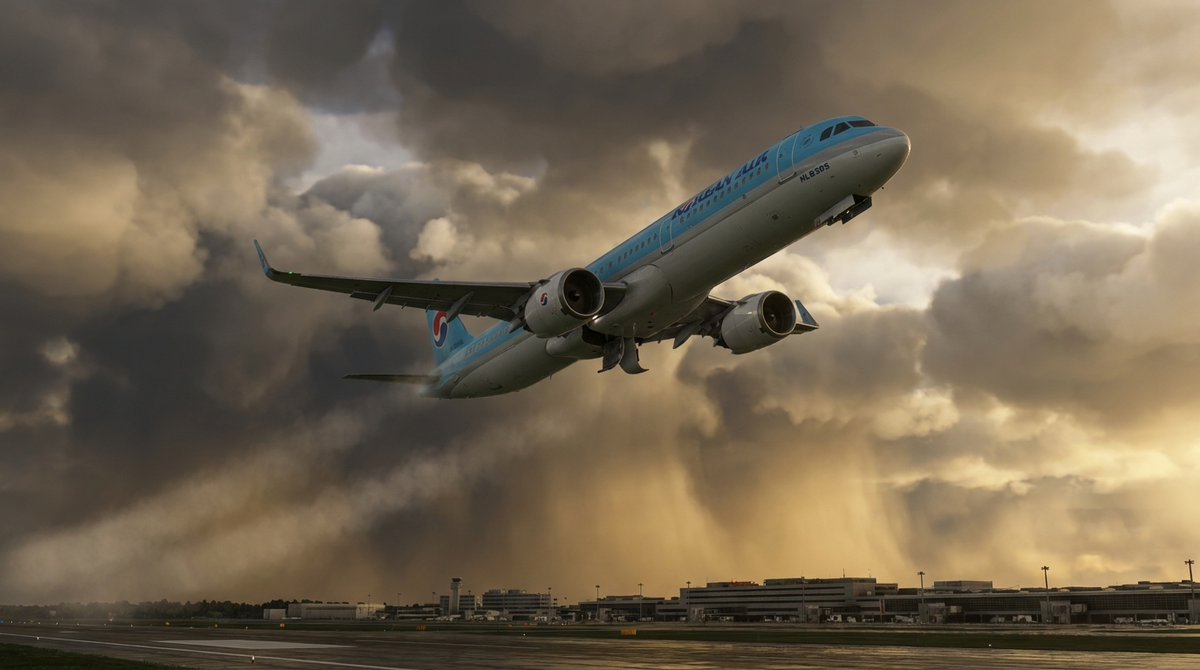
A Korean Air Airbus A321neo executed a high-performance go-around at Tokyo's Narita International Airport on Tuesday morning after severe crosswinds destabilised the jet during its final approach, in an incident now drawing global praise for the flight crew's decision-making.
The aircraft, operating inbound from Seoul Incheon, was already configured for landing with gear and full flaps extended when a series of erratic, high-intensity surface gusts hit the airframe at its most vulnerable point. The wings began dipping and the fuselage oscillated uncontrollably, with the jet pitching dangerously close to the tarmac in the final seconds before the planned touchdown.
Split-second decision
Rather than attempt to muscle the aircraft onto the runway, the captain applied full thrust and pitched up into a textbook go-around manoeuvre. Within seconds, the A321neo had stabilised and was climbing safely back into the approach pattern, where air traffic control vectored it for another attempt at landing.
All passengers and crew on board were unharmed, and the 2.6-year-old Airbus sustained no damage during the manoeuvre. The aircraft completed a normal landing a short time later, once the surface wind conditions had moderated.
Weather conditions
Narita's meteorological readings on May 12 indicated a near-perfect storm of surface gusts that challenged multiple inbound flights through the morning window. Crosswind components at or near the A321neo's published certification limits — combined with their erratic, gusting nature — created conditions that would have tested even highly experienced crews. Several other arrivals at Narita reportedly diverted to alternates or entered holding patterns for improved conditions during the same window.
Why go-arounds matter
Go-arounds — also known as missed approaches — remain one of the most underappreciated safety tools in commercial aviation. Modern jet cockpits are designed around the principle that an unstabilised approach is a non-negotiable trigger to reject the landing, regardless of fuel state, schedule pressure, or how close the aircraft is to the threshold. Industry safety data consistently shows that the decision to abandon an approach, far from being a failure, is one of the strongest indicators of a healthy safety culture inside an airline.
The maneuver itself is heavily practiced in the simulator and is one of the first procedures every airline pilot demonstrates competence in during type training. Going around is rarely the wrong call, and very often the only correct one.
The A321neo at Korean Air
The A321neo is rapidly becoming a backbone of Korean Air's short and medium-haul operation, with the type now serving high-frequency Japan routes alongside the carrier's wider Airbus and Boeing narrowbody fleet. The aircraft seats around 195 passengers in Korean Air's two-class configuration and offers significantly improved fuel efficiency over earlier generations, alongside an upgraded business class with sliding privacy doors on selected frames.
The incident has been hailed across global aviation forums as a masterclass in safety-first airmanship — and a reminder that, even at modern hub airports operating into multi-runway complexes, the final 100 feet of any approach remains the most demanding moment in commercial flight.
Compiled from publicly available aviation news sources. Featured image: AI-generated by AviationShop. This article is original editorial content; facts have been verified across multiple public sources.










Comments
Loading comments…