


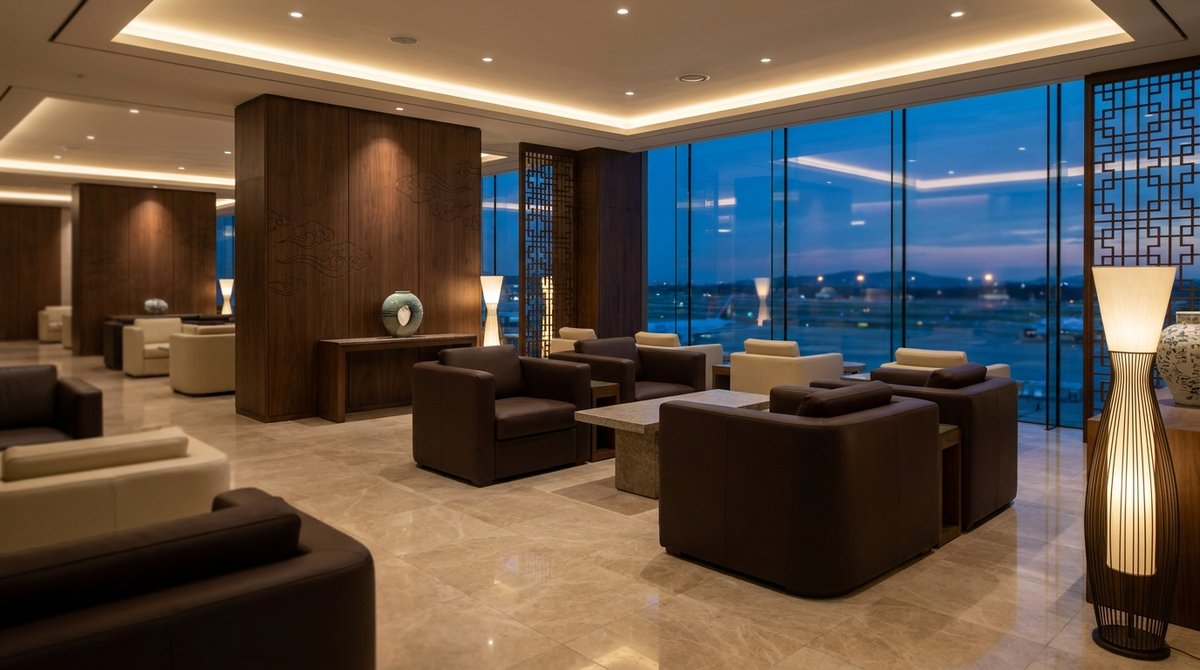
Korean Air has completed a multi-year overhaul of its premium lounge network at Seoul Incheon International Airport Terminal 2, more than doubling its footprint and seat count in a clear signal that the carrier intends to anchor its post-merger identity in elevated ground product.
The redesigned First Class and Prestige Class West lounges opened to passengers on April 16 and April 17 respectively, capping a 42-month renovation that the airline says required an investment of roughly KRW 110 billion. The total lounge area at Incheon Terminal 2 has expanded from 5,105 to 12,270 square meters, while seating capacity has grown from 898 to 1,566 chairs across the network.
A flagship First Class space
The new First Class Lounge spans 921 square meters, more than double the size of its predecessor, and is designed around private dining areas, a la carte service, and quiet zones with full airfield views. The Prestige Class West Lounge, meanwhile, is now the single largest lounge facility at Incheon, occupying 2,615 square meters with more than 420 seats. Korean Air now operates seven distinct lounges in Terminal 2, including First Class, Miler Club, two Prestige East rooms, Prestige West, and two Prestige Garden lounges.
Design cues lean into a contemporary Korean aesthetic, with walnut paneling, marble flooring, and warm ambient lighting offset by traditional decorative motifs. Food and beverage service has been overhauled in tandem, with hot Korean menu items now available across both Prestige tiers and a wider Champagne and wine list reserved for First Class guests.
Built for the Asiana era
The expansion is not just a premium-product play. Korean Air is preparing to absorb significant additional traffic as it integrates with Asiana Airlines, and the larger lounge footprint is designed to handle the combined long-haul premium passenger flows of both carriers without the bottlenecks that have dogged similar mergers in Europe and North America.
The investment also fits into a broader Asia-Pacific trend in which flag carriers are pouring capital back into airport ground experience after several years of cabin-focused upgrades. With Singapore Airlines, Cathay Pacific, and ANA all moving in the same direction, Korean Air's new Incheon complex sets a high bar for what a hub airline lounge looks like in 2026, and gives the carrier a tangible asset to point to as Asiana's network folds into its own.
Compiled from publicly available aviation news sources. Featured image: AI-generated by AviationShop. This article is original editorial content; facts have been verified across multiple public sources.






Comments
Loading comments…