


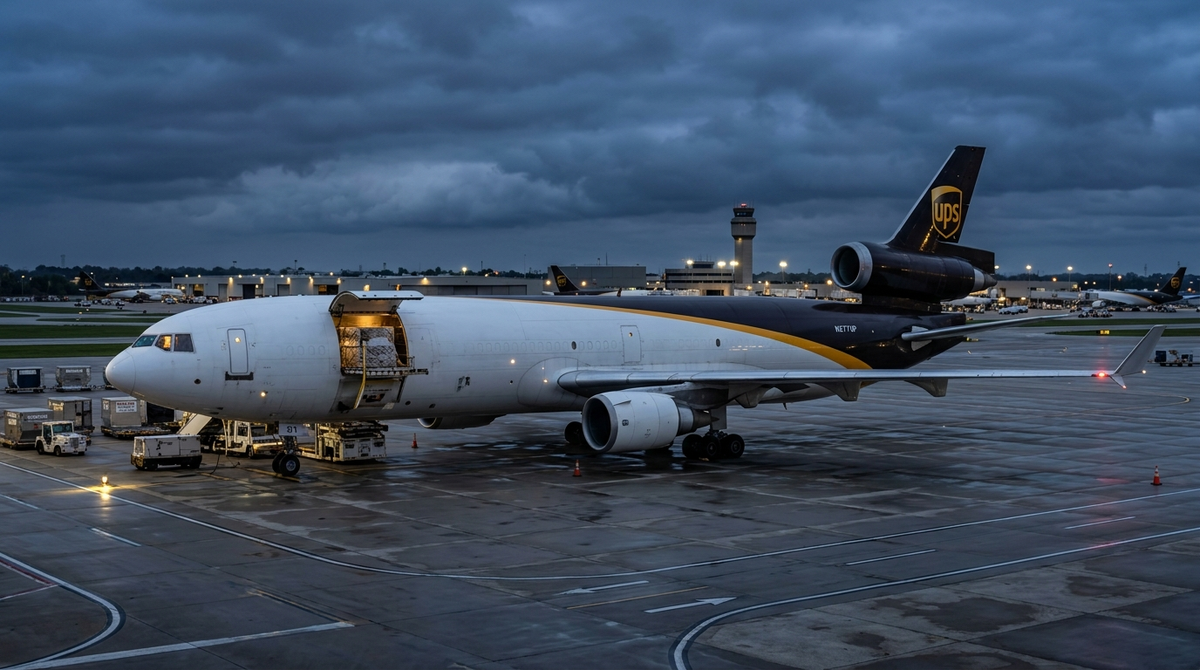
The National Transportation Safety Board opened a two-day investigative hearing on Tuesday, May 19, into the fiery crash of UPS Flight 2976, a McDonnell Douglas MD-11F freighter that killed 15 people in Louisville last November. Early testimony has already produced one of the most damning revelations of the year: the spherical bearing whose failure triggered the catastrophic engine separation had cracked four previous times on other aircraft, and Boeing flagged the defect to operators as far back as 2011.
UPS Flight 2976 was bound for Honolulu when it lifted off runway 17R at Louisville Muhammad Ali International Airport on November 4, 2025. Seconds after rotation, the left CF6-80C2 engine and its pylon tore away from the wing, igniting a fireball that consumed the freighter as it slammed into a nearby industrial area. All three crew members on board died, along with twelve people on the ground, making the accident the deadliest US aviation incident in years and the highest-casualty MD-11 crash on record.
According to documents released as the NTSB hearing convened, the spherical bearing at the heart of the failure had a history. Boeing issued a service bulletin in 2011 alerting MD-11 operators to repeated bearing cracking and updated the maintenance manual to require visual inspections. Investigators say similar bearing failures had occurred on four separate aircraft prior to the Louisville accident. Boeing maintained at the time that the defect did not pose a safety-of-flight risk, a position that is now under intense scrutiny in front of federal investigators.
The hearing has also revealed unusual operational details. According to local reporting, the UPS crew had switched aircraft before departure, raising questions about pre-flight inspection sequencing and how Boeing's 2011 service bulletin was implemented across the freighter fleet. UPS, the Federal Aviation Administration and Boeing are all giving testimony over the two-day proceeding at NTSB headquarters in Washington.
The implications stretch far beyond Louisville. Roughly 100 MD-11 freighters remain in commercial service worldwide with cargo operators including UPS, FedEx and Western Global. A formal probable cause finding is still months away, but investigators have already signaled that bearing inspection intervals, manufacturer safety messaging and the broader question of how legacy widebody freighters are maintained at the end of their service lives will dominate the final report. For UPS, which grounded its remaining MD-11 fleet days after the crash, the hearing is also the first major public accounting of the worst accident in the carrier's history.
Compiled from publicly available aviation news sources. Featured image: AI-generated by AviationShop. This article is original editorial content; facts have been verified across multiple public sources.












Comments
Loading comments…