


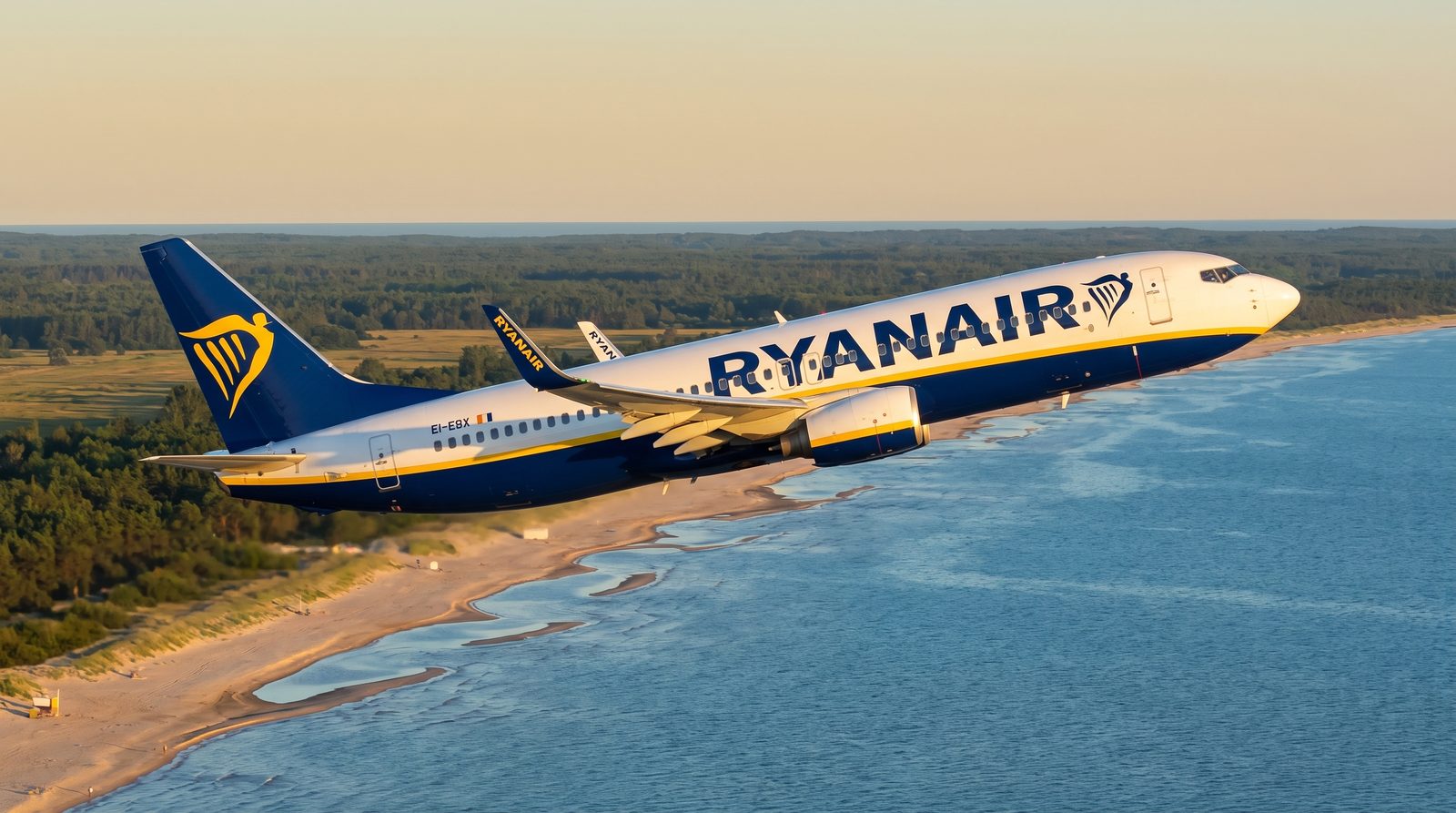
Ryanair has floated a five-year, $1.6 billion Baltic expansion that would roughly double its capacity across Latvia, Lithuania and Estonia to about 11 million annual seats and lift based aircraft from seven to sixteen by 2031, Aerospace Global News and Travel PR News reported after the carrier’s 17 September briefing in Riga, with Reuters also summarizing the conditional investment pitch.
The proposal is explicitly conditional. Ryanair says further aircraft, routes and seats depend on governments and airports cutting operating costs. Chief commercial officer Jason McGuinness tied the pitch to airBaltic’s plan to shrink its all-Airbus A220 fleet by about one-third, arguing that a lower-cost Ryanair Boeing 737 network can fill the capacity gap if airport economics improve across the three Baltic capitals.
Near-term flying already splits the Baltics unevenly. For winter 2026/27 Ryanair will base two aircraft at Riga, operate sixteen routes and raise capacity about 6 percent—adding roughly 40,000 seats—after Latvia’s incentive framework improved effective charges. Frequencies rise on ten existing routes, including Alicante, Barcelona and Milan Bergamo; the airline did not announce a batch of brand-new Riga destinations in the same breath as the five-year headline.
Estonia and Lithuania tell the opposite story. Ryanair says combined winter capacity there will fall about 25 percent, or roughly 550,000 seats, as aircraft move toward Slovakia, Poland, Italy and Sweden. The airline blames higher airport and access costs in Tallinn and Vilnius; local airport operators dispute parts of that characterization, noting that some core tariffs have been stable even as security or other fees changed in recent years.
The competitive backdrop sharpened when airBaltic entered U.S. Chapter 11 protection while continuing to fly. The Latvian carrier’s revised plan points to a fleet cut from 54 to about 36 aircraft by the end of 2026, reversing an earlier path toward a 100-strong A220 fleet. Ryanair used the Riga event to criticize cumulative Latvian public support for airBaltic—figures Ryanair itself aggregates—and to contrast that aid with the incentives it says unlocked its own Riga growth this winter.
For passengers, the immediate change is more Ryanair seats and frequencies from Riga this winter, not a sudden new Baltic city-pair map. Alicante, Barcelona and Bergamo densification helps leisure travelers first. The strategic contest is over the next five years: whether Estonia and Lithuania match Riga-style cost structures enough for Ryanair to station more 737s, or whether the $1.6 billion headline stays a negotiating lever rather than a funded basing plan with firm aircraft assignments.
Either way, the Baltic short-haul market is being redrawn around cost and restructuring, not just tourism demand. Ryanair’s conditional doubling sets a public benchmark against which every airport charge decision and airBaltic fleet cut will be judged through 2031. If governments blink and cut fees, more yellow-liveried 737s follow; if not, Riga remains the island of growth while Tallinn and Vilnius watch seats leave for cheaper Central European bases.
Airport managers in Tallinn and Vilnius now face a public scoreboard: match Riga’s incentive math or watch winter seats continue to leave for cheaper bases while Ryanair’s five-year chart stays on the podium as a reminder of what lower charges can unlock.
Sources: Aerospace Global News, Travel PR News, Reuters reporting on the Sept. 17 plan.


Comments
Loading comments…