


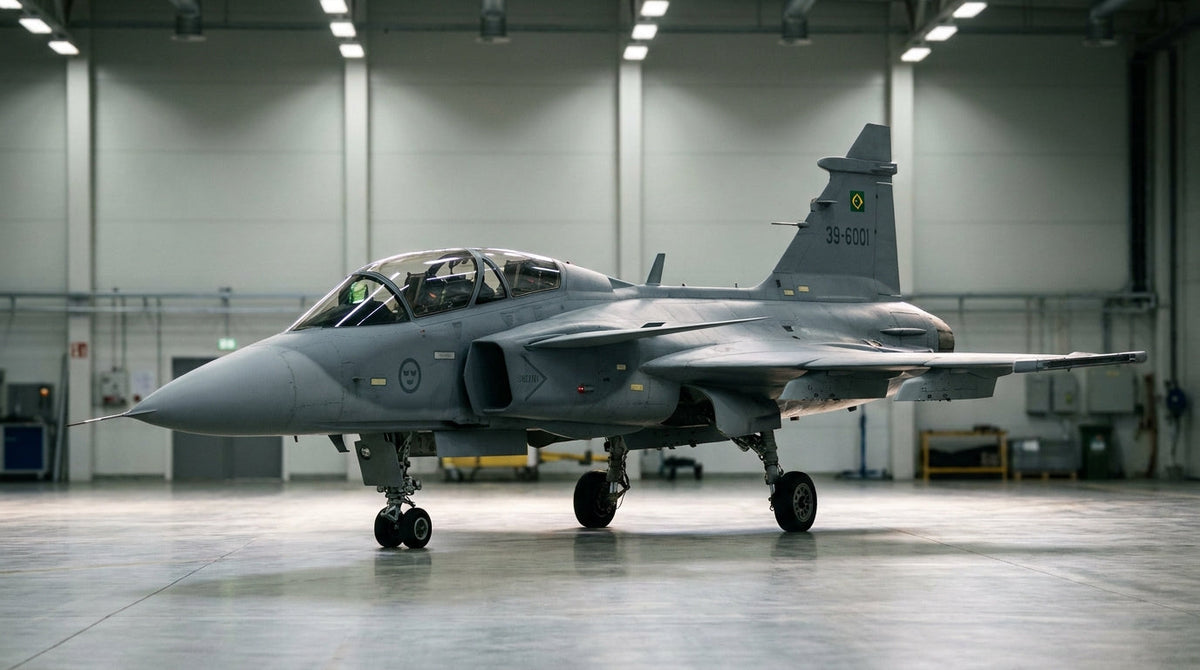
Saab has flown the two-seat version of its newest fighter for the first time. The Gripen F took off from the company's airfield at Linköping in Sweden at 09:40 local time on 28 August 2026 and remained airborne for 40 minutes, marking the start of the type's flight test campaign.
Saab chief test pilot Jakob Högberg was at the controls, joined by a Brazilian Air Force test pilot, Lieutenant Colonel Abdon de Rezende Vasconcelos. The sortie was flown from Saab's primary fighter development and production centre and was used to verify the functionality of the single-engined jet's core systems along with its initial flight performance. The aircraft carried Brazilian Air Force insignia.
“This first flight represents an important step forward for both Saab and the Brazilian air force,” said Lars Tossman, head of Saab's aeronautics business area. “It is designed to accelerate pilot training while enhancing operational performance in advanced combat missions.” Tossman added that seeing the aircraft fly was particularly significant for the Swedish and Brazilian engineering teams who spent years bringing it to reality.
What the second seat is for
The primary member of the family is the single-seat Gripen E, the successor to the long-serving Gripen C. The F model adds a second crew station, and Saab describes its purpose in two ways. The most obvious is training: a rear seat lets an instructor fly with a new pilot rather than relying entirely on simulators and single-seat conversion. The second is operational. Saab positions the rear cockpit as a station for a weapons systems officer who can take on tasks that are difficult for a single pilot to manage while flying the aircraft — airborne battle management, electronic warfare, and the control of unmanned aircraft operating alongside the fighter.
That second role reflects where combat aviation has been heading. Modern sensor and datalink suites generate more information than one crew member can reasonably process during a demanding mission, and several air forces have concluded that a dedicated back-seater is the practical answer, particularly for missions built around electronic warfare or teaming with uncrewed platforms.
Brazil is the launch customer
Brazil is the launch customer for the Gripen F, which the Brazilian Air Force designates the F-39F. Eight examples are on order for the FAB, in addition to 28 Gripen E aircraft known locally as the F-39E. Saab has partnered with Brazilian airframer Embraer to assemble 15 of the FAB's 36 Gripens in São Paulo state, covering both the E and F models. The first Brazilian-built F-39E was unveiled in March of this year, and the FAB currently has 11 single-seat jets in service, with the initial tranche manufactured in Sweden.
The Gripen F was formally rolled out at a ceremony on 2 June, and the first flight now moves the programme from ground testing into the air. Beyond Brazil, the Gripen E/F has picked up additional orders from Colombia and Thailand.
What happens next
Following initial production acceptance flights, the test campaign moves into a progressive envelope expansion phase. That is the methodical part of any new variant's development: each performance limit — speed, altitude, G-load and angle of attack — is cleared step by step, with engineers confirming that the aircraft behaves as predicted before the next boundary is approached. Adding a second cockpit changes an aircraft's aerodynamics, weight distribution and internal layout, so even a variant derived from a flying single-seater needs its own validation.
Running in parallel, Saab says the tactical capabilities and rear-cockpit functions specific to the two-seat configuration will also be evaluated — the systems work that determines whether the back seat delivers the operational value the company has promised its customers.
Sources: FlightGlobal, The Aviationist. Featured image: AI-generated by AviationShop. By Marco Bianchi.













Comments
Loading comments…