


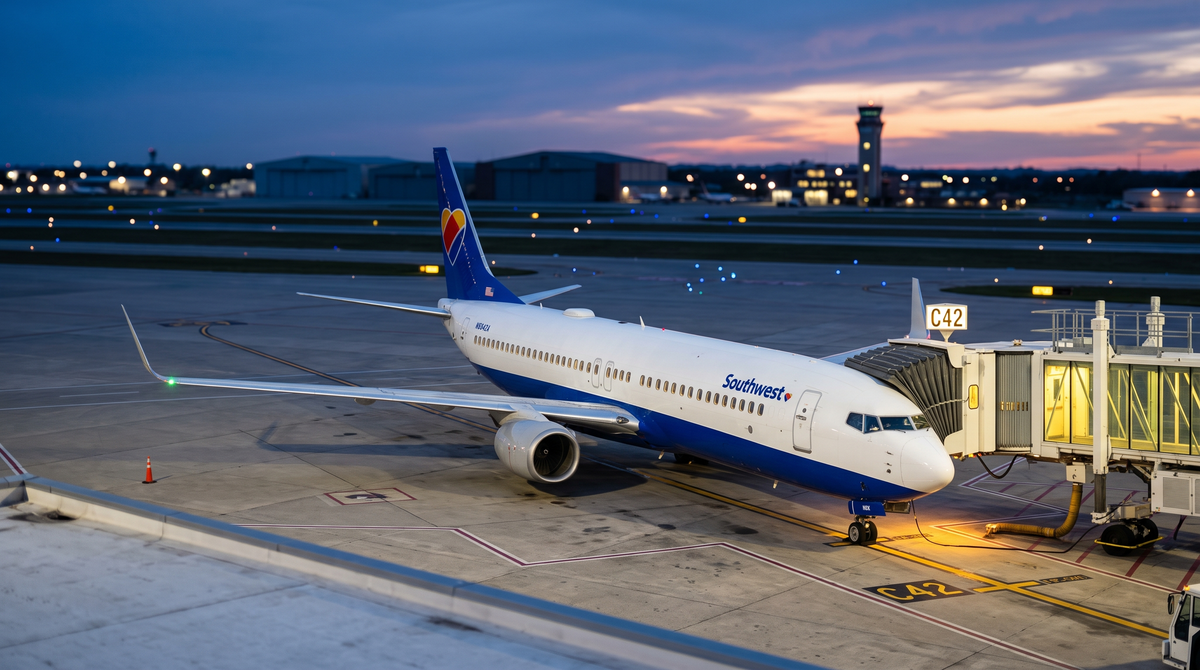
Southwest Airlines began 2026 as the most punctual airline in the United States. Six months later it sits at the bottom of the table. The carrier's on-time performance fell from 79.75% in January to 64.94% in June, and OAG's June rankings placed Southwest 17th among North American carriers — a collapse of roughly 15 percentage points in half a year.
That is a remarkable reversal for an airline whose brand was built on operational reliability. For most of the past decade Southwest's simple, single-fleet, point-to-point model was the industry's answer to the question of how to run a large network without the fragility that comes with hub-and-spoke banking. Roughly two thirds of its June departures arrived on time, which in practical terms means one in three Southwest passengers last month landed late.
What is driving the delays
The immediate trigger has been weather. A run of difficult convective conditions across the US interior in the late spring and early summer hit Southwest's core markets hard, and a point-to-point network has less slack in it than a hub network when a day starts to unravel — an aircraft delayed on its first sector carries that delay through every subsequent leg of its day, with no spare frames sitting at a hub to break the chain.
The deeper problem, though, is staffing. Southwest's punctuality slide has been attributed to a shortage of trained pilots and of airport employees. Crewing and ground-handling shortfalls do not usually cancel flights outright — they simply slow everything down. That pattern shows up clearly in the data: while the delay rate has climbed sharply, Southwest's cancellation rate has stayed comparatively low. The airline is still flying its schedule. It is just not flying it on time.
The 737 fleet is not the constraint
Southwest remains the world's largest operator of the Boeing 737, with a fleet built around the 737-700, 737-800 and 737 MAX 8. The commonality of that fleet is precisely what is meant to protect the airline's day of operations: any crew can fly any aircraft, and any aircraft can cover any rotation. When utilisation is high and the crew pool is thin, however, that same commonality offers no cushion. There is no smaller sub-fleet to shuffle, and no reserve aircraft type to pull forward.
Signs of a recovery
There is better news in the current month. Through the first stretch of July, Southwest's on-time performance has climbed back to around 77.8% — still short of where the airline started the year, but a marked improvement on June and evidence that the operation is being stabilised rather than left to drift.
The commercial stakes are real. Southwest has spent the past two years reshaping its product, and reliability is the one attribute a low-fare carrier cannot afford to lose while it is asking customers to accept change elsewhere. Punctuality is also expensive to fix: it requires crews and ramp staff sitting in reserve, which is precisely the cost line airlines trim first when margins tighten.
Whether June proves to be the low point of the year or the start of a longer slide will depend on how quickly Southwest can close its crewing gap before the autumn schedule ramps up.
Sources: Simple Flying, OAG. Featured image: AI-generated by AviationShop. By James Holloway.















Comments
Loading comments…