


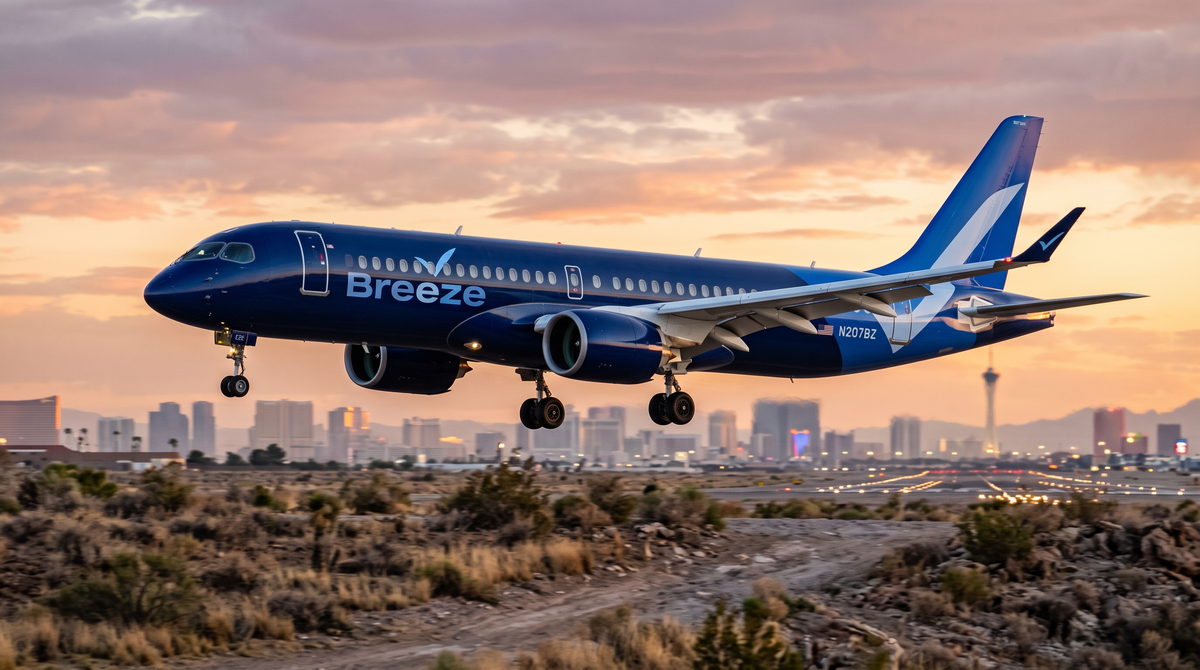
Breeze Airways is adding two more routes at Tampa International Airport, filing daily service to Las Vegas from 5 January and twice-weekly service to Long Island MacArthur Airport in Islip from 6 January. Both routes have now appeared in the carrier's schedule.
The Islip addition is the more interesting of the pair. Breeze has not previously served the Tampa–Long Island market, and the route is currently unserved on a non-stop basis. Data shared by route analyst Enilria shows demand between the two airports has risen sharply over the past year, which is exactly the signal Breeze has built its network strategy around: find a city pair with real underlying traffic and no non-stop, then put a right-sized aircraft on it before anyone else does.
Two very different routes
Tampa–Las Vegas is a different proposition. It is a long, competitive leisure trunk route rather than a niche gap in the map, and Breeze is going in at daily frequency from launch. Las Vegas has become an increasingly important market for the airline, and a daily Tampa link slots into a Florida operation that Breeze has expanded aggressively over the past year.
Tampa–Islip, by contrast, is a twice-weekly experiment in a market that no one else is flying non-stop. Long Island MacArthur is a classic Breeze target: a secondary airport serving a large catchment that has been steadily abandoned by legacy carriers in favour of the New York majors. Passengers from Suffolk County who want Florida currently connect, drive to JFK or LaGuardia, or fly from a different airport entirely.
Why Tampa
Tampa International has become one of the more important pieces of the Breeze map. The airline's Florida build-out has been one of the largest single-state expansions by a US carrier in recent years, and Tampa — big enough to generate its own local traffic, but not so contested that fares are already at the floor — fits the model well.
Breeze operates a mixed fleet of Airbus A220-300s and Embraer E190/E195 aircraft. The A220 is the type that has unlocked the airline's longer transcontinental flying, and its economics on thin, long routes are central to the strategy: it carries enough passengers to make a coast-to-coast sector work, but not so many that Breeze has to fill seats it cannot sell.
The wider pattern
Route additions like these rarely make headlines on their own, but they are how Breeze grows — a couple of city pairs at a time, weighted toward markets where the airline will be the only non-stop operator. It is a slower way to build a network than buying share on trunk routes, and a considerably less expensive one.
Both routes are on sale now for a January start.
Sources: Simple Flying. Featured image: AI-generated by AviationShop. By Elena Vargas.









Comments
Loading comments…