


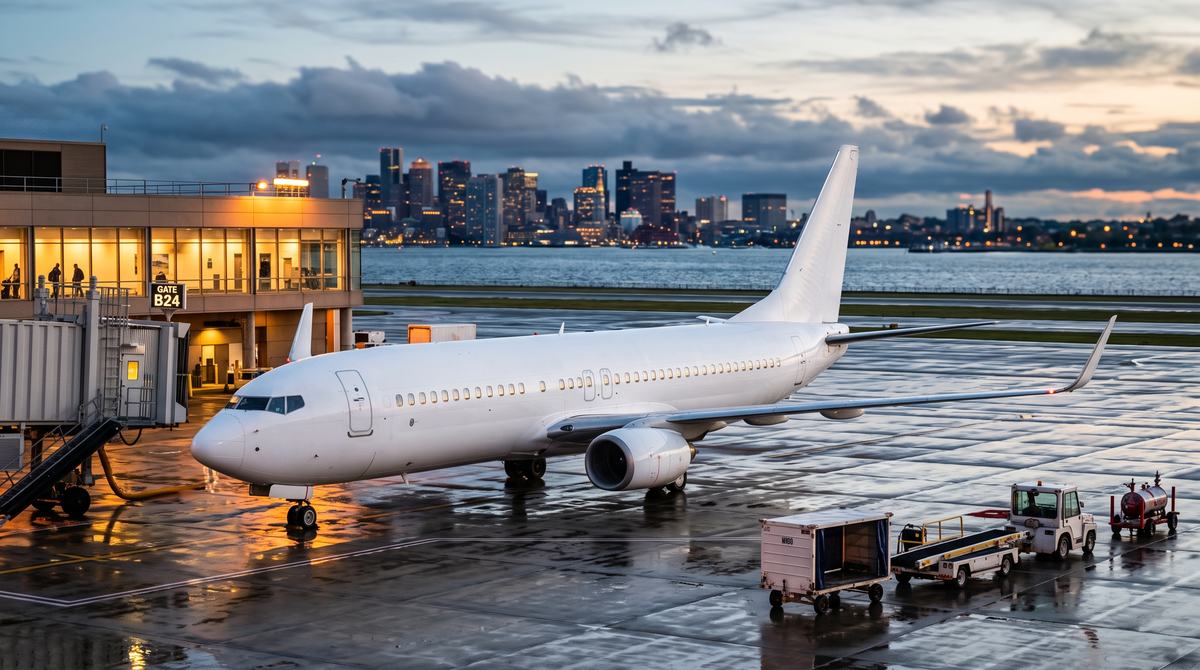
A fleet of nineteenth-century sailing ships has done what weather systems and equipment failures usually do at Boston Logan International Airport: it has generated hundreds of delays. More than 340 flights were delayed as tall ships taking part in Sail Boston 2026 moved through Boston Harbor beneath the airport's approach path, Simple Flying reports.
Why a sailing ship can delay a jet
The answer is geometry. Boston Logan sits directly on the harbour, and several of its instrument approaches bring arriving aircraft in low over the water on final. An aircraft on a standard three-degree glideslope is only a few hundred feet above the surface in the last mile or so before the runway threshold — and the tallest masts on a square-rigged sailing ship reach well over 150 feet.
That combination forces air traffic control to protect the airspace. When a vessel with a very tall mast transits beneath an active approach corridor, the options are to hold arrivals, re-sequence them onto a different runway, or increase spacing until the water below is clear. All three cost throughput, and at an airport operating close to capacity in July, lost throughput turns into delay almost immediately.
Sail Boston 2026
The event behind the disruption is the largest of its kind in Boston in a generation. Sail Boston 2026 has brought more than 60 vessels from over 20 countries into Boston Harbor between 11 and 16 July, including the USS Constitution — "Old Ironsides" — the oldest commissioned warship afloat. The Parade of Sail on 11 July drew the ships into the harbour in procession, and the fleet has remained in and around the port through the week.
It is the biggest Sail Boston since 2000, and the city has treated it as a headline summer event. For the airport, it is an unusually literal example of how an airfield's operations are shaped by everything around it, not just what happens on the field.
A familiar problem in an unfamiliar form
Airports have always had to reckon with what sits under the final approach. Cranes at construction sites are surveyed and, where necessary, height-limited. Buildings near the runway are subject to obstacle protection surfaces. Ports adjacent to airports — and Boston, Hong Kong, Sydney and others qualify — add a moving version of the same problem, because a ship's air draft can change the obstacle picture from one hour to the next.
The usual mitigation is coordination rather than closure: the port and the airport agree on transit windows, and the traffic is timed to fall in the quieter parts of the operating day. When dozens of ships are moving in and out of a harbour over the course of a week, though, those windows become harder to protect, and the buffer is absorbed by delay.
What it means for passengers
Delays of this type tend to be short individually and painful cumulatively. A ten- or fifteen-minute hold on arrival does not sound like much, but at a hub in mid-July it consumes the slack that airlines rely on to turn aircraft and protect connections. Once several hundred flights are affected, the knock-on effects spread well beyond Boston.
The tall ships depart at the end of the week, and Logan's approach corridors return to normal with them. Until then, the airport is a reminder that an approach path is a shared piece of sky — and occasionally, a shared piece of water too.
Sources: Simple Flying. Featured image: AI-generated by AviationShop. By Daniel Okafor.













Comments
Loading comments…